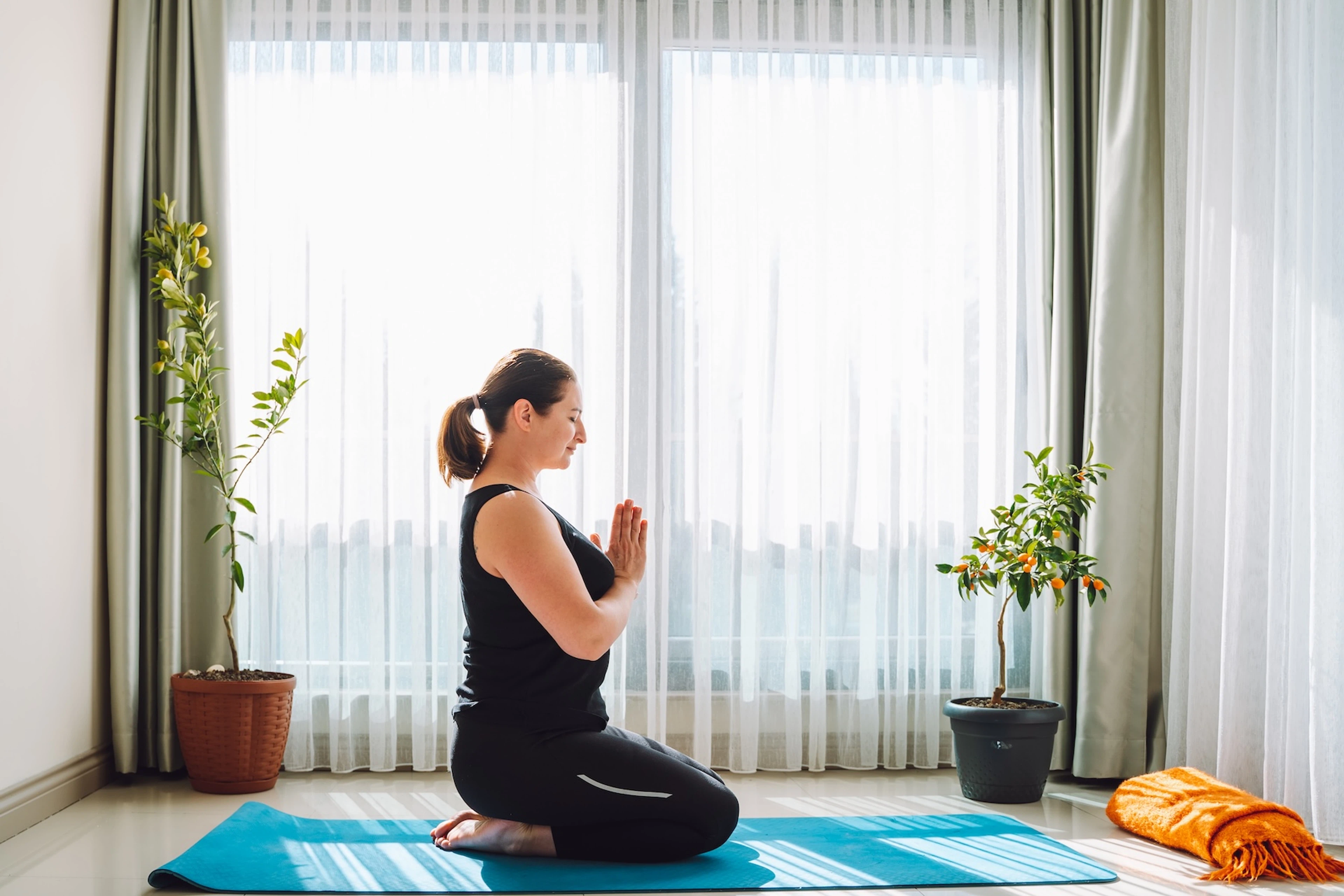
Olga Rolenko / Moment via Getty Images
Yoga Can Have a Huge Impact on How You See Yourself and the World—Here’s How
The practice continues to benefit your mental wellbeing long after you roll up your mat.
By Michele Ross•
You might take up yoga for the sake of becoming more flexible, or perhaps as a form of cross-training for your runs or rides. But by stepping onto your mat on a consistent basis, you’ll experience far more than physical perks alone. One of the most unanticipated yet welcome of the bunch? A more positive mindset.
Ahead, discover some of the many ways in which yoga can improve your mindset for the better. Plus: how to translate these benefits into your everyday life long after you’ve finished your flow.
How Yoga Can Improve Your Mindset
Here are a handful of ways your yoga practice can enhance how you view and handle your day-to-day life.
1. It Fosters Grace
No matter if you practice yoga with Peloton or in a studio setting, it’s standard to move from one pose to the next with a sense of ease, even when things get challenging. (Think: succumbing to gravity during an arm balance, shaking during a long Warrior 2 hold, or not landing a posture that usually comes to you naturally.) You simply take a breath and a beat to find your footing and focus once again—a powerful response to carry off your mat too.
“Yoga helps us ride the waves of life with a little more grace,” says Peloton instructor Kirra Michel. “It reminds us life will always have highs and lows and teaches us to try to remain centered and grounded within it all.”


2. It Invites You to Have a Beginner’s Mind
“Yoga emphasizes approaching the practice and life with a beginner’s mind, which is free from judgment while welcoming curiosity and play,” says Marlynn Wei, MD, a board-certified holistic integrative psychotherapist and psychiatrist and author of The Harvard Medical School Guide to Yoga.
During your practice, this can look like listening to your instructor’s exact cues before diving into a sequence you’re familiar with or testing the waters while prepping for a new peak pose. Elsewhere in life, a beginner’s mindset could involve finding new things to marvel at during your commute to work, discovering new layers of sensory delight while eating your usual meals, or dropping preconceived notions of how a coworker or a loved one will respond to a given scenario.
In other words, a beginner’s mind allows you to have a fresh perspective and discover new possibilities.
3. It Offers Perspective and Awareness
Similar to meditation, yoga invites you to embark on an inner journey of reflection and awareness. “Yoga asks us to step into witness conciseness,” Kirra says. “In this space, we begin to notice that our thoughts, feelings, and emotions are fleeting and erratic. They jump from one to the next fairly quickly.” This awareness can help us detach from what’s not serving us, paving the way for a quieter and kinder mind.
“Recognizing that thoughts and feelings can come and go without having to become entangled in them offers us freedom,” Dr. Wei adds. “For those who can get stuck in negative spirals or self-esteem attacks, this is an important way to disrupt downward spiraling and shift away from that mindset.”
4. It Promotes Flexibility
Yoga improves physical and mental flexibility, both of which contribute to your overall wellbeing.
Every time you step onto your mat, it offers you a new experience—and that’s a good thing. “Our body and mind feel different day-to-day and over the years,” Dr. Wei says, “and yoga helps us realize that we naturally shift and change.” Perhaps one day you have the drive and motivation to explore Crow Pose, for example, while the next day you need more grounding and choose not to take flight.
“Yoga invites us to offer ourselves individualized options based on how we feel moment to moment,” Dr. Wei says. There is no single ‘right’ answer or ideal yoga practice to follow. Instead, you should listen to your body and intuition to guide you on what’s best for you at present. Better yet, this approach can help you make important decisions beyond yoga, such as in your career, relationships, and countless other corners of your life.
5. It Strengthens Boundaries
At the same time, yoga allows you to get comfortable with setting boundaries and shifting them as needed.
Going off the same example above, dialing things back or opting for modifications during a yoga flow is far from ‘failing’ or ‘being lazy.’ Rather, doing so helps us set and strengthen boundaries while allowing us to get comfortable with what does and doesn’t work for us in the moment.
“This translates off the mat, where listening to your own intuition and emotional and physical needs is an essential part of self-care and healing,” Dr. Wei says.
6. It Fosters Patience, Consistency, and Resilience
A yoga practice takes time to build, and patience, discipline, and dedication are necessary. “This practice takes time and is in fact a ‘practice,’ Kirra says. “It’s one we come back to time and time again. Whether on the mat, the meditation cushion, or your relationship to yourself or others—these all take time to build.”
Sometimes, a goal or a technique in yoga—which can be as diverse as landing a full frontal split (Hanumanasana) to simply finding stillness in Savasana—can take months or even years to attain, and you’ll likely stumble or hit setbacks in the process. Yet over time, this becomes an integral and rewarding part of the journey and helps to build character and resilience. “We learn to not hold so tightly to the outcome; rather, enjoy the process of showing up, putting the work in, and riding the success and failures along the way,” Kirra says.
This mindset shift applies wonderfully to longer-term life goals too—whether that’s putting in the consistent effort to reach a workout PR, landing your dream job, or simply shedding old patterns that don’t serve you.
7. It Promotes Self-Acceptance
“Practicing yoga helps us nurture self-acceptance and self-compassion,” Dr. Wei says. “By centering ourselves in our own mind and body with compassion, we shift away from notions of perfection or comparing ourselves to others.”
Even the mere act of stepping on your mat can be powerful. By learning to allow yourself to be who and where you are today, the ensuing softness and acceptance can lighten your physical and mental load.


How to Apply Learnings from Yoga to Your Daily Life
Not everyone takes up yoga to positively shift their mindset, but it’s a benefit well worth exploring.
In one recent study published in the International Journal of Yoga, yoga practitioners cited key mental benefits of the practice, from improved mindfulness and confidence to feeling compelled to help others experience the healing qualities of yoga—all of which goes to show that a physical yoga practice can blossom into a more positive way of living.
“How we show up on the mat is a window into how we are showing up in other parts of our lives, including others and ourselves,” Dr. Wei says. “This awareness helps us recognize what is happening both within and around us, giving us a platform to set an intention and envision change.”
To keep the positive mindset and intentions strong from your yoga practice into the real world, Dr. Wei suggests:
Pausing and/or slowing down when stressed, frustrated, or overwhelmed
Deciphering facts from biased thoughts or expectations
Finding healthy ways to get grounded (yoga and otherwise)
Trusting your intuition to see what you need in the moment
There’s always something yoga can teach you that may or may not have to do with your practice at all. Get curious about what comes up and explore the lessons you can walk away with.
The Takeaway
Ever since I started my own yoga practice 20 years ago, one thing remains certain: I always step off my mat feeling better than when I walked onto it. This speaks to not only the countless physical benefits associated with yoga, but also the tangible shifts in mental and emotional wellbeing that come with a consistent routine.
All things considered, how you handle yourself on your yoga mat can serve as a metaphor for how you live your life off of it. The more grace and light you invite in during your practice, the more you’ll be able to foster it within yourself—and be able to share it with others—long after your mindful movement ends.

Peloton App
Access thousands of classes with no equipment needed.
This content is for informational and educational purposes only and does not constitute individualized advice. It is not intended to replace professional medical evaluation, diagnosis, or treatment. Seek the advice of your physician for questions you may have regarding your health or a medical condition. If you are having a medical emergency, call your physician or 911 immediately.

Level up your inbox.
Subscribe for a weekly dose of fitness, plus the latest promos, launches, and events.
By providing your email address, you agree to receive marketing communications from Peloton.
For more about how we use your information, see our Privacy Policy.