Bike Sprints Can Supercharge Your Cycling Performance and Cardio Fitness. Here’s How to Try Them
Discover how pedaling all out can help you make the most of your time, ignite your metabolism, and get fitter faster.
By Karla Walsh•
What Are Bike Sprints, Exactly?
How Are Bike Sprints Different from Other Intense Pushes?
The Benefits of Doing Bike Sprints
Types of Bike Sprint Workouts
8 Tips for Getting the Most Out of Your Bike Sprints
If you ever participated in the Presidential Fitness Test, you probably remember the concept of sprinting from the shuttle run. Love it or hate it, that quick assessment taught many of us from a young age what it meant to sprint while running.
But what about bike sprints? Peloton instructors cue sprinting on the bike all the time during cycling classes. But what, exactly, does that mean, and why bother? Here, we’ll coach you through everything you need to know about bike sprints, including their benefits, mistakes to avoid, how to add them to your workouts, and the sneaky strength training exercises that can help you push your pace even more confidently.
What Are Bike Sprints, Exactly?
Ready, set, go! A true “sprint” is a short, all-out burst of effort that any biker can arrive at by finding a cadence and resistance combination that produces the highest output possible for 10 to 30 seconds, says Peloton instructor Christine D’Ercole. For most athletes, a bike sprint is around the 90 to 105 revolutions per minute (RPM) cadence range.
“It takes some practice—and plenty of warm-up—to discover what resistance will support the highest output at different durations. The shorter the effort, the higher resistance, and the higher the output,” Christine says.
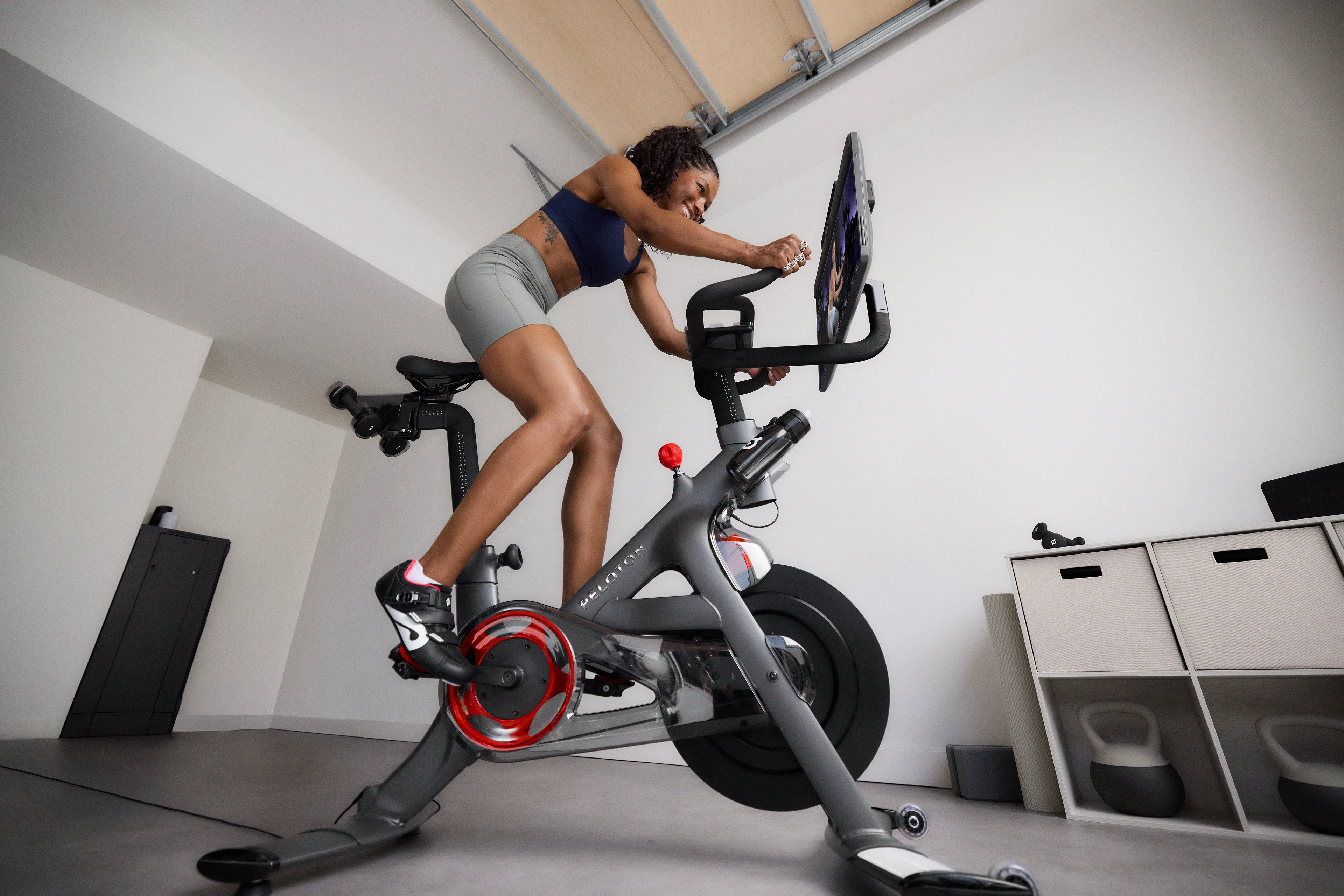
Bike sprints may require getting out of the saddle to use your whole body. It will definitely require engaging your core and arms to allow you to pedal as hard and fast as you can, explains Colin Izzard, a premier cycling coach with CTS.
Often, this explosive power is something a rider might activate to edge out a competitor in a race, take the lead around a turn, or simply edge up the Leaderboard during a Peloton class.

Peloton Bikes
Two bikes. One Peloton experience.
How Are Bike Sprints Different from Other Intense Pushes?
Imagine a bike sprint like lighting a match. Both are fast, intense, and burn out quickly.
“Bike sprints are different from other intensity pushes because it involves all-out power—10 out of 10—for a short duration, about 5 to 20 seconds. Since you’re often out of the saddle to max out your power, your full body is required, including your legs, arms, and core,” Izzard says. “The purpose of bike sprints is building explosive speed, finishing power, and peak output.”
Other pushes might last longer or ask you to work at a challenging or very hard effort level—but not your maximum. Here’s how bike sprints differ from other pushes you might try, according to Christine:
Climbs
Cadence: 60 to 80 RPM
Resistance: Much higher than a sprint
Time: Longer than a sprint
Goal: Increase strength and endurance
Spin-Ups
Cadence: 110+ RPM
Resistance: Lower than a sprint
Time: Longer than a sprint
Goal: Increase efficiency and smoothness of the pedal stroke
Threshold Efforts
Cadence: About 80 percent of sprint RPMs
Resistance: About 80 percent of sprint resistance
Time: About 10 to 20 minutes
Goal: Build aerobic capacity
The Benefits of Doing Bike Sprints
After seeing that “all-out” part, you might be thinking that sounds like a lot. We won’t pretend that bike sprints aren’t a challenge. So why bother? Here are some of the reasons why you might want to consider incorporating bike sprints into your next ride.
Increased Efficiency
Bike sprints are an effective option for those who are crunched for time: “Sprinting is incredibly efficient,” says Heather Baker, a physical therapist at Endeavor Health Swedish Hospital.
If you’re really pushing the pace, you can achieve a great workout in a short period of time—say, 20 to 30 minutes with a few 10- to 15-second sprints sprinkled in, Izzard adds.
Higher Power Output
Sprints activate fast-twitch muscle fibers, which we don’t use much during slow and steady rides. “Bike sprints train your body to generate more wattage [power], which is important in our ability to do things like run upstairs and improves your ability to respond quickly to stimulus,” Christine says. Plus, fast-twitch fibers are the first type of muscle fibers to disappear as we age, according to research—so counteracting that natural age-related muscle loss with bike sprints is beneficial.
More Speed
Even a few short bike sprints per ride can make you feel stronger and snappier as an athlete, Izzard says. That’s because “sprinting trains your muscles and nervous system to produce maximum force quickly,” he says. “This allows you to pedal faster in short bursts and helps improve your maximum speed and acceleration.”
Boosted Metabolism
Due to the amount of effort required, “sprinting stimulates our metabolism and creates an ‘afterburn’ effect,” Christine says. You’ll burn more calories post-workout, which may translate into a change in body composition, she notes.
Improved Cardiovascular Fitness and Anaerobic Capacity
Max-effort sprints stress your heart and lungs in a different way than endurance rides. As a result, “you’ll feel more in control during tough sections of a ride, even if you’re not sprinting,” Izzard says. And the gains don’t stop there. Over time, your body learns to recover faster between hard efforts, handle short and intense bursts with less fatigue, and tolerate activity near the lactate threshold better (while feeling less of a “burn”), he adds.
Types of Bike Sprint Workouts
Now that we’ve covered what and why, let’s dive into how to incorporate bike sprints into your routine. Here are a few of Christine’s favorite specific—and super-effective—bike sprint workouts. (You can find many of these types of workouts on the Peloton App.)
High Intensity Interval Training (HIIT): HIIT workouts alternate high-intensity work intervals with periods of rest. They can involve a variety of timeframes for work vs. recovery.
Sprint Interval Training (SIT): A specific type of HIIT, SIT often involves work intervals of 30 seconds or less at 100 percent power, then recovery periods of 2-4 minutes in between each sprint. On the Peloton App, look for Christine's Sprint Interval Training class collection.
Tabata: Tabata is a specific type of interval training that involves 20-second pushes at 100 percent power, then 10 seconds of recovery. Repeat 4–8 times.
30/30s or 40/20s: Push for 30-40 seconds at 100 percent power, then recover for 20-30 seconds.
Sprint Ladders: Ladder-style workouts involve gradually increasing your effort ("going up the ladder"). For example, you might increase the length of your intervals in increments: Push for 10 seconds at 100 percent power, then recover for 10 seconds. Push for 20 seconds at 100 percent power, then recover for 20 seconds. Push for 30 seconds at 100 percent power, then recover for 30 seconds.
Sprint Pyramids: Pyramids, like ladder workouts, involve gradually increasing your effort, but then also reducing it (going "up," then "down," just like a pyramid). For example, you might push for 10 seconds at 100 percent power, then recover for 10 seconds. Push for 20 seconds at 100 percent power, then recover for 20 seconds. Push for 30 seconds at 100 percent power, then recover for 30 seconds. Then, work your way back down the pyramid.
Power Zone Max Rides: Peloton’s Power Zone Rides use personalized output ranges to coach you through specific intensities. Power Zone Max Rides are the most challenging of the Power Zone classes, and focus on performance in zones 3–7.


8 Tips for Getting the Most Out of Your Bike Sprints
No matter what style of bike sprint you try, keep these overall best practices in mind, Izzard suggests.
Start with a Warm-up
Before you do any sprint work, spend 10 to 15 minutes cycling easily to warm up your legs and get your heart rate up. Include a few short pushes to prime your body for the challenge ahead.
Pick a Safe Spot
If you’re riding outdoors, seek out a quiet road or bike path with plenty of room, no traffic, and a flat or slightly uphill section. “You want to focus on sprinting, not dodging cars,” Izzard says. Or clip in on your Peloton Bike so you don’t have to fuss about the elements and X factors like potentially distracted drivers.
Don’t Be Shy with the Resistance
Sprinting with resistance too low can lead to bouncing in the saddle and/or pedaling out of control, Christine says. In this way, it’s possible for a bike sprint to cause an injury since the body may move erratically, Baker warns.
The best resistance will vary per rider, so Christine recommends experimenting with adding enough resistance to “create the feeling of the wheel being connected to the ground.” Think of it this way: If you can sprint for 10 seconds and feel like you could have gone for 60, then add resistance. If you’re burning out after 10 seconds, dial it back.
Check Your Cadence
Just like there isn’t one universally accepted resistance level, there’s no overall prescription for bike sprint speed. For most riders, though, 95 to 105 RPM is the sweet spot, Christine says.
“Try to find a cadence that you can maintain for up to 30 seconds without losing form,” Baker adds. “Focus on turning the feet over quickly and smoothly, but make sure you’re actually fatigued by the end of the push.”
Use Your Whole Body
Sprinting isn’t just about pedaling fast. “Focus on gripping the handlebars firmly along the drops, or the lower curved part of the handlebars. Drive power from your legs, core, and arms,” Izzard says. “A strong core helps you stay stable and transmit more power through your legs. Think of your body as a strong frame, transferring every bit of force into forward motion.”
Mind Your Form
Izzard notes that it’s tempting to “yank back and up on the bars, trying to muscle your way through. This often leads to wasted energy, loss of traction or balance, and poor power transfer from your legs to the pedals.” Instead, focus on pushing the bike forward and down, holding the drops firmly with your elbows slightly bent and shoulders relaxed. “This lowers your center of gravity and gives you better control,” he says.
Track Your Progress
Don’t just improvise. On a Peloton Bike, keep an eye on your instant output (power, measured in watts) displayed on your screen during your workout; it’s calculated using your cadence and resistance combined. (After you're done, you can see your best output during that workout in your History tab.)
Use Strength Training for More Powerful Bike Sprints
“Strength is a big part of what supports a good sprint,” Christine says, and a strong body reduces the risk that you’ll fall victim to a bike sprint-related injury, Izzard adds.
Check out the Strength for Cyclists program on the Peloton App, or consider incorporating some of the following exercises into your routine. The following are among the best strength moves for cyclists on a mission to become a superior bike sprinter:
Lower body strength moves, like squats, deadlifts, lunges: Ideal to build foundational strength.
Core strength exercises, including planks, bicycles, and hip bridges: Stabilizes your upper body during sprint efforts.
Olympic lifts, such as cleans and snatches: Key to develop power.
Plyometrics, including jump squats, bounding, and box jumps: Effective at enhancing explosiveness.
Cross training, like rowing or running: Improve cardiovascular endurance and help you push harder and recover faster.
Make Sprints Part of a Balanced Routine
Keep in mind that practice makes progress and bike sprint training will certainly make you a stronger sprinter. That said, it’s wise to incorporate bike sprint workouts into your agenda just once per week if you’re new to the training style, working up to a two to three sessions per week max. There are certainly benefits to other formats (we’re looking at you, climbs, endurance, and recovery rides!) too.
Related Articles


This content is for informational and educational purposes only and does not constitute individualized advice. It is not intended to replace professional medical evaluation, diagnosis, or treatment. Seek the advice of your physician for questions you may have regarding your health or a medical condition. If you are having a medical emergency, call your physician or 911 immediately.

Level up your inbox.
Subscribe for a weekly dose of fitness, plus the latest promos, launches, and events.
By providing your email address, you agree to receive marketing communications from Peloton.
For more about how we use your information, see our Privacy Policy.