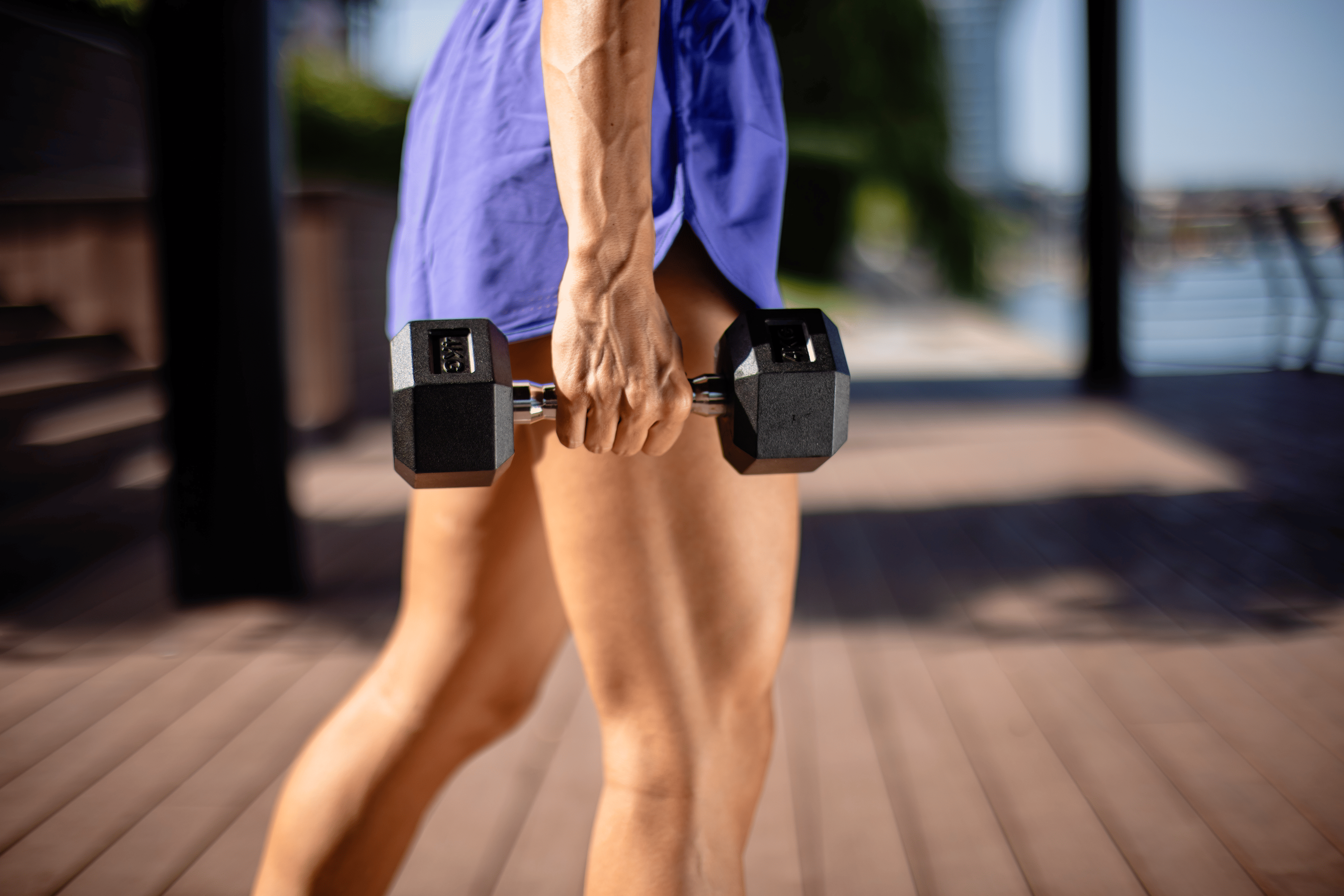
Boris_Zec via Getty Images
11 Dumbbell Leg Exercises That Prove You Don’t Need a Whole Gym to Get Strong
Your next leg day workout is sorted.
By Jordan Smith•
What Are the Key Muscles In Your Legs?
The Benefits of Doing Dumbbell Leg Exercises
How to Warm Up Your Legs Before Strength Training
11 Dumbbell Leg Exercises to Try
How Often Should You Do Dumbbell Leg Exercises?
If your fitness goals include becoming a better runner, more powerful cyclist, or overall stronger and more resilient human, training your legs with dumbbells may just be the key. This simple piece of equipment, often overlooked for the squat rack when it comes to building leg strength, can help improve your functional strength and performance, thanks to its versatility.
Dumbbell leg exercises provide benefits like improved stability, endurance, and overall strength, says Peloton instructor Tunde Oyeneyin. Having strong legs is especially important for runners and cyclists who rely heavily on their lower bodies to power them forward, but will serve athletes of any type—including those of us just trying to move effortlessly through the day. “Stronger legs help you lift more and move faster, whether you’re focusing on cardio or strength training,” Tunde says.
Looking for some inspiration to build out your leg day workouts? Keep reading to learn everything you need to know about dumbbell leg exercises, including expert favorites to add to your strength training routine.
What Are the Key Muscles In Your Legs?
There are many muscles in your legs, but these are the five major muscle groups you’ll target with dumbbell leg exercises—all of which are key to supporting your performance as a runner or cyclist, according to Justine Roper, doctor of physical therapy and RRCA-certified run coach.
Glutes: Your glutes, or your butt muscles, include the gluteus maximus, gluteus medius, and gluteus minimus. “Basically, those are our power generators,” Roper says. “They help the pelvis maintain stability, which is where all of our movement is coming from.”
Quads: The quad muscles, found on the fronts of your thighs, help with extending your knees (i.e., straightening your legs), which you do whether you’re cycling, running, or standing up from a chair, Roper says.
Hamstrings: The hamstrings, found on the back of your thighs, bend your knees and support hip extension (i.e., straightening your hips or pulling your leg behind you). Strong hamstrings will help you with forward propulsion, like pushing off the ground when running.
Calves: The calf muscles, found on the back of your lower legs, engage to help you push off the floor, whether to jump, run, or walk.
Adductors: Your adductors (inner thigh muscles) pull your legs in toward your center and stabilize your pelvis, supporting your body as you change directions or shift weight from side to side.

Peloton App
Access thousands of classes with no equipment needed.
The Benefits of Doing Dumbbell Leg Exercises
You’ll reap health and performance benefits no matter how you build strength and muscle in your legs, but here are some of the distinct perks offered by dumbbell leg exercises.
Build Functional Strength
Strengthening your leg muscles is important whether you’re an athlete or training for everyday life. “The stronger your leg muscles are, the better your stability and ability to perform daily tasks, as well as your overall mobility to move from point A to point B,” Tunde says. “Stronger legs also mean healthier knees and hips, which also helps reduce risk of injury.”
Boost Sports Performance
Building lower body strength can also enhance your fitness performance by helping to improve your power and speed. “That makes us more effective at the sport, no matter if you're running or cycling,” Roper says. Stronger legs also mean better output and greater endurance, Tunde adds—helping you run, ride, or play for longer without tapping out.
Add Versatility to Your Workouts
One major benefit of dumbbells is that free weights offer more versatility than machines, Tunde says. With dumbbells, you can move in all directions—forward, backward, sideways, vertically, and even in rotation—which trains your body to move 360 degrees in sports and life. Not to mention, dumbbells take up less space in your home gym than a machine or barbell setup.
Enhance Single-Leg Power
One of the best ways to train your leg muscles, especially for runners and cyclists, is through unilateral movements, or exercises that target one side of your body at a time. “Unilateral work is really important for cyclists and runners because that's what the sport is, and that’s what your body is mechanically doing,” Roper says—you’re shifting your weight into one leg at a time.
“Dumbbells allow you to focus on one side of your body at a time, which helps improve technique and overall performance,” Tunde says. In fact, research shows that doing lower-body unilateral work may result in even more lower body strength and core stability gains compared to bilateral training.
Improve Balance and Stability
Adding dumbbells to your leg exercises challenges your body to stay stable, building the core strength required for activities like running and cycling, Roper says. For example, if you hold dumbbells in front of your chest, your core must engage to keep your torso upright against the forward pull of the weight. This translates to increased core stability and trunk control, which you need to maintain proper form and posture, and more efficiently transfer power into every stride and pedal stroke.
Progress Safely
Especially for those newer to strength training, the wide range of weights dumbbells come in can help you safely load your moves. Roper suggests first performing each move with just your body weight until you feel comfortable and have mastered proper exercise form, then moving up in three- to five-pound increments, depending on the weights you have available.
How to Warm Up Your Legs Before Strength Training
Warming up your muscles before a lower body workout is important to help boost performance and reduce your risk of injury. Incorporating some light cardio and dynamic warm-up exercises can help get your body ready for the work ahead.
“I usually start with 10 to 15 minutes of light cardio, whether that’s an incline walk, an easy jog, or a short cycling session,” Tunde says. “Then I’ll incorporate some bodyweight squats, walking lunges, leg swings, good mornings, hip circles, and other movements into my stretching routine.”
11 Dumbbell Leg Exercises to Try
Tunde and Roper recommend these 11 dumbbell leg exercises to build lower-body strength. “I like that these movements engage different muscles in my legs and glutes, and I find it really satisfying to perform them with strong, controlled technique that using dumbbells has helped me refine,” Tunde says.

Goblet Squat
A goblet squat doesn’t only work your leg muscles but also helps build stability in your core. Beginners should start with just their body weight while advanced athletes should use a heavy weight.
Start standing with feet slightly wider than hip-width distance apart and toes pointed slightly outward. Hold one dumbbell vertically in both hands in front of your chest.
Engage your core as you push your hips back and bend your knees to lower into a squat. Keep your back neutral and the weight close to your body.
Pause at the bottom, when your thighs are parallel to the floor or just past parallel.
Then push your feet into the floor to return to the starting position.

Bulgarian Split Squat
“The Bulgarian split squat is like the gold standard for runners,” Roper says. “When you're trying to improve your power, it happens on the push, and that's exactly what you're doing in a Bulgarian split squat.” For this move, you’ll need a bench or box to elevate your back leg. If you haven’t done this move before, try it with body weight before adding dumbbells.
Start standing a few feet in front of a workout bench with dumbbells in hand, facing away from the bench. Reach one foot behind you and rest the top of your foot on the bench, standing close enough so your shin is parallel to the floor.
With your front foot planted and chest proud, bend your front knee to lower into a squat, keeping your knee tracking over your toes.
Lower until your front thigh is parallel to the floor (or as low as is comfortable for you), then pause, and press through your front foot to straighten your front leg to return to the starting position.
Repeat for the desired number of reps, then repeat on the other side.

Dumbbell Romanian Deadlift (RDL)
The Romanian deadlift works your hamstrings and glutes, protecting you from overstriding and preventing the hamstrings from fatiguing during long runs or rides, Roper explains.
Start standing with feet hip-width distance apart and a slight bend in the knees. Hold a dumbbell in each hand in front of your thighs with palms facing your legs.
Brace your core as you hinge at your hips, pushing them backward as you keep a straight back.
Slowly lower the dumbbells to the tops of your shins (or as far as you are able) while maintaining a neutral spine.
Pause at the bottom of the move, then push your hips forward to lift the dumbbells and return to starting position.

Dumbbell Glute Bridge
While Roper loves to add bodyweight glute bridges to her warm-ups, you can also add weights to this move during your workout, which will help build your glutes, hamstrings, and core.
Lie face up on the floor with your arms by your sides. Hold a dumbbell in each hand, resting them vertically on each hip bone. (Or start with one weight: Hold a dumbbell in both hands, resting it horizontally on your pelvis.) Bend your knees and plant your feet flat on the ground about shoulder-width apart, about six inches away from your glutes.
Squeeze your glutes and brace your core, lifting your hips up until your body forms a diagonal line from knees to shoulders.
Pause at the top, then slowly lower your hips to lower to return to the starting position.

Single-Leg Dumbbell Glute Bridge
Once you’ve mastered the glute bridge, progress to the single-leg weighted glute bridge, Roper says. “Unilateral work is really important for cyclists and runners because that's what the sport is, so if you can get good at doing a single-leg weighted glute bridge it will help you build power,” she adds.
Lie face up on the floor with your arms by your sides. If you’re using a dumbbell, hold it in both hands, resting it horizontally on your pelvis. Bend your knees and plant your feet flat on the ground about shoulder-width apart, about six inches away from your glutes.
Keep your right foot planted on the ground as you lift your left leg, extending it straight into the air.
Squeeze your glutes and brace your core to lift your hips up as high as you can without arching your back, stopping if you reach a point where your body forms a straight diagonal line from right knee to shoulders.
Pause at the top then slowly lower your hips to return to the starting position.

Dumbbell Hip Thrust
Hip thrusts are another move that both Tunde and Roper love using to target their glutes. For this move, you’ll need a workout bench or box to elevate your back.
Start sitting on the floor with your upper back resting against a bench, knees bent, and feet flat on the ground hip-width distance apart. Hold one heavy dumbbell horizontally across your hip bones with both hands.
Engage your core and glutes and press into your feet to lift your hips up into a bridge position, keeping your upper back against the bench.
Squeeze your glutes at the top, then slowly lower your hips toward the floor to return to the starting position.

Reverse Lunge to Knee Drive
This move will help you build stability, power, and acceleration, Roper says.
Start standing with your feet hip-width distance apart, one dumbbell in each hand at your sides.
Brace your core and, with your left foot firmly planted, step your right leg behind you, lowering into a lunge until your front knee is parallel to the floor and your back knee is hovering just off the ground. Both legs should be bent at about 90 degrees.
Push off the right foot to shift your weight forward into your left leg. Balance on your left foot, straightening your leg as you drive your right knee up and toward your chest.
Lower your right leg and immediately step backward into a reverse lunge to begin the next rep. Repeat for the desired number of reps, then repeat on the other side.

Dumbbell Step-Up
This move is great because you can perform it explosively or controlled and slow, Roper says. The movement of a dumbbell step-up also mimics the gait of running and the power of the pedal stroke in cycling. “This is going to help your balance and fire up your glutes,” Roper adds. For this move, you’ll need a sturdy workout bench, box, or stair to step onto.
Start standing facing a box or bench with feet hip-width distance apart, holding a dumbbell in each hand by your sides.
Step your left foot onto the bench, and press into the left foot, straightening your leg to stand up on the bench, right foot hovering behind you.
Bend your left knee to lower your right foot back to the ground, then follow with your right leg to return to the starting position. Repeat, alternating the leading leg.

Dumbbell Calf Raise
A dumbbell calf raise will help your balance and isolate these lower-leg muscles, Roper explains. You can also add calf raises to many of your leg exercises (think: a squat to calf raise) to add more power to your movement.
Start standing with your feet hip-width distance apart. Either hold one dumbbell vertically in front of your chest, or hold a dumbbell in each hand by your sides.
Slowly raise up onto your toes, pause at the top, then slowly lower back down to return to starting position.

Dumbbell Lateral Lunge
A lot of cyclists have really tight hip adductors (inner thigh muscles). This move helps strengthen the hip abductors (outer thigh muscles) and balance out the stability of your hips and thighs, Roper explains.
Start standing with your feet hip-width distance apart, holding a dumbbell in your right hand by your side. (To level up, hold two dumbbells, one in each hand.)
With your left foot, take a large step out to the left. Keep your right foot planted and right leg straight, pushing your hips back and leaning your torso slightly forward into a lunge position. Lower the dumbbell toward your left ankle.
Push off the left foot to stand, placing your left foot next to the right and returning to the starting position. Repeat for the desired number of reps, then repeat on the other side.
Heel-Elevated Dumbbell Squat
The heel-elevated dumbbell squat will help target your quads. For cyclists, quad strength is especially important to support climbs, Roper explains. To elevate your heels, place them on a one or two weight plates, a 2x4 piece of wood, or a rolled up towel.
Start with your feet about hip width apart with your heels elevated a few inches, holding a single heavy dumbbell at your chest.
Engage your core as you push your hips back and bend your knees to lower into a squat. Keep your back straight and the weight close to your body.
Push into your toes to return to the starting position.


How Often Should You Do Dumbbell Leg Exercises?
How often you should do dumbbell legs exercises depends on your fitness goals and overall workout routine. In general, experts and health organizations recommend that adults engage in muscle-strengthening activities two to three times per week as part of a well-rounded workout routine. This could mean doing a full-body workout (that includes dumbbell leg exercises) twice per week, or breaking up your strength days into a workout split, which targets specific muscle groups on different days.
If a lower body–heavy sport (such as running or cycling) is your main focus, it’s important to keep that in mind when programming dumbbell leg exercises, as the con of dedicated “leg days” for runners and cyclists is recovery time, Tunde says. You won’t want to follow a leg day with a long run or ride, as your legs will be too tired to sustain a longer effort.
“Dedicating too much time to your legs requires even more time resting them instead of consistently being able to practice your sport,” Tunde says. “That's why incorporating legs into multiple full-body workouts is beneficial.”
Working dumbbell leg exercises into full-body workouts allows you to increase overall strength while maintaining a good recovery routine, Tunde says. On the flip side, doing this will progress your leg gains at a slower rate.
To help combat both excessive soreness and longer recovery and to help ensure you build your leg muscles in a timely manner, Tunde recommends being strategic with your plan. “Do both dedicated days and full-body workouts, but space it out in a way that works for you and your long cardio sessions,” she says. A good rule of thumb is to give a muscle group 48 hours to rest between intense workouts. Finally? “Don't forget rest days,” Tunde says.
Related Articles

Member News
How to Sync Your Fitness Apps and Wearables with Peloton, and All The Perks That Come with It

Run
The Benefits of Running on a Treadmill (Plus, When to Head Outside Instead)

Equipment
What Is Peloton IQ? Tap Into the Smarter Way to Work Out

Strength Train
Which Is Better: High- or Low-Rep Workouts?
This content is for informational and educational purposes only and does not constitute individualized advice. It is not intended to replace professional medical evaluation, diagnosis, or treatment. Seek the advice of your physician for questions you may have regarding your health or a medical condition. If you are having a medical emergency, call your physician or 911 immediately.
Level up your inbox.
Subscribe for a weekly dose of fitness, plus the latest promos, launches, and events.
By providing your email address, you agree to receive marketing communications from Peloton.
For more about how we use your information, see our Privacy Policy.