3 Benefits of Doing Yoga with Weights, and How to Try It
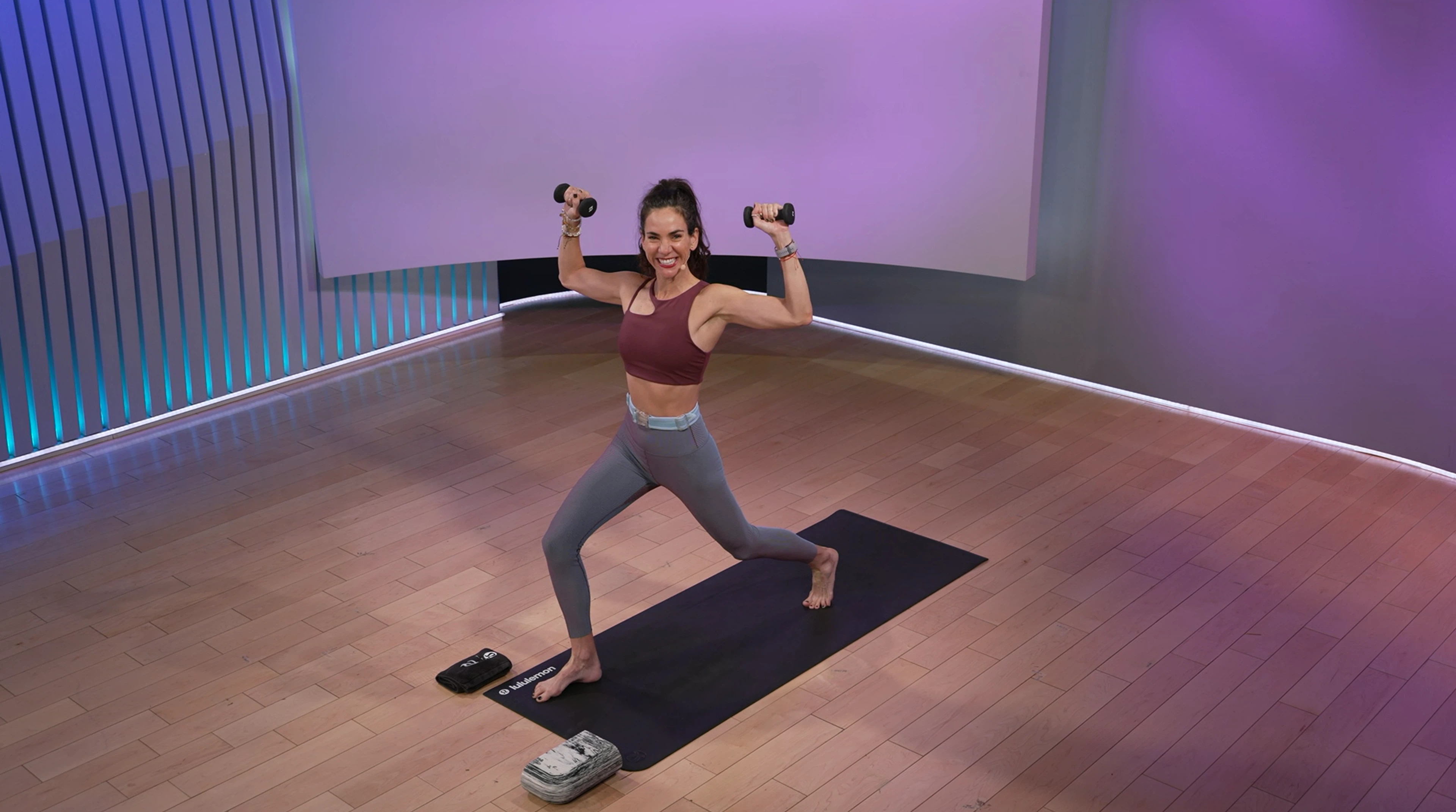
Peloton’s Sculpt Flow classes incorporate light weights to build strength for yoga postures.
By Michele Ross•
What Is Yoga with Weights?
The Benefits of Doing Yoga with Weights
5 Example Yoga Poses with Weights
What Weights Should You Use for Yoga with Weights?
Who Should Try Yoga with Weights?
How to Do Yoga with Weights with Peloton
If you’re anything like me, you might be a creature of habit and prefer to stick to a single fitness modality. For years, I pretty much exclusively practiced yoga, leaving the likes of weight training and running by the wayside. As beneficial as yoga is for your mind and body alike, I’m well aware of the merits of a well-rounded workout routine—and I’ve since taken greater care to switch up my sweat sessions.
If you, too, gravitate towards yoga but are looking to diversify your routine, I have a feeling you’ll love yoga with weights. Keep reading to learn how adding weights can transform your yoga practice, and see what Peloton’s Sculpt Flow classes are all about.
What Is Yoga with Weights?
Yoga with weights is exactly what it sounds like: a yoga practice that incorporates free weights, such as dumbbells. You can think of it as a happy marriage between yoga and strength training. (And, depending on the class you take, perhaps a dash of cardio for good measure.)
On the Peloton App, you’ll find weights included in Sculpt Flow classes, which blend traditional yoga flows with intentional strength movements. You’ll see a lot of your favorite and familiar yoga poses shapes in this class, but add weights and repetition.

Peloton App
Access thousands of classes with no equipment needed.
The Benefits of Doing Yoga with Weights
Yoga and resistance training are wonderful options on their own for moving and strengthening your body, but together, they’re a multitasking force to be reckoned with (plus, it’s pure fun!). Here are a few reasons why they create a perfect pairing.
Builds Strength
Anyone who’s completed a Chaturanga-packed yoga class knows that you can get seriously strong—and sore—from a Vinyasa flow with resistance from your own body weight. Perhaps you’ve even done 108 Sun Salutations (Surya Namaskars) to usher in a new season, or enrolled in an inversion workshop that activated your muscles in ways you never thought possible. However, adding external resistance via free weights can increase the challenge and lead to greater muscle- and strength-building results.
Yoga with weights classes incorporate free weights to activate and strengthen specific areas of the body that will enhance your yoga practice. For example, building muscle and endurance in your arms for the likes of planks and arm balances, and in your legs to help you hold lunging and balancing poses. By incorporating strength-focused elements into these classes, you’ll build strength that increases your ability to hold and/or flow through many poses with more power and greater ease. Adding weights can also help you reach muscles that may otherwise be neglected or not sufficiently by a typical yoga flow (think: your glutes or biceps, for example).
Diversifies Your Fitness Routine
As the saying goes, variety is the spice of life… yet it’s also a crucial element for building a well-rounded workout routine. People who only gravitate towards, say, Yin yoga might lack adequate cardio fitness and muscle strength. Similarly, those who prioritize heavy weight lifting could be missing out on the mobility benefits that yoga offers.
Doing yoga with weights through a class like Sculpt Flow helps to check off multiple boxes—strength, flexibility/mobility, and potentially even cardio—in one session, helping you meet the physical activity guidelines set forth by the Centers for Disease Control (CDC) and American College of Sports Medicine (ACSM). Both organizations recommend that adults perform muscle strength or endurance activities at least twice per week, as well as at least 150 minutes of moderate-intensity cardio.
Introduces Novelty to Your Yoga Practice
If you’ve been practicing yoga for years, you may feel like you’ve done it all. Adding weights is one way to introduce novelty to your practice, which can refresh your motivation and enjoyment, and also introduce a new challenge to level up your practice.
One 2020 study published in Frontiers in Psychology found that adding novelty and challenging variations of familiar exercises to fitness routine are linked to the flow state (i.e., a high level of absorption, motivation, and sense of reward during an activity). This can ultimately help you enjoy your workout more, making you more likely to stick with it and show up day after day—which is key to seeing results.


5 Example Yoga Poses with Weights
If you have yet to check out a Sculpt Flow class on the Peloton App, you might be wondering how weights are included alongside your favorite poses or flows. Here are a few examples of yoga poses with weights (and, in some cases, an optional yoga block) to give you an idea of what a Sculpt Flow class might entail.

1. High Lunge with Weights
“One of my favorite poses to do with small hand weights is a high lunge with arms extended up,” says Peloton instructor Mariana Fernández. She mentions that, without weights, you might not fully engage your arms in certain poses because you’re mostly aware of your legs holding you up (think: during Warrior 1 and 2, or Virabhadrasana 1 and 2). “Holding the weights requires you to really activate the arms, starting with the shoulder rotation. And by having the weights, you make sure that the whole length of the arm works together to keep those weights up,” she explains. “You feel the energy move all the way from the shoulder to the fingers keeping the weights in your hands.”

2. Warrior 3 with Weights
Another weighted yoga pose Mariana loves is Warrior 3 (Virabhadrasana 3)—in which you balance on one leg as the opposite leg floats behind you—while holding weights. “The weights at the center of the chest help stabilize you in the pose,” she shares. “Once you find yourself balanced, you can reach the arms out in front of you, creating a capital letter ‘T’ with your body, which will work the shoulders and arms.” Another variation would be to reach the arms behind you like an airplane along the sides of your body with your palms facing up, which Mariana says will strengthen your back and triceps. “There's so much activation in a singular pose depending on the variation you want to do,” she says.

3. Chair Pose with a Block and Weights
Mariana also loves this super strengthening pose, which uses light weights and a yoga block. “I place the block between my thighs for chair pose to serve as a reminder to activate the muscles,” she explains. “In order not to drop it, your adductors are fired up, your glutes are working, and you make sure that the whole legs are engaged.” You can do this with arms overhead, no weights, or hold a set of weights with elbows bent to 90 degrees, palms facing up.

4. Boat Pose with Weights
This version of Boat Pose (Navasana) incorporates light weights and a yoga block to increase the challenge on your abs, adductors, and upper body. Try placing your arms in any of the positions Mariana demonstrates above: hands together in front of your chest, extended forward, or overhead.
She also recommends holding the block between your thighs in Plank Pose (Phalakasana), which “will activate the lower abdominals as well as the full legs,” and prevent you from front-loading your weight into your hands and wrists. “Once you feel your whole body working together to not just hold the block, but hold the pose, you will feel a full body strengthening,” Mariana adds.

5. Side Plank with Weights
To add a challenge to your typical yoga Side Plank (Vasisthasana), hold a weight in your top hand as you extend it toward the ceiling. You can stagger your feet, as shown, or stack one on top of the other to increase the difficulty of balancing. To modify, lower your bottom knee to the floor.
What Weights Should You Use for Yoga with Weights?
Mariana advocates for a slow and steady approach when adding weights to yoga. “I recommend starting super light with one- or two-pound weights,” she shares. You may also find that you need to build up strength with just your bodyweight before reaching for weights at all. In this case, she advises creating a fist to mimic holding a weight until you’re ready for the real deal.
Although you may very well be able to lift heavier weights, it’s best to leave your stronger sets for another workout. As Mariana explains, the goal for using weights during yoga isn’t to max out strength, but rather to create greater muscle engagement. “A lot of times you think heavier is better, but given the longer holds or amount of reps, the muscles can fatigue too soon, which will lead to misalignment,” she warns.
Once you make it through a few classes, you may wish to increase the weight by one pound from there. Taking things one step at a time is “the best way to gauge your strength and improvements as you hold the poses,” Mariana explains.
Who Should Try Yoga with Weights?
Again, doing yoga with weights is ideal for people seeking to diversify their routines from yoga or strength training alone. Classes like Peloton’s Sculpt Flow are also a solid choice if you want to kill two birds with one stone. At least some familiarity with yoga will likely make the class easier to navigate so you can perform the moves safely and without sacrificing form.
These classes can help you build the strength and stability you need to feel more confident in your yoga practice and in life. They aren’t designed to replace your yoga practice, but rather to complement it.
How to Do Yoga with Weights with Peloton
Peloton’s Sculpt Flow classes are a great way to give yoga with weights a try. Using light weights (2–5 pounds), Sculpt Flow classes are designed to induce a satisfying burn with high-repetition movements, isometric holds, and pulses to amp up the intensity. They’re great for beginner to intermediate exercisers who want to add a challenge to their yoga practice or build some foundational strength without heavy weights.
In Sculpt Flow classes, you won’t find as much of an emphasis on deep breathing, relaxation, or traditional flows—for that, try Peloton’s many other types of yoga classes, including Yoga Flow, Yin Yoga, Restorative, and Power Flow classes.
You can stream all those, plus Sculpt Flow classes (and so much more), on the Peloton App or any Peloton device.
Try a Sculpt Flow Class with Peloton


This content is for informational and educational purposes only and does not constitute individualized advice. It is not intended to replace professional medical evaluation, diagnosis, or treatment. Seek the advice of your physician for questions you may have regarding your health or a medical condition. If you are having a medical emergency, call your physician or 911 immediately.

Level up your inbox.
Subscribe for a weekly dose of fitness, plus the latest promos, launches, and events.
By providing your email address, you agree to receive marketing communications from Peloton.
For more about how we use your information, see our Privacy Policy.