If You Can Do One Stretch After a Long Day of Sitting, Make It the Scorpion Stretch
By Michele Ross•
What Is the Scorpion Stretch?
Muscles Worked By the Scorpion Stretch
How to Do the Scorpion Stretch
Variations of the Scorpion Stretch
Benefits of the Scorpion Stretch
Mistakes to Avoid
Who Should Skip Scorpion
How to Include the Scorpion Stretch In Your Routine
Chances are you spend more time flexed forward than you realize. (Even the best of us who work on posture exercises are still prone to hunching over our phones and laptops or slumping into a chair or couch on the regular.) While correcting your position tends to be an afterthought, the front of the body—not to mention the sensitive lower back—yearns to open and realign. Enter: the scorpion stretch, which basically functions as a reset button to counteract front-heavy loads.
Ahead, we asked pros to unpack why the scorpion stretch is such a solid front-body opener and how to do it safely.
What Is the Scorpion Stretch?
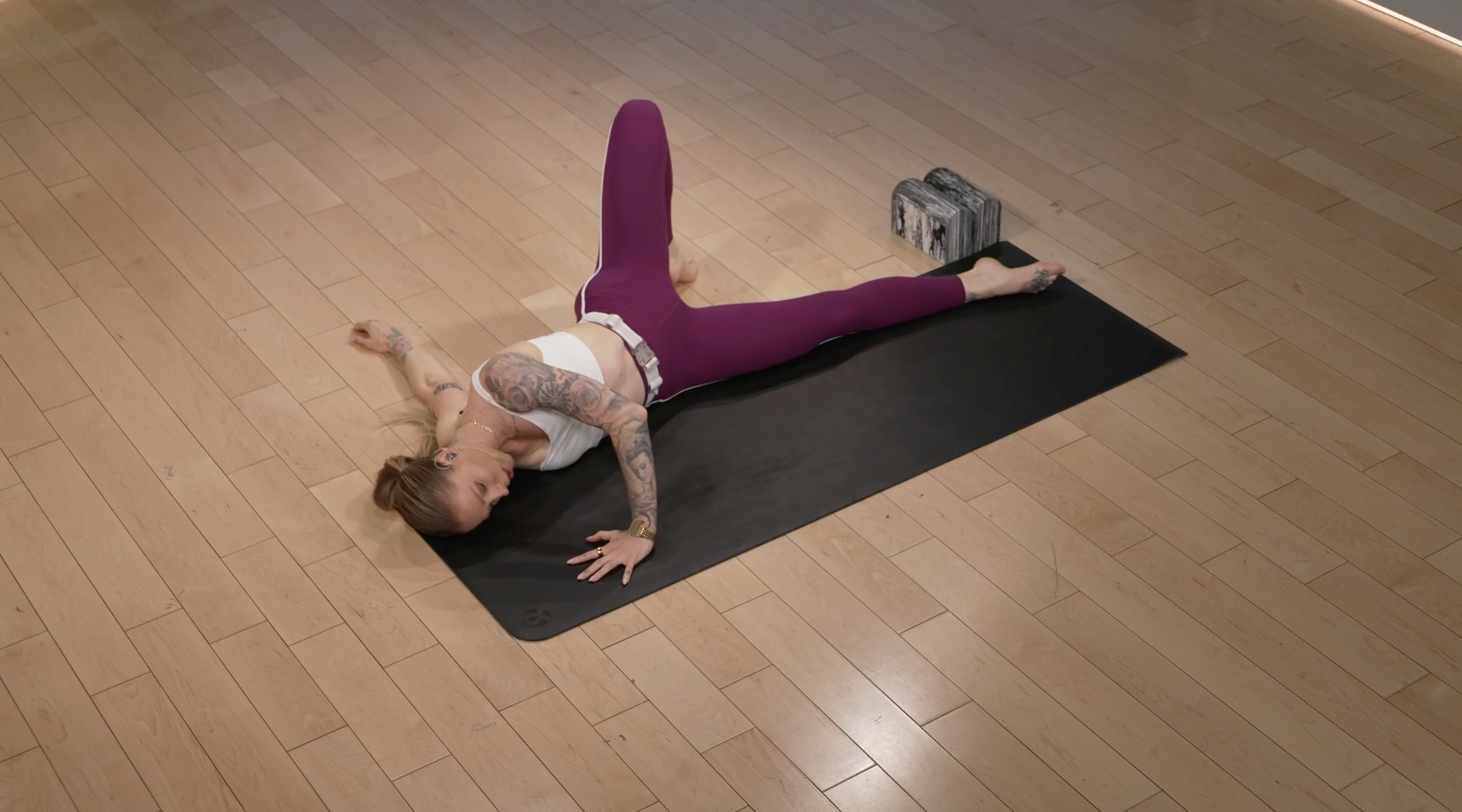
The scorpion stretch is a powerful move that opens the chest, unlocks the hips, and releases the lower back. It also gives your spine a chance to recalibrate.
It’s a perfect antidote for those who spend long days sitting and those who are prone to hunching forward. Moreover, it can help a variety of athletes—including runners, cyclists, and skiers—who take similar forward-yearning positions.

Peloton App
Access thousands of classes with no equipment needed.
Muscles Worked By the Scorpion Stretch
The scorpion stretch works the majority of your front body, but it also rotates the posterior chain.
According to Ashley Katzenback, doctor of physical therapy at Cape Concierge Physical Therapy, you’ll feel the scorpion stretch most in your:
Shoulders
Quads
Abdominals
Hip flexors
Lower back
Glutes
You can expect a stretch in the psoas, one of the hip flexor muscles, all the way into the abdominals. “We rarely get into that lower abdominal area,” says Peloton instructor Mariana Fernández. “For you to be able to open up, keeping the torso on the ground, and feeling that rotation, you're going to get really deeply into that hip flexor.”

How to Do the Scorpion Stretch
Here, Mariana cues how to do the scorpion stretch for yourself.
1. Find Your Starting Position
Lie face down on a mat or soft surface with your legs long. Gently rest your forehead on the floor to keep a neutral spine. “You want to make sure to not crank your neck, especially as you're starting to create the twist in your spine,” says Mariana.
Extend your arms out to the sides in a T-position, ensuring that your shoulders, elbows, and wrists are in line. Press your palms into the floor.
2. Lift Your Leg and Rotate
Lift your left foot up, bending the knee at about 90 degrees. Twist it up and over your right leg, reaching your left toes to the floor. Keep both palms planted on the floor.
3. Go Deeper, If You Choose
Mariana says you should start to feel the stretch in your hip flexor and perhaps your outer hip. You should also feel a stretch across your right shoulder and chest. The sensation will depend on how deeply you want to go. In her yoga classes, Mariana says it’s “yogi’s choice,” depending on how your body feels that day and what your goals and limitations are.
“If you want to lead the foot to the opposite hand [for a deeper stretch], start to rotate from the base of the spine,” she says. “It's allowing your hip flexor to open and that spinal mobility from the base into the thoracic spine.”
Go only as far as is comfortable, and back off if you feel any pain or compression in your lumbar spine (lower back). “Let the foot move to where it best serves you,” Mariana adds. You can keep your foot near the opposite knee, or reach it closer to your opposite hand for a deeper stretch.
4. Hold and Breathe
Hold the pose for five even rounds of breath.
5. Release and Repeat
Gently unwind and return to the starting position, then repeat the stretch on the opposite side.

Variations of the Scorpion Stretch
For a deeper stretch, you can plant one hand on the floor underneath your shoulder on the same side as the lifted leg (as shown above). Press into that hand to spiral your chest open, turning your gaze to the left.
If you’re comfortable doing scorpion and would like to make this a more dynamic stretch (for example, as part of a workout warm-up), you can hold for just one second before returning to center, then alternating sides (as shown below).

Benefits of the Scorpion Stretch
The scorpion stretch is a great full, front-body stretch—namely for spinal mobility and the hips, says Mariana—so long as it’s done right. “You can really feel the benefits and get some deeper elongation,” she says.
Katzenback reiterates that scorpion stretch particularly shines at counteracting the effects of sitting too much. By sitting for extended periods of time, day in and day out, our glutes shut down and our lower back and hip flexors tighten up. “The scorpion is a great way to stretch your thighs, hips, lower back, abdominals, upper chest, and neck—all of which shorten while sitting,” she says.
In addition to helping desk workers, people with long commutes, and those of us who love to cozy up on the couch, the scorpion stretch is also great for those who love to cycle, row, and ski (i.e., activities that include forward-flexed postures). “Such sports often leave athletes with tight hip flexors, tight lower back muscles, shortened glute muscles, and forward-flexed shoulders,” says Katzenback. These sports also tend to require spending long periods in one position, which won’t only make you tighten up but also doesn’t allow much lateral or rotational movement.
“Whether we're at work, sitting down, or even on the Peloton Bike, a lot of us are spending a lot of our time hunched over,” says Mariana. “We're so used to existing on a certain plane.” Fortunately, the simple movement of the scorpion stretch can counteract these patterns and help bring the body back into balance. Better yet, it feels really good and often provides an immediate sense of release.
Mistakes to Avoid
It’s important to move mindfully in order to reap the biggest benefits and avoid injury when doing the scorpion stretch. Here are some common mistakes you’ll want to avoid with this powerful front-body opener:
Moving too quickly into the pose. According to Mariana, one of the biggest mistakes with scorpion stretch—and any stretch, for that matter—is going too quickly into it without aligning yourself properly. Remember to slow down as you progress into the stretch.
Misaligning your neck. Keeping your neck aligned is key since it’s such a sensitive area. If it helps to keep the back of your neck long, Mariana says you can place a blanket or a towel beneath your forehead. And once you’re in the stretch, don’t try to move your head. “Because you’re playing with mobility and distributing weight side to side, don't make any sudden movements or try to check on your foot or anything,” she adds.
Compressing the sacroiliac (SI) joint. Mariana says that this is a red flag for runners, in particular, since SI joint issues and tightness in the area are common. “If you compress it any more, which is what happens when you’re rotating, it can give you discomfort,” she cautions. Be sure to back off a bit if you feel any pain or like you’re compressing the space in your lower back.
Neglecting your breath. Many people tend to hold their breath while stretching, especially in twists. Mariana reminds us of the importance of breathing into the space you create, especially in potent opening stretches like Scorpion. “You're creating this mobility from your hip into your pelvis into the lumbar spine—this chain reaction—so allow yourself to breathe as you get into it,” she says. “Don't hold your breath, and then while you’re there, take deep breaths.” (Tip: If and when you’re ready to progress, go for a deeper stretch on the exhale. Exhales also help to release the tension in the muscle, and the joints start to get a little more mobile as well, Mariana adds.)


Who Should Skip Scorpion
Keep in mind that certain people should steer clear of the scorpion stretch, Katzenback says. This includes those with hypermobility in their spine, an injury to their shoulder, back, or hip, and those recovering from a quad strain or recent abdominal surgery. (Instead, consider other gentler shoulder, hip flexor, and chest stretches.) When in doubt, consult with your doctor or a fitness or medical professional to better understand whether or not scorpion is right for you.
How to Include the Scorpion Stretch In Your Routine
The scorpion stretch is an instructor favorite in stretching and warm-up classes on the Peloton App—and for good reason. Pretty much anyone, from desk workers and sedentary folk to seasoned cyclists and runners, can stand to benefit from this stretch that corrects hunched postures and tight hips.
However, it’s just as good on its own after a long day at work or a tough workout. Mariana says she particularly likes to include it at the end of a workout once the shoulders have opened and the hips are adequately warmed up. “Once you have the mobility in, like in a post-run or post-cycling class, when you know that your joints have been lubricated, you can ease in,” she says. “Those joints can breathe after the fact.”
After all, an exhale always helps take the load off—especially when it’s accompanied by a solid, well-deserved stretch.
If you’re looking to counteract the effects of sitting all day at a desk job, check out the Desk Worker Strength & Mobility Collection, created in partnership with the Hospital for Special Surgery (HSS), in the Peloton App.


This content is for informational and educational purposes only and does not constitute individualized advice. It is not intended to replace professional medical evaluation, diagnosis, or treatment. Seek the advice of your physician for questions you may have regarding your health or a medical condition. If you are having a medical emergency, call your physician or 911 immediately.

Level up your inbox.
Subscribe for a weekly dose of fitness, plus the latest promos, launches, and events.
By providing your email address, you agree to receive marketing communications from Peloton.
For more about how we use your information, see our Privacy Policy.