South_agency via Getty Images
How to Use Kettlebell Halos to Build Rock-Solid Shoulders
Improving shoulder mobility and strength can benefit athletic performance and everyday life—that’s where the kettlebell halo comes in.
By Elizabeth Millard•
What Are Kettlebell Halos?
Which Muscles Do Kettlebell Halos Work?
The Benefits of Kettlebell Halos
How to Do a Kettlebell Halo
Common Mistakes to Avoid When Doing Kettlebell Halos
Kettlebell Halo Variations to Try
How to Add Kettlebell Halos to Your Strength Routine
When it comes to boosting shoulder mobility, you can lean on tried-and-true stretches, such as the Thread the Needle Pose in yoga or simple arm circles. To build strength, you have a breadth of dumbbell-based options, from overhead presses and lateral raises to reverse flys.
But what if you could get both shoulder strength and mobility benefits with one sleek move? Meet the kettlebell halo, which efficiently and simultaneously does both—with the added benefit of throwing core work into the mix.
“Kettlebells have an off-center weight distribution, as opposed to the even weight distribution of a dumbbell, which creates an added layer of core and stability work to your strength training,” says Peloton instructor Katie Wang. “That means kettlebell halos help with shoulder strength and mobility in the shoulder girdle, while also building core strength by challenging your stability.”
Here's a look at this all-in-one move, which you may want to consider adding to your next strength workout.
What Are Kettlebell Halos?
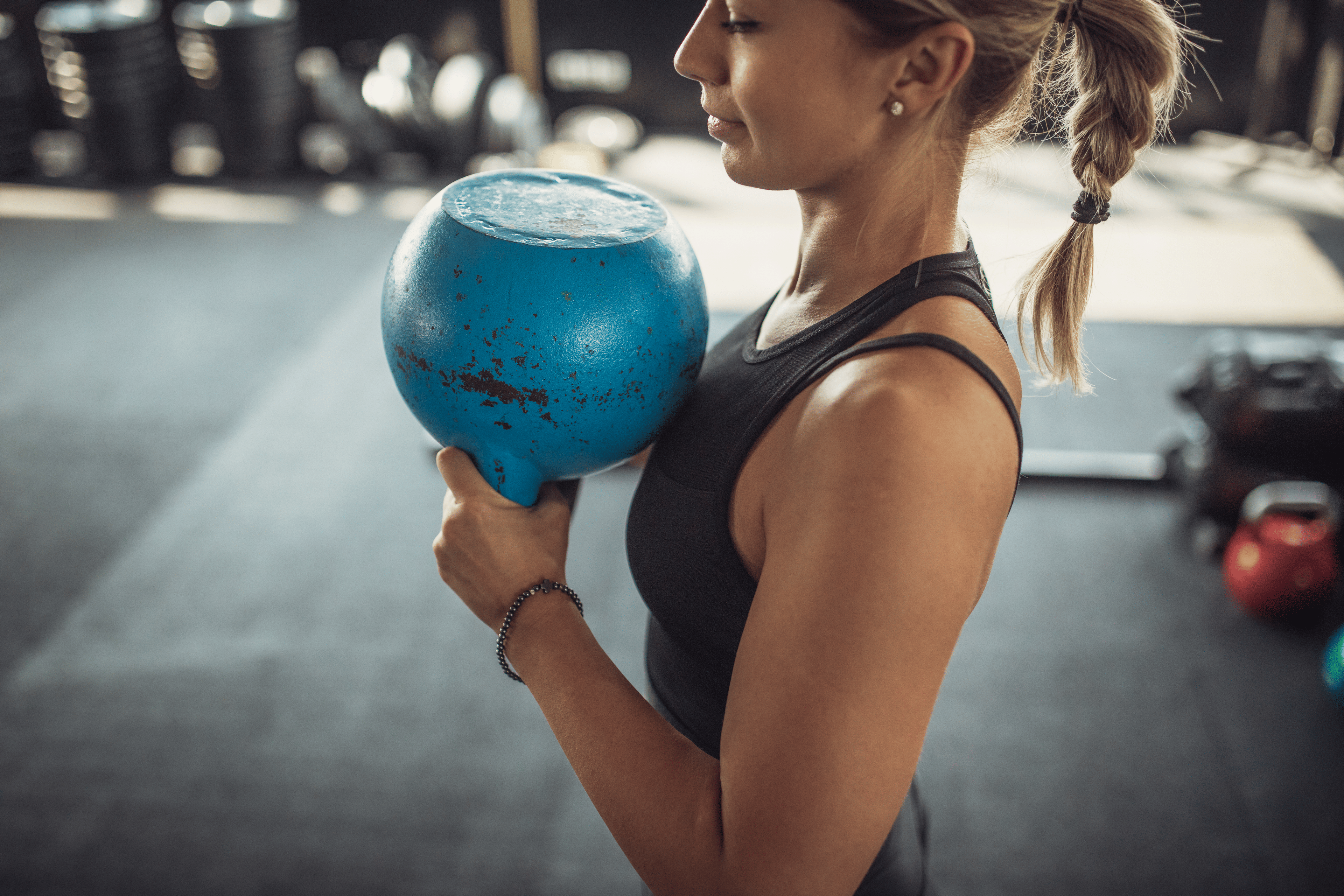
A kettlebell halo is an exercise where you hold a kettlebell upside down in both hands and circle it around your head, says Carol Mack, a physical therapist specializing in sports performance.
Although it’s called a “halo,” the circle you make isn’t small in size and above your head, like you’d see in a depiction of an angel. Instead, you go around the middle of your head, which requires substantial shoulder mobility and engagement in order to maintain stability and manage the weight as you complete the circle.
Unlike some kettlebell moves that use explosive power, such as a kettlebell swing, a halo is done in a slow, methodical way, Mack says. You can do kettlebell halos while seated, kneeling, or standing, and they’ll each tap into your core in a slightly different way. It’s also possible to do halos with a single dumbbell, though kettlebells tend to be the more popular choice.

Peloton App
Access thousands of classes with no equipment needed.
Which Muscles Do Kettlebell Halos Work?
Although it may feel like a shoulder isolation exercise, kettlebell halos work several different muscle groups simultaneously, according to Mack. These are the main ones targeted by kettlebell halos:
Deltoids and Rotator Cuff Muscles: Your deltoids (aka shoulder muscles) and rotator cuff muscles engage to help maintain control of the weight as you move through the halo’s full circle.
Trapezius and Rhomboids: These upper-back muscles fire to both move and stabilize your shoulder joints as you take the kettlebell through the full circle.
Erector Spinae: These muscles run along the sides of your spine and work to keep you in a tall, upright posture.
Biceps and Triceps: Your elbows stay bent at a relatively fixed angle throughout a kettlebell halo; to maintain this position, your biceps and triceps have to continuously contract, working against the weight of the kettlebell and gravity.
Obliques and Transverse Abdominis: During a kettlebell halo, you’re continually shifting the distribution of weight. This calls on your core muscles to engage to keep you stable, so you don’t tip or bend to one side.
The Benefits of Kettlebell Halos
The main advantage of kettlebell halos is that they work the shoulders from all different angles, building dynamic strength and increasing range of motion. Research published in the Journal of Bodywork and Movement Therapies notes that halo exercises loosen up the shoulders and the thoracic spine, making them stronger and more resilient.
“When you have that kind of strength and resilience, it helps reduce the risk of injuries, because your muscles are engaging more efficiently,” Mack says.
But that’s not the only perk you get from this move, according to Katie. “Because of the structure of a kettlebell, they’re excellent for working on grip strength,” she says. Improved grip strength helps you hold onto heavy dumbbells or haul around a suitcase, and is even linked to increased longevity.
“You’re also establishing better stability through that core engagement,” Katie adds. Core stability—your core muscles’ ability to stabilize your spine during activity—helps improve balance, coordination, and sports performance, as well as improve your posture, which has a cascade of other positive effects.
“Creating stability and mobility in the core and shoulders can go a long way toward improving how you move overall,” Mack says. “That can have a ripple effect, not just for your training and performance goals, but other aspects of your life.”
For example, a 2015 study published in the Journal of Physical Therapy Science, which examined the effect of exercise on posture, found that just two months of bodyweight strength training resulted in reduced pain, less joint imbalance, and improved range of motion. Other studies have noted that good posture can even improve your response to psychological stress. For instance, research in the journal Health Psychology found that those with a more upright posture had higher self-esteem, less fear, and a better mood.

How to Do a Kettlebell Halo
Below, Katie breaks down how to do the kettlebell halo with proper form, step by step.
1. Take a strong athletic stance.
In the case of kettlebell halos, this means feet hip-width apart and parallel, with a soft bend in the knees and no arch in the lower back, Katie says. It also means engaging your core: as you do a halo, your core will fire up naturally, to some degree, for stability, but you’ll need to make a conscious effort not to let your back arch as you bring the kettlebell behind your head. To engage your core, think about gently drawing your belly button toward your spine, tucking your pelvis slightly, and drawing the bottom of your ribs very gently toward the tops of your hip bones.
2. Start with the kettlebell in front of your chest.
Hold the kettlebell upside-down (bottom of the bell pointing up) in front of your chest, with your hands gripping the horns—the sides of the handle where it attaches to the bell. Your elbows should be bent and tucked in close to your sides.
3. Move the kettlebell to one shoulder, then around the back of your head.
Inhale to move the kettlebell over the top of your right shoulder, lifting the left elbow. Then circle the kettlebell behind your head, lifting the right elbow so both elbows are pointing up toward the ceiling. “Keep the elbows tight to the head as you bring the bell behind you,” Katie says.
4. Complete the circle.
Exhale to continue the circle, passing the kettlebell over the left shoulder and dropping the left elbow. Continue to rotate back to the starting position until the bell is in front of your chest. Throughout the movement, keep your elbows close to the body, not flaring out to the sides.
5. Repeat or reverse directions.
“You can either focus on moving one direction for a certain number of reps and then repeat the same number of reps in the opposite direction, or you can alternate directions (counterclockwise and clockwise) each rep,” Katie says.


Common Mistakes to Avoid When Doing Kettlebell Halos
The biggest challenges to maintaining proper form come from doing halos too quickly, Katie says. Moving too fast means you’re likely relying on momentum to swing the bell around, which can put stress on the shoulder joint.
“Don’t rush the exercise. You want to stay as stable as possible throughout to get the full benefits of the movement,” Katie adds. “Try not to let the elbows splay out as you bring the bell behind the head. When your arms frame the face, your elbows should naturally point up towards the ceiling.”
Another mistake to avoid is releasing your core engagement, she says. Because of the way the halo shifts weight distribution, it’s easy to sway back and forth or let your back arch—both of which can put pressure on the lower back. Avoid moving your head inside the halo (a common tendency as you anticipate the movement), as it can overtax the neck muscles. Instead, focus on keeping your gaze straight ahead, neck long, and head as still as possible.
As with any strength training, choose a weight that’s appropriate for your needs and abilities. Using a bell that’s too heavy can compromise your form and may lead you to arch your back or struggle to complete the full motion. A heavier weight could also be more difficult to grip properly, which can increase the risk of dropping it in the middle of the exercise.

Kettlebell Halo Variations to Try
In addition to the standard kettlebell halo described above, you can try a few different variations.
Use a different piece of equipment. “You can also do a halo using a dumbbell by holding onto either end of the dumbbell,” Katie says. Other equipment options for halos include a small medicine ball, a weight plate, or even a resistance band stretched to about the same width as kettlebell horns.
Change your position. Kettlebell halos are often done standing, but you can modify by sitting on a bench or kneeling, either on both knees or one knee. Performing halos on one knee can help increase the stability challenge on your core, as you’ll work to keep your balance.
Add a move between reps. Instead of doing multiple kettlebell halos in a row, you can make it a full-body exercise by incorporating a lower-body move between each rep. For instance, try a kettlebell halo followed by a goblet squat or lunge. You can also max out the upper body burn by adding a triceps overhead extension mid-rep (when the kettlebell is behind your head), as shown above.
How to Add Kettlebell Halos to Your Strength Routine
“It's always a good idea to be properly warmed up before any strength workout, particularly before bringing a weight overhead,” Katie says. She suggests doing jumping jacks, banded pull-aparts, and arm circles before doing kettlebell halos. You can also cue up a 5- or 10-minute strength warm-up on the Peloton App before diving into a kettlebell workout.
“Kettlebell halos are a fun and dynamic way to train your core and shoulders, so try adding them into your strength training once a week to start,” she says. You can include kettlebell halos in your upper body strength days, full body strength workouts, or during a push or pull routine.
For a more guided approach to tackling kettlebell workouts (including halos), try some of the kettlebell strength and conditioning classes on the Peloton App.
Related Articles

Strength Train
How to Work Your Entire Core with a Kettlebell

Strength Train
9 Kettlebell Exercises That Build Shoulders of Steel

Strength Train
Upright Rows Can Build a Stronger Back and Shoulders—If You Do Them Right. Here’s How

Strength Train
The Kettlebell Snatch Is a One-Stop Shop for Cardio and Total-Body Strength. Here’s How to Do It
This content is for informational and educational purposes only and does not constitute individualized advice. It is not intended to replace professional medical evaluation, diagnosis, or treatment. Seek the advice of your physician for questions you may have regarding your health or a medical condition. If you are having a medical emergency, call your physician or 911 immediately.

Level up your inbox.
Subscribe for a weekly dose of fitness, plus the latest promos, launches, and events.
By providing your email address, you agree to receive marketing communications from Peloton.
For more about how we use your information, see our Privacy Policy.