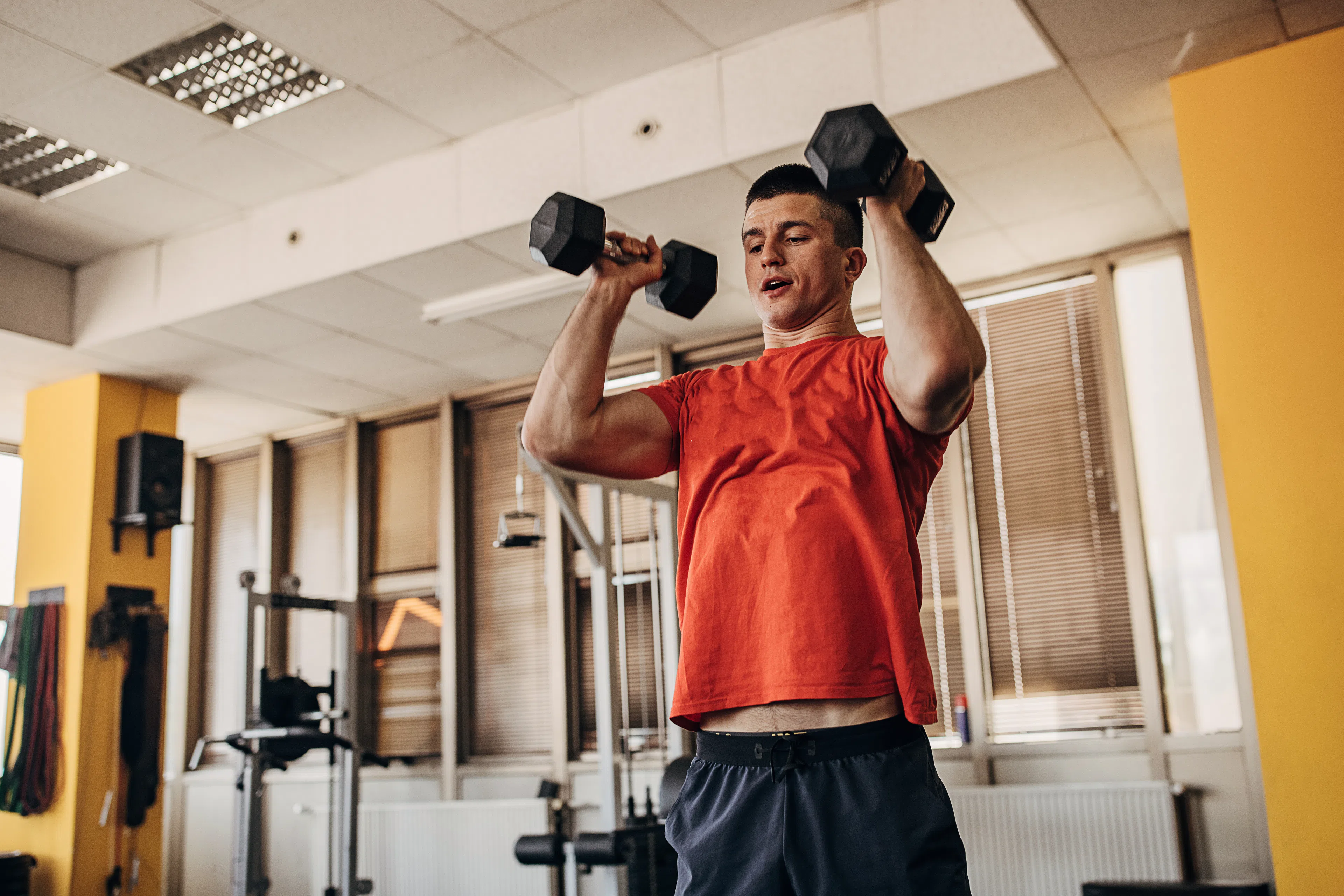
Hirurg via Getty Images
Knock Out Strength and Cardio with One Powerful Move: Thrusters
Fitness experts agree this is one of the most efficient exercises you can add to your routine.
By Danielle Zickl•
What Are Thrusters?
Muscles Worked by Thrusters
The Benefits of Thrusters
How to Do Thrusters Correctly
Thruster Variations
Tips for Adding Thrusters to Your Routine
Most of us don't have the time to fill our workouts with exercises that only target one muscle group at a time. Enter: the thruster exercise. Not only is it the ultimate strength move, engaging your upper body, lower body, and core all at the same time, but it has some pretty legit cardio benefits too.
Ahead, we dive headfirst into all the reasons you should add thrusters to your fitness routine, plus how to do them, variations to switch things up, and tips for making the most of the move.
What Are Thrusters?
Thrusters are a compound exercise that combines a front squat with an overhead press in one fluid movement, according to Peloton instructor Ben Alldis. (FYI: A compound exercise is one that works multiple muscles and joints at the same time.)
You can do thrusters with virtually any piece of gym equipment you have on hand, like a barbell, dumbbells, or kettlebells, adds Grayson Wickham, a physical therapist and certified strength and conditioning specialist.
Depending on the amount of weight you use and the intensity at which you perform them, you can use thrusters to improve muscular endurance or strength, Wickham explains. Using lighter weights relative to your strength will skew the exercise more toward building muscular endurance, or how long your muscles can work against gravity or resistance before becoming fatigued. Using heavier weights, on the other hand, will skew the exercise more toward building strength.

Peloton App
Access thousands of classes with no equipment needed.
Muscles Worked by Thrusters
“Thrusters do a brilliant job at working virtually every muscle in your body, making them an incredibly effective full-body movement,” Ben says. Here’s a look at the main muscles worked by the thruster exercise:
Glutes and Legs: “The main muscle groups that [thrusters] work include your quads, glutes, hamstrings, and calves during the squat section,” Ben says.
Core: Your core—including your abdominal muscles, transverse abdominis (your deepest core muscle), obliques, and lower back—stabilizes your body throughout the motion of the move.
Back: The muscles along your spine and throughout your upper back engage to support the weight, according to Ben. This includes the latissimus dorsi (aka lats), which extend from the shoulder blade to the lower back.
Upper Body: Your shoulders, triceps, and upper chest are all engaged during the pressing movement of thrusters, Ben explains.
The Benefits of Thrusters
Below, Ben and Wickham explain the many pros of adding thrusters to your workout routine.
1. They’re Time-Efficient
“Thrusters are a great bang-for-your-buck exercise that works your entire body in a short amount of time,” Wickham says. You can perform numerous sets of thrusters and get in a good full-body workout in under 20 minutes, he adds.
2. They Build Strength
Thrusters are “incredible” for building functional strength—aka the ability to perform everyday movements efficiently and effectively—since the movement pattern “mimics real-life activities, like lifting objects overhead,” Ben says.
Interestingly, a small 2017 study in Frontiers in Physiology found that resistance training programs involving compound, multi-joint exercises—such as thrusters—may be better at improving muscle strength than resistance training programs involving single-joint exercises (aka isolation exercises).
3. They Boost Muscular Endurance
Thrusters are great for building muscular endurance when performed with high reps and a lighter weight, according to Wickham. Because muscular endurance is the ability to sustain physical activity without your muscles getting tired, it’s important for athletes who want to improve their performance—for example, their ability to last through all four quarters of a football game or multiple tennis matches. And even if you’re not competing in a sport, adding thrusters to your routine can help make daily activities—like carrying heavy groceries from your car to your kitchen—feel easier.
4. They Improve Cardiovascular Endurance
Both experts agree thrusters are great for boosting your aerobic fitness. Because the move engages almost your entire body, it forces your heart and lungs to work hard to deliver oxygenated blood to all the working muscles. As such, “this exercise increases your heart rate quickly and will help you improve your metabolic capacity,” Ben says.
Science backs that up: In the 2017 Frontiers in Physiology study, researchers also found that multi-joint movements improve cardiorespiratory fitness more than single-joint movements.
5. They Enhance Mobility
Thrusters can help you improve mobility, particularly in your shoulders, hips, and ankles, Ben says. That’s because the movement requires a full range of motion in these joints.
However, Wickham cautions that if you have poor mobility in these joints, there’s a good chance you won’t perform them correctly. “This will cause compensations in your joints due to trying to overcome this tightness, leading to poor form, poor performance, joint wear and tear, and eventually, pain and injury,” he says. As a best practice, you should always perform mobility exercises before a workout that includes thrusters, he adds. These can include air squats, light overhead presses, cat cow, and thread the needle.
How to Do Thrusters Correctly
Ben recommends dumbbell thrusters for beginners because they allow for better shoulder mobility and let you work each arm independently. “I always recommend athletes begin with this variation before jumping into other alternatives,” he says. “Those with shoulder issues should start here with light weights before trying any other variation.”
Using two separate weights allows your right shoulder and left shoulder to move freely and individually, which is important because most people have one shoulder that is a little tighter than the other shoulder, Wickham adds.
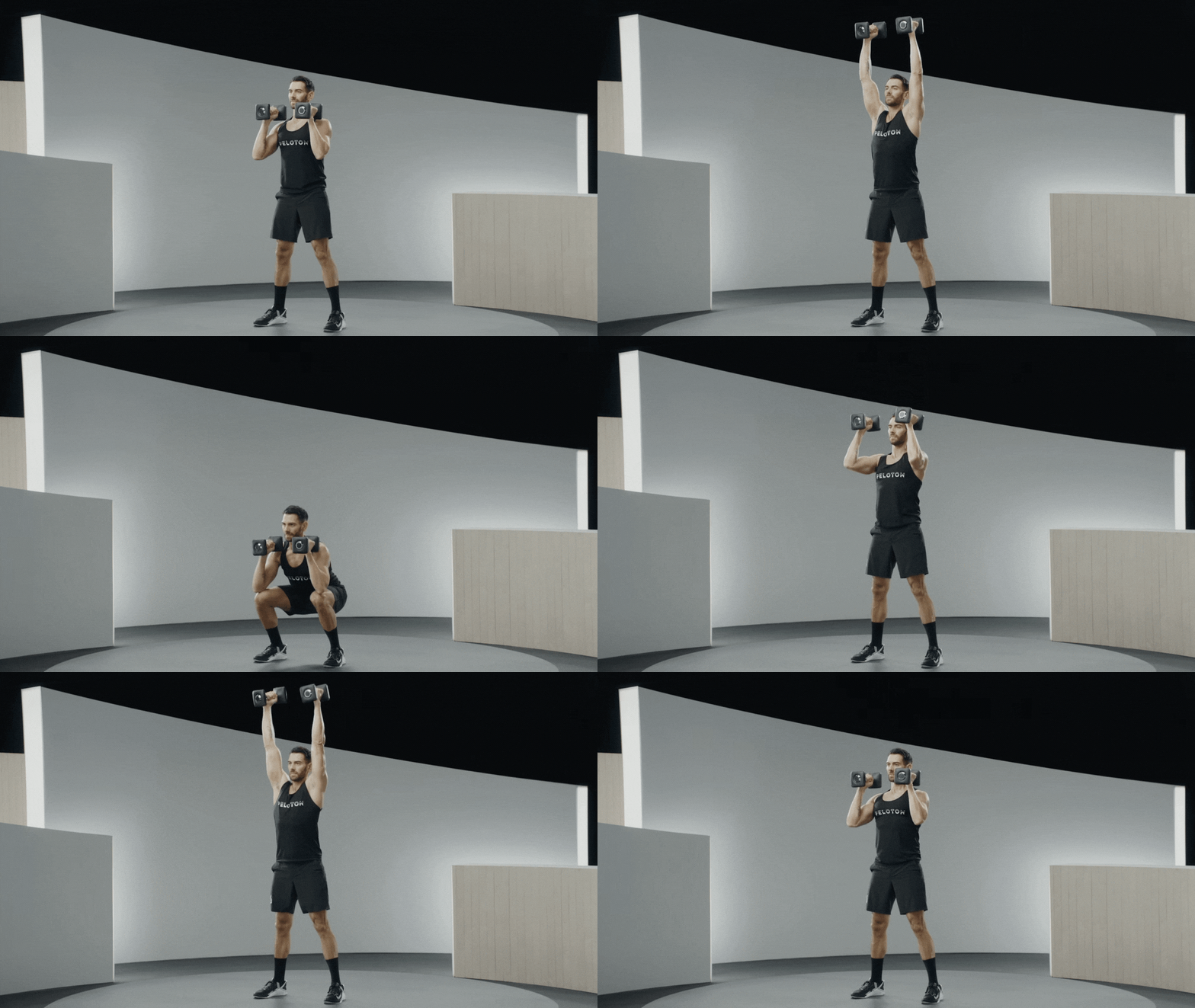
Here’s how to do dumbbell thrusters with perfect form, according to Ben:
Start standing with your feet shoulder-width apart, toes slightly turned out, holding dumbbells at shoulder height with your elbows in by your sides, palms facing in.
Sit back into your hips and squat until your thighs are parallel to the floor, keeping your chest up and core engaged.
Powerfully drive through your heels to stand up. As you reach the top of the squat, use the momentum from the squat to press the weights straight overhead. Maintain a neutral spine.
Fully extend your arms and finish at the top of the movement with the weights directly above your shoulders, palms still facing in toward each other.
With control, lower the weights to shoulder height. That's one rep.
Thruster Variations
There are plenty of ways to switch up the thruster exercise for different fitness levels and goals, or simply so you don’t become bored.
1. Barbell Thrusters
This variation is “amazing for adding heavy loads and building maximum strength,” Ben says. “[It’s] best for intermediate to advanced lifters who want to challenge themselves with heavier weights.”
Start standing with your feet shoulder-width distance apart, toes slightly turned out. Hold a barbell with an overhand grip (palms facing away from your body) at shoulder height with your hands shoulder-width distance apart and elbows by your sides.
Sit back into your hips and squat down until your thighs are parallel to the floor, keeping your chest up and core engaged.
Powerfully drive through your heels to stand up. As you reach the top of the squat, use the momentum from the squat to press the barbell straight overhead.
Fully extend your arms and finish at the top of the movement with the barbell directly above your shoulders. Keep your core engaged; don't allow your back to arch.
With control, lower the barbell to shoulder height. That's one rep.

2. Single-Arm Thrusters
This single-arm variation adds an anti-rotation challenge, according to Ben, meaning it works on your midsection’s ability to stay stable and fight the urge to rotate. “It’s fantastic for athletes or anyone wanting to improve unilateral strength and core stability,” he says.
Start standing with your feet shoulder-width distance apart, holding a dumbbell in your right hand at shoulder height, palm facing in. Extend your left arm out to the side for stability.
Sit back into your hips and squat down until your thighs are parallel to the floor, keeping your chest up and core engaged.
Powerfully drive through your heels to stand up. As you reach the top of the squat, use the momentum from the squat to press the weight straight overhead.
Fully extend your right arm and finish at the top of the movement with the weight directly above your shoulder.
With control, lower the weight to shoulder height. That's one rep. Complete all reps before switching to the other side.
3. Kettlebell Thrusters
This kettlebell thruster variation “offers a different grip position that some people find more comfortable, and the weight distribution can feel more natural,” Ben says.
Start standing with your feet shoulder-width distance apart, holding a kettlebell in each hand at shoulder height with your elbows in by your sides and palms facing in.
Begin the movement by sitting back into your hips and squatting down until your thighs are parallel to the floor, keeping your chest up and core engaged.
Powerfully drive through your heels to stand up. As you reach the top of the squat, use the momentum from the squat to press the kettlebells straight overhead.
Fully extend your arms and finish at the top of the movement with the kettlebells directly above your shoulders.
With control, lower the kettlebells to shoulder height. That's one rep.


Tips for Adding Thrusters to Your Routine
Ben recommends incorporating thrusters into your workout routine one to two times per week. “Given the demanding nature of the movement, allow at least 48 hours between sessions,” he says.
If you’re focusing on overall strength and muscle building, Ben recommends starting with 3–4 sets of 8–12 reps. If you’re focusing on maximum strength development, try 4–5 sets of 5–8 reps with heavier weights.
For conditioning workouts, you could do shorter sets with more rounds, like 5 sets of 5 reps with minimal rest between sets, or add them into a circuit or EMOM finisher, Ben says.
Regardless of your strength goals, Ben emphasizes the importance of prioritizing form over weight or speed, especially when you're new to the move or are fatigued. “It’s always best to start with lighter weights than you think, so you can master the movement pattern first,” he says. “I advise people to focus on perfecting their form and listening to their bodies before progressing too heavy on the weights.”
It’s important to note that thrusters aren’t for everyone. If you’re pregnant or have back, shoulder, or knee issues, mobility restrictions, or weak or injured wrists, you may want to think twice about adding thrusters into your workouts. If you’re not sure, consult with a doctor, physical therapist, or personal trainer before attempting the thruster exercise.


This content is for informational and educational purposes only and does not constitute individualized advice. It is not intended to replace professional medical evaluation, diagnosis, or treatment. Seek the advice of your physician for questions you may have regarding your health or a medical condition. If you are having a medical emergency, call your physician or 911 immediately.

Level up your inbox.
Subscribe for a weekly dose of fitness, plus the latest promos, launches, and events.
By providing your email address, you agree to receive marketing communications from Peloton.
For more about how we use your information, see our Privacy Policy.