Sarah McEwan via Getty Images
How to Do Biceps Curls with Proper Form—No Cheating
Biceps curls aren’t just for vanity. Discover how to do them properly to grow stronger, healthier arms.
By Andrew Gutman•
Muscles Worked by Biceps Curls
Benefits of Biceps Curls
How to Do Biceps Curls Correctly
5 Biceps Curl Variations
3 Mistakes to Avoid When Doing Biceps Curls
How to Add Biceps Curls to Your Strength Training Routine
You may think biceps curls are a waste of time for anything but making your arms look more toned, but you’d be wrong.
Sure, curls will undoubtedly add size to your upper arms, but they’ll also help strengthen your biceps muscle, which plays a key role in pulling your forearms toward your body. Not only will stronger biceps help you excel at any sport where you need to bend your arms, (which is, you know, almost all of them), but they’ll also help you become more proficient at lifting and pulling anything towards your body (think: doors and heavy bags).
The biceps curl—which you can do with a barbell or dumbbells—is a favorite among lifters because it’s simple to do. To help you master it, we’ve enlisted the help of Peloton instructor Rad Lopez and Domenic Angelino, an exercise scientist and strength and conditioning coach. Below, we’ll break down how to do biceps curls correctly, common mistakes, and variations you should try when you want to spice up your training.
Muscles Worked by Biceps Curls
The biceps curl is an isolation exercise, which means it involves one joint and aims to target one muscle. In this case, that’s the biceps muscle, which runs the length of your upper arm from the inside of your elbow to the front of your shoulder. Digging deeper, the biceps muscles consist of two heads (or sections): the short head and the long head. The short head sits on the inside of your arm, and the long head sits on the outside of your arm.
Even if the biceps curl is an isolation exercise, it also calls a few other muscles into action. Your forearm muscles also work during the curl as you’re gripping the weight and slightly bending and rotating your wrist. There’s also a muscle that sits under your biceps called the brachialis, which is also involved in bending the elbow, and “serves to ‘push out’ the biceps and make them appear much larger by increasing the overall volume of the muscles on the top part of your upper arm,” Angelino adds.
You can target specific parts of your upper arm by making slight changes to the exercise, Angelino explains:
To train the inner head of the biceps, use a wide grip.
To train the outer head of the biceps, use a narrow grip.
To train both heads equally, use a grip that’s slightly wider than shoulder-width distance.
To emphasize the brachialis, do a reverse-grip curl with your palms facing down instead of up.
Benefits of Biceps Curls
“Curls are obviously great for building arm size, but they also have benefits beyond aesthetics,” Rad says. “They improve grip and forearm strength, protect your elbows and shoulders during heavier lifts, and carry over to movements like rows, pull-ups, and even athletic skills like throwing.”
Another overlooked perk is muscular balance. Think of your body as a system of levers (bones) and pulleys (muscles). For that system to run smoothly, you must train both the pulling muscles that flex your limbs (biceps, hamstrings, back) and the pushing muscles that extend them (triceps, quads, chest, delts). Neglect one side, and you set yourself up for posture problems and injuries. As Rad puts it, “Curls help balance out pressing work so your upper body stays strong and healthy.”

How to Do Biceps Curls Correctly
At its core, a curl is simple: extend your arm fully, then bend your elbow to bring your wrist toward your shoulder. You can do this with nearly any piece of equipment—barbell, kettlebell, machine—but the dumbbell curl is the gold standard. It gives you more range of motion and freedom than the others, and most of the form cues below apply no matter what you’re holding.
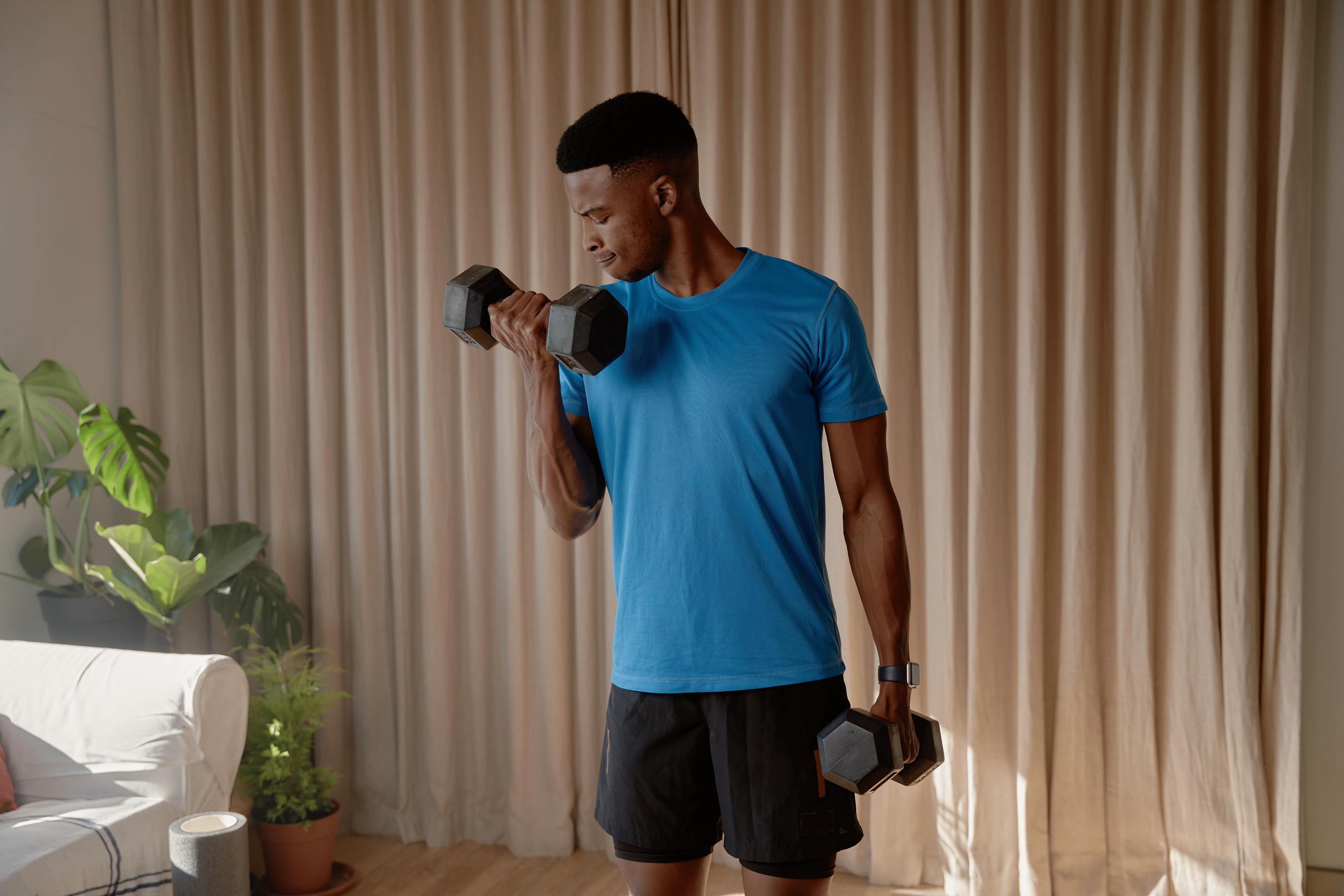
Stand with your feet hip-width apart and hold a dumbbell in each hand, palms facing forward. Let your arms hang so the dumbbells rest on either side of your thighs. Pull your shoulder blades together and allow your arms to drift slightly back.
Without shifting your shoulders, bend your elbows to lift the weights toward your shoulders. Keep your elbows tight to your ribs without swinging or jerking the weights, and keep your core engaged (don’t round or arch your back).
Slowly lower the dumbbells over three seconds until your arms are fully extended. You should feel a stretch in your biceps at the bottom of the rep.
That’s one rep. Pause for one beat, then repeat.
5 Biceps Curl Variations
By switching up your hand position and arm angle, you can make the exercise more comfortable and effective for different training goals (like muscle growth). Here are five curl variations that Rad recommends.
Incline Dumbbell Curl
This is Rad’s favorite curl variation. Lying back on a workout bench (set between 45-60 degrees) with your arms hanging straight down places the biceps in a deep stretch, forcing them to work harder through the entire range of motion, Rad explains. The setup also prevents you from swinging, so you can’t cheat by using momentum.
Hammer Curl
This curl variation is identical to the dumbbell curl except that you maintain a neutral grip (palms facing each other) for the entire repetition. This hand position is typically more comfortable on the elbow joint and allows you to lift more weight than the traditional dumbbell curl.
Zottman Curl
Curl the weight up like normal, but at the top, rotate your palms downward before lowering. That small twist turns the eccentric into a forearm burner, making this one of the best curl variations for grip strength.
EZ-Bar Curl
Doing biceps curls with an EZ bar (a small barbell with a bent shaft) offers two main benefits. First, the curved grip puts your wrists in a semi-neutral position for a little elbow joint relief (especially compared to straight-bar curls). Second, you can typically curl more weight with a barbell than with dumbbells since you’re lifting one tool with two hands and don’t need to stabilize each weight separately. More weight means more total volume for more muscle and strength gains over time.
Preacher Curl
Preacher curls can be done on a machine or with free weights. It’s basically a supported curl on an angled pad that allows you to immobilize your upper arm and obtain an intense stretch using a relatively heavy weight. It’s a popular exercise for building muscle mass.
Learn How to Do Biceps Curls on the Peloton App

3 Mistakes to Avoid When Doing Biceps Curls
The biceps curl may look simple, but there are plenty of ways to mess it up. Avoid these three mistakes, provided by Rad and Angelino, to lock in your form for optimal biceps engagement.
Swinging the Weights
Using momentum to complete a rep is known as a “cheat curl.” Some lifters argue that swinging allows them to overload the biceps with more weight than strict form would permit. Angelino disagrees for the most part. He notes that swinging usually reduces tension on the biceps, which means less growth over time. That said, he does see a role for cheat curls as a strategic workout finisher.
“If you were to perform a normal set with standard form, and then are unable to perform another rep, you can intentionally do a few extra controlled curls with momentum to extend your set a bit further, providing more of an incentive for your body to build muscle,” he says.
To ingrain proper form, Angelino suggests practicing curls with lighter weights. “If someone gets used to moving in a certain way, without the weight being so heavy that it incentivizes them to use momentum to lift it, then those movement mechanics tend to stay with people throughout their training span,” he explains. Another option: curl with your back against a wall so you can’t swing your torso into the lift.
Doing Partial Reps
A partial rep is precisely what it sounds like: a biceps curl taken through only a part of the range of motion. A full biceps curl should begin with your arm extended and finish with the dumbbell near your shoulder. Stopping short robs your biceps of tension and your joints of the benefits of moving through a full range of motion.
That doesn’t mean partial reps have no place. Recent evidence suggests that “long-length partials”—working the bottom half of the rep where the muscle is stretched—can be just as effective for growth as full-range-of-motion reps. The key is not to replace all your curls with partials, but to use them strategically. Try this: after finishing a set of strict curls, tack on three to five bottom-half reps, curling from full extension to about a 90-degree elbow bend. This way, you extend the set, increase time under tension, and drive more adaptation without sacrificing quality.
Programming Too Many Curls
It’s easy to assume that if a few sets of curls build bigger arms, more must be better. But that’s not how muscle growth works. “Many people who want bigger arms tend to involve too high a volume of biceps curls in their programming,” Angelino says. “Muscles can only respond to so much within a given workout, which is why nobody is in the gym 12 hours a day. Once you get enough training stimulus, more volume won’t help too much.”
The sweet spot for most people is around 10 to 15 sets of direct biceps work per week, spread across your training days. If you train arms twice weekly, aim for about five sets of biceps work per session. This way, you’ll apply enough stimulus to grow without doing extra work that wastes time and slows recovery.


How to Add Biceps Curls to Your Strength Training Routine
Because biceps curls are easy to do and don’t cause a lot of fatigue, they’re easy to tack on to any workout.
Rad says that for bigger and stronger arms, you should train your biceps with 10 to 15 weekly sets spread across two to three training sessions. (The National Academy of Sports Medicine recommends giving a muscle group 48 hours to recover between workouts, so be sure to take two days off between biceps workouts.) Perform anywhere from six to 12 reps for growth, mixing in the occasional higher-rep set. Rest about 60 to 90 seconds between sets.
“Train your curls after your bigger pulling exercises like rows or pull-ups,” Rad says. The reason is that your biceps are players in pulling movements like pull-ups and rows. Tired biceps muscles will impact your ability to perform those exercises effectively, but tired back muscles won’t impact your curls. When in doubt, do exercises that hit the most muscles (aka compound exercises) first and then end your workout with isolation exercises.
Rad’s last piece of training advice is to steadily progress your workouts over time. This principle is known as progressive overload, and it means that you need to do a little bit more each workout. More can mean one more rep than your last workout or lifting a few more pounds. You don’t need to make huge jumps from session to session, either—a little goes a long way.
Cheat code: Let a Peloton instructor worry about all that for you. On the Peloton App, try Arms & Shoulders Strength classes or Upper Body Strength classes, both of which will include biceps work. Also look for Extra 10: Biceps classes that are designed to be stacked after another workout and are dedicated solely to this small but mighty muscle group.
For more routine guidance—including how to organize your weekly workout routine and level-up over time—consider following an strength program on the Peloton App or Peloton Strength+, which are all designed by instructors to help you reach your strength goals.
Try an Upper Body Strength Workout on the Peloton App


This content is for informational and educational purposes only and does not constitute individualized advice. It is not intended to replace professional medical evaluation, diagnosis, or treatment. Seek the advice of your physician for questions you may have regarding your health or a medical condition. If you are having a medical emergency, call your physician or 911 immediately.
Level up your inbox.
Subscribe for a weekly dose of fitness, plus the latest promos, launches, and events.
By providing your email address, you agree to receive marketing communications from Peloton.
For more about how we use your information, see our Privacy Policy.