8 Rotational Core Exercises That Train You to Move Dynamically Through Life
These twisting movements build the spinal mobility and functional power required for every move you make.
By Alyssa Sparacino•
What Are Rotational Core Exercises?
The Importance of Doing Rotational Core Exercises
8 Rotational Core Exercises to Stabilize and Strengthen
How to Add Rotational Core Exercises to Your Routine
When it comes to building a well-rounded fitness routine, there are a few key elements you can expect to include: adequate recovery, intentional progressions, and necessary variety. That last one is a biggie. Variety of modalities, intensities, and movements all help keep your workouts challenging, engaging, and effective.
But there’s one type of variation that can be overlooked: plane of motion, or the directions in which you move. It’s important not only to move front to back and up and down, but also side to side and rotationally.
“Rotation is a fundamental movement pattern,” says Peloton instructor Mila Lazar. Twisting movements are essential to moving dynamically and athletically throughout your workouts, sports, and everyday life—and training that pattern with moves like rotational core exercises will prep your body to handle those demands with ease.
What Are Rotational Core Exercises?
Rotational core exercises aim to “either produce or resist rotation through the torso,” says Kevin Carr, certified functional strength coach and co-founder of Movement As Medicine. These twisting and turning movements strengthen muscles of the trunk (i.e., your core), including the rectus abdominis, obliques, multifidus, erector spinae, and quadratus lumborum, he adds.
Rotational vs. Anti-Rotational Moves
Rotational core exercises focus on creating rotation (e.g., twisting moves, such as a dumbbell woodchop), while anti-rotational exercises involve resisting rotation (e.g., the renegade row). Anti-rotational moves require you to maintain a stable torso against external forces trying to cause rotation, Carr explains.
“Both are essential for improving performance, injury resilience, and everyday functional movement,” he says. “Anti-rotational exercises build stability and control, while rotational exercises develop power and dynamic movement capacity. Together, they teach the body to both generate and resist rotational forces—key for athletic performance and functional movement in daily life.”

Peloton App
Access thousands of classes with no equipment needed.
The Importance of Doing Rotational Core Exercises
“Rotational core work is often overlooked but it’s one of the most powerful tools for creating a responsive, strong body,” Mila says. It can help improve not just how you move during your workouts, but during your daily life too.
“Peloton Members often tell me that these exercises improved their real-life movement, such as turning the wheel of the car, reaching for a child, or improving their backswing in golf,” Mila says. In Pilates, for example, you use rotation to strengthen the obliques, deepen core connection, increase thoracic mobility, and balance the spine, she explains.
Rotational core movements offer a wide range of body benefits across recovery, mobility, and athleticism, explains Mila. All that twisting helps promote a healthy spine, and practicing strength and control during rotational movements helps you in many different sports, including tennis, golf, swimming, running, and dancing.
What’s more, since rotating is a part of everyday movements such as walking, reaching, throwing, and turning, prioritizing this movement pattern in your workout can prevent falls and other injuries as well as keep you moving with ease. And yes, rotational exercises can also help you form some killer core definition through deep engagement of the internal and external obliques, Mila adds.
8 Rotational Core Exercises to Stabilize and Strengthen
Here, Mila and Carr share their go-to rotational core exercises. Remember, while you’re moving dynamically throughout these movements, you still want to maintain good control. Slow down, modify, or start with anti-rotational exercises if you find yourself wobbling too much to achieve proper form.

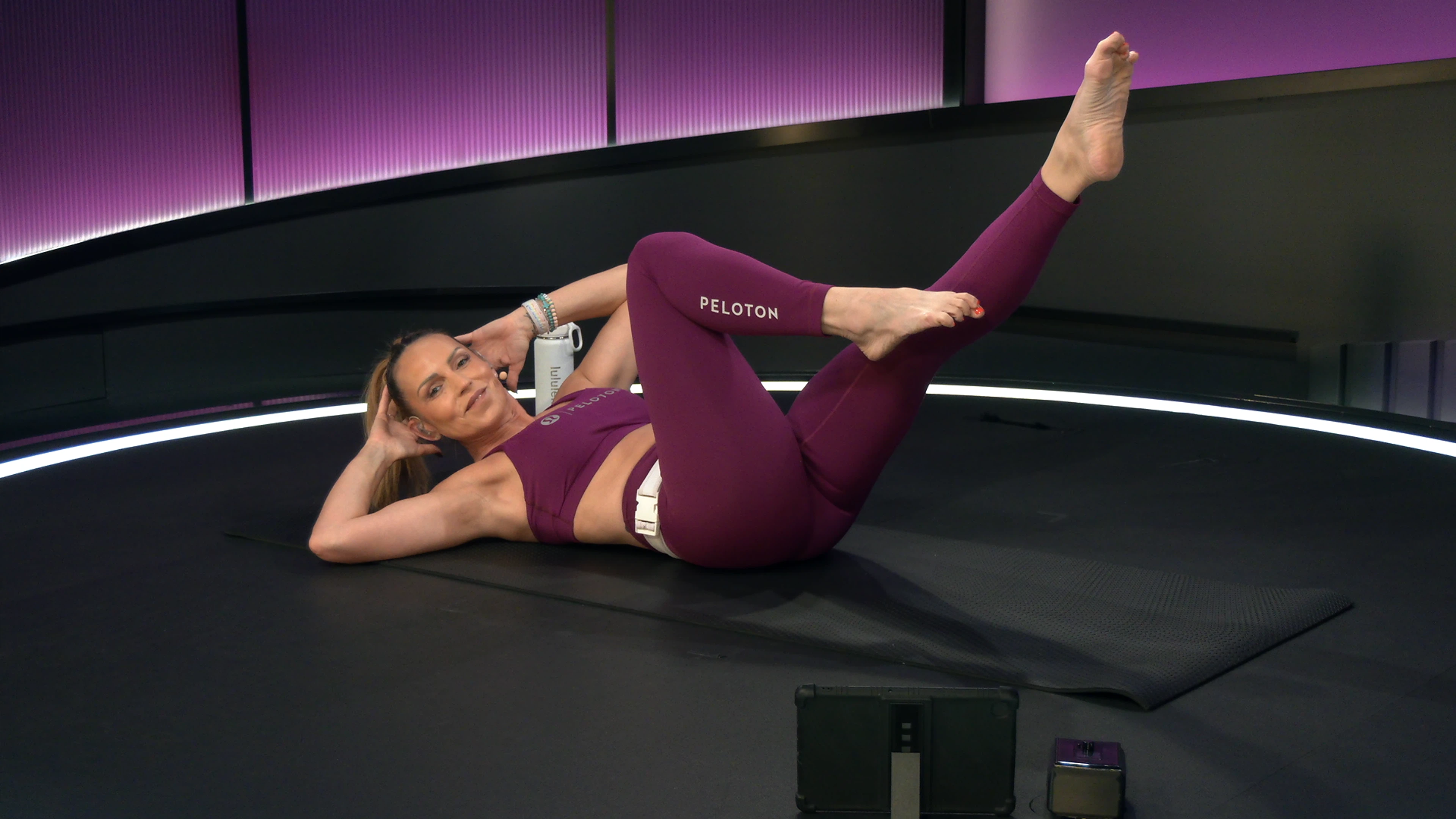
1. Criss Cross
This rotational core exercise is very similar to a bicycle crunch, but you want to move slowly and with control, ensuring your pelvis stays stable. To really dig into the rotation of this movement, “think ribs to opposite hip, not elbows to knee,” says Mila.
Lie on your back with a neutral spine and your core engaged. Place your hands behind your head with elbows out wide. Bring your legs to a tabletop position with knees above hips and knees bent at a 90-degree angle.
Inhale, then exhale to extend your right leg and pull your left knee toward your chest as you lift your head, neck, and shoulders off the mat, twisting to bring your right shoulder toward your left knee. (They won’t actually touch.)
Inhale as you come back through the center, and exhale to switch sides, moving fluidly to straighten your left leg and bend your right knee in while twisting to the right.

2. Seated Spine Twist
You’ll find this rotational core exercise in Pilates classes as it’s excellent for targeting your obliques, deep spinal rotators, and posture muscles, Mila says. Be sure to keep your hips anchored to the floor as you twist. Stop the rotation if you feel your glutes lift off the floor.
Sit tall with your legs extended, feet flexed, and your arms reaching out to the sides in a T-position.
Inhale, then exhale as you rotate your torso to the right. Try to grow taller as you twist.
At your furthest point, pulse three times to deepen into the twist as you continue to exhale.
Inhale to return to the center, then exhale to repeat on the opposite side. That’s one rep.
3. Standing Cable Wood Chop (Low to High)
A cable machine is great for both rotational and anti-rotation exercises, but if you don’t have access to one, you can do this movement with a long resistance band looped around a sturdy base at ankle height.
Stand with your right side facing the machine or resistance band. Grab the cable or band in both hands with your arms straight.
Bend your knees to come into a squat with the cable/band below your hip on your right side.
In one fluid motion, lift the cable or band diagonally up and to the left while simultaneously straightening your legs to stand tall.
Reverse the motion to return to the starting position, resisting the pull of the cable or band to lower with control.
That’s one rep. Do the same number of reps on both sides.
4. Horizontal Cable Chop
Use a cable machine or resistance band anchored at torso height for this rotational core exercise.
Standing with your right side to the machine or band, grab the handles or ends with both hands, with your arms straight, extended toward the anchor. There should be some tension to begin.
Twist your torso as you bring the cable or band across your body and over to your left side, pivoting on your right foot and allowing your hips to turn.
Reverse the movement, resisting the pull of the cable or band to slowly return to the starting position.
That’s one rep. Do the same number of reps on both sides.

5. Forearm Side Plank Rotation
To keep your form in check throughout this rotational core exercise, keep your hips lifted and legs active to avoid collapsing into your shoulder. This challenging movement focuses on your obliques and shoulders and is great for working on spinal and hip stability.
Begin in a forearm side plank on your right side with your left arm extended toward the ceiling.
Inhale, then exhale to thread your left arm under your torso, rotating your chest and head to look under the bottom arm.
Inhale as you reverse the move and extend your left arm back toward the ceiling.
That’s one rep. Do the same number of reps on both sides.

6. Saw
One important tip: Don’t force the stretch at the bottom of this sawing position. Don’t round your back or lift your hip off the ground to go further.
Sit tall with your legs extended a bit wider than your mat, feet flexed, and arms reaching out to the sides in a “T” position.
Inhale as you rotate your torso to the right.
Exhale and reach your left pinky toward the outside of your right foot, aiming to keeping your back straight.
At your furthest point, pulse three times to deepen into the twist as you continue to exhale.
Inhale to roll up through the spine and return to the center before repeating on the opposite side. That’s one rep.

7. Kneeling Side Kick with Rotation
This Pilates move targets the obliques and glutes, building core control and balance. “This exercise is a beautiful movement for rotational strength and balance,” Mila says. “Use the breath to guide the rotation and keep your hips square.”
Start kneeling on your right leg with your right hand pressed into the mat about 1.5 feet to the outside of your right knee. Extend your left leg out to the side, foot resting on the floor.
Lift the left leg up to hip height, keeping your knee pointing forward and hips square. Pace your left hand behind your head.
Inhale to prepare, then exhale and rotate your torso toward the floor, reaching your left elbow toward your right arm. You can bend and lower your left leg, as shown, or continue to hold it extended at hip height.
Inhale to return to the starting position. That’s one rep. Do the same number of reps on both sides.
8. Medicine Ball Side Toss
You’ll need a wall and medicine ball for this rotational core exercise. Give yourself a little space to move laterally, as well.
Begin standing in an athletic stance (knees slightly bent, feet hip-width apart) with a wall on your right side, holding a medicine ball at belly button height. You should be one big step away from the wall.
Wind up by bringing the ball over to your left, then twist your torso to the right to throw the weighted ball into the wall.
Catch the ball as it bounces off the wall.
That’s one rep. Do the same number of reps on both sides.


How to Add Rotational Core Exercises to Your Routine
Whether you add some rotational core moves onto an existing workout or warm-up or string them together for a complete core session, you can’t go wrong.
Mila suggests choosing three rotational core exercises from the list above as a way to start building this kind of movement into your routine, aiming for one seated spinal move, one plank-based exercise, and one lying-down rotation. From there, you can sprinkle them into full body workouts or add them together as a standalone core finisher. Try to include rotational core exercises in your workouts two to four times per week, Mila says.
If you’d rather follow a guided workout, turn to the Peloton App. There, you’ll find rotational core exercises in many core strength classes and Pilates classes (including those taught by Mila!), as well as incorporated into other workouts, including full body strength, warm ups, cardio, yoga, and more.
Working out in a gym or want to incorporate some of these cable machine exercises into your core work? Check out the Peloton Strength+ app, which allows you to create your own workouts, generate custom plans based on your preferences and goals, or follow self-paced instructor-led programs.


This content is for informational and educational purposes only and does not constitute individualized advice. It is not intended to replace professional medical evaluation, diagnosis, or treatment. Seek the advice of your physician for questions you may have regarding your health or a medical condition. If you are having a medical emergency, call your physician or 911 immediately.

Level up your inbox.
Subscribe for a weekly dose of fitness, plus the latest promos, launches, and events.
By providing your email address, you agree to receive marketing communications from Peloton.
For more about how we use your information, see our Privacy Policy.