
Cavan Images / Cavan via Getty Images
Should You Really Be Doing Push-Ups Before Bed?
We asked experts whether this trend is a good way to sneak in some extra movement, a recipe for ruining your sleep, or something in between.
By Mirel Zaman•
Benefits of Push-Ups Before Bed
Drawbacks of Push-Ups Before Bed
So, Should You Do Push-Ups Before Bed?
Logistics to Consider If You Do Push-Ups Before Bed
The Takeaway
Maybe your schedule was so busy you simply didn’t have a minute to devote to exercise. Or conversely, maybe you had a much-needed day of relaxation and skipped your usual strength training plan. Either way, by the time the evening rolls around, you might be craving a little movement. You may not have the time or energy for a full-on workout, but a few quick sets of push-ups before bed sounds doable. But is it advisable?
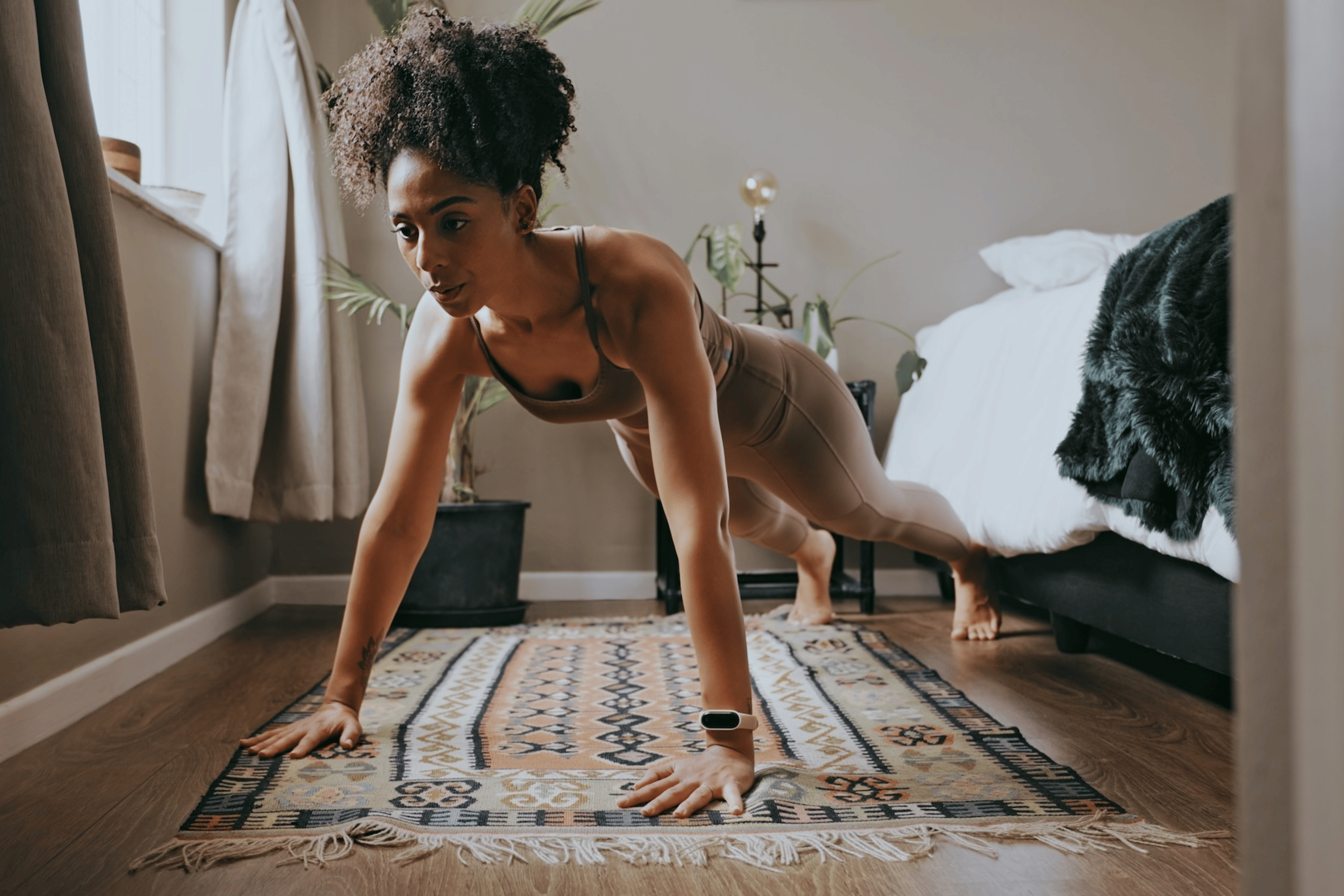
In recent months, the idea of doing push-ups before bed has trended on social media as a simple way to start a strength training habit or squeeze exercise into an otherwise jam-packed schedule. It sounds like a straightforward enough way to sneak some muscle-building and even a little cardio into your day at the eleventh hour. But as with most hacks we come across on social media, doing push-ups before bed can come with some potential downsides that are important to consider before adopting the practice yourself.
We spoke to fitness and sleep experts for their opinions on the push-ups before bed trend. Keep reading for what they want you to know about the pros and cons, plus tips on how to maximize the benefits of push-ups before bed without putting your wellbeing at risk.
Benefits of Push-Ups Before Bed
Adding push-ups to your wind-down routine has the potential to be a low-effort, high-reward strategy. Here are a handful of benefits you could look forward to, according to the experts we spoke with.
It Can Build Muscle Strength
First and foremost, push-ups are a muscle-building strength exercise—one that has the potential to engage your core, chest, triceps, and shoulders when done correctly.
“For beginners, this can be a great starting point,” says Noel Capuno, a physical therapist at Fit Club NY. “It helps build consistency, creates a routine, and slowly introduces the habit of daily movement. Over time, that small effort can grow into something bigger.”
But if you’re already adhering to a full fitness routine, “nightly push-ups might not move the needle much,” he says. “If you’re already training upper body strength in a balanced way during the day, doing extra push-ups at night is more like bonus points than a necessity.”
Sleep coach and personal trainer Sarah Petroski agrees: “A few push-ups before bed won’t replace a full strength workout, but they can build consistency and help with core stability if done regularly.” She calls them “movement snacks,” and says they’ve been shown to help regulate blood sugar and improve mobility in addition to building strength.
Also worth noting: Push-ups come in many different variations, and switching up your palm or elbow positioning can help you target different muscles. Narrow-grip push-ups activate the triceps and pecs more than wide-grip, and placing your hands slightly in front of or behind your shoulders will recruit your back and ab muscles more intensely, per the Journal of Athletic Training. So it is possible to target slightly different muscles each night by switching up the type of push-up you do.
Learn How to Do a Push-Up with Perfect Form

It’s Beneficial for Whole-Body Health
Studies have linked push-up capacity to a reduced risk of cardiovascular disease and cancer-related deaths. Men who were able to complete 40 push-ups had a 96 percent lower risk of cardiovascular disease events (such as stroke or heart failure) than those who could do less, according to findings in JAMA Network Open. And other research showed that people who did any amount of strength-based exercises like push-ups or sit-ups had a 31 percent lower risk of cancer-related death than those who didn’t, per the American Journal of Epidemiology.
These studies don’t prove that push-ups directly reduce the risk of cardiovascular disease or cancer. But strength training exercises like push-ups do help support your heart and immune system, and being able to do a solid set or two of push-ups is a good indicator of whole-body fitness. Not to mention, generally prioritizing exercise is great for your overall health and risk of diseases.
It Could Become the Foundation of a Healthy Routine
Petroski says that what she likes most about the push-ups before bed trend isn’t the physical activity; it’s the ritual. While adding push-ups to your bedtime routine may seem like a small change, it could trigger what’s known as the “behavioral spillover effect,” which occurs when adopting one habit leads you to adopt others. “I see [small nightly habits like push-ups] more as a ‘habit anchor’ than a full workout,” she says. “Small anchors are powerful to change habits over time.”
Indeed, taking positive actions can change the way you think of yourself (“I’m someone who prioritizes exercise”), which may encourage you to adopt other related habits, according to 2014 research in the Journal of Environmental Psychology. Aiming for small habits that are easy to add to your routine and that can still noticeably impact health can increase your self-confidence, motivating you to work toward other positive changes, reports the British Journal of General Practice.
“[Doing push-ups before bed is] a simple way to add a little physical activity into your day and build a habit—kind of like brushing your teeth, but for your muscles,” Capuno says. “Once it becomes part of your nightly routine, it sets a personal standard: You don’t go to bed without doing your push-ups.”
It Could Improve Sleep
The relationship between nighttime exercise and sleep is complex. But for some people, sneaking in one to three sets of push-ups before bed could end up improving their sleep quality, Petroski says. “Done slowly and with control, push-ups may help release muscle tightness and elongate the spine without spiking heart rate or core body temperature, both of which are key for sleep,” she explains.
An analysis of 23 studies in the journal Sleep Medicine found that evening exercise seemed to increase the amount of time spent in the deepest stage of sleep, known as slow-wave sleep, by a little over 1 percent. Still, there were some drawbacks too: It took longer participants about 8 minutes longer to fall into REM sleep, a key phase of sleep for processing and memory. (More on other potential disadvantages for your Zzzs below.)
LaylaBird / E+ via Getty Images
Drawbacks of Push-Ups Before Bed
While push-ups before bed have plenty of advantages, there are also some drawbacks to consider before adding the practice to your routine. Here are a few potential cons to consider.
It Could Harm Sleep
Remember how we said the relationship between nighttime workouts and sleep is complex? While it’s possible that a slow, controlled set or two of push-ups can be a restorative way to prepare for bed, doing them too late or too intensely could have the opposite effect, says Kin Yuen, MD, a board-certified physician in sleep medicine, a fellow of the American Academy of Sleep Medicine, and an adjunct faculty member at Stanford University School of Medicine.
She references a recent study in the journal Nature Communications that used data collected from Whoop® fitness trackers to assess how both exercise intensity and timing affect sleep. The findings: The closer to your typical bedtime you exercise, and the harder you push yourself, the longer it’ll take you to fall asleep, the less time you’ll spend asleep, and the less quality sleep you get.
Pushing back your usual bedtime to sneak in a quick workout may be especially harmful to your sleep: When participants worked out two hours after their typical bedtime, on average, it took them 80 minutes longer to fall asleep, and they slept for 43 minutes less overall. Why does this happen? It’s complicated, but the study authors say that intense or late-evening exercise disrupts the parasympathetic nervous system, which directly impacts your body’s ability to wind down at night.
Long story short? Before bed isn’t the time to be pushing your limits, Dr. Yuen says. It’s fine to experiment with doing push-ups at night, but do them earlier in your routine, try to avoid getting your heart rate too high, and pay attention to how your body responds. If you find that they seem to be making it harder for you to drift off, it may be better to experiment with doing them in the morning instead, she says. And never push back your regular bedtime in order to exercise, she adds.
It Could Put You at Risk of Injury
You know how they say you can have too much of a good thing? The same holds true for push-ups. “There’s a risk of overuse if you go too hard. Doing 100-plus push-ups every night with no variation or rest can lead to strain or repetitive-use injuries,” Capuno says. “A good general rule: If you feel pain during the exercise, or lingering pain 24–48 hours after, you might be overdoing it.”
Petroski agrees that nightly push-ups could risk overworking the chest, shoulder, and tricep muscles. “Done nightly without balance, you risk overuse and postural imbalances,” she says. Capuno notes that if you’re doing other workouts during the day, you’re not likely at risk of developing a muscular imbalance issue from nighttime push-ups. But Petroski suggests pairing push-ups with a pull-movement exercise, such as prone superhumans, to further reduce the risk.
It takes the body longer to recover from a strength-focused workout (including exercises like weighted push-ups) than from a power-focused one (including moves like an explosive push-up), according to a 2020 study in the journal PeerJ. So honor your need for rest. Add in rest days, and consider doing push-ups one night and superhumans the next to prioritize muscular balance.
And again, listen to your body. If you start feeling the beginnings of an injury, back off and consider visiting a physical therapist. When you return to the movement, add in more recovery nights to avoid strain.
Its Effects Are Limited
Push-ups before bed aren’t a substitute for a full body workout, especially if you’re keeping the intensity low to avoid disrupting your nighttime sleep, Capuno cautions. “[The practice is] a great supplement, especially for beginners, but it’s not a full replacement for a well-rounded strength training program,” he says. “A solid upper body routine should include pushing and pulling movements in different directions (horizontal and vertical), plus accessory work based on your goals.” (Psst: You can use Peloton to build a well-rounded strength training routine.)

Peloton App
Access thousands of classes with no equipment needed.
It’s fine to use the trend as a way of forming a healthy habit, but ideally, push-ups before bed should ultimately become an “add-in” rather than a standalone routine, Petroski says.
So, Should You Do Push-Ups Before Bed?
Doing push-ups before bed is generally a solid practice to try out—with a few caveats. “If you’re short on time and just trying to build better habits, go for it!” Capuno says. “Just make sure it’s not messing with your sleep or causing pain.”
If you’re someone with insomnia or other sleep issues, or if you’d have to push back your usual sleep time in order to squeeze in the push-ups, you’d be better off skipping this trend, Dr. Yuen adds.
In general, though, both Dr. Yuen and Petroski would rather see people do push-ups in the morning (again, assuming you’re not waking up early and cutting your sleep short in order to do it). “I’d love to see this trend shift toward mornings,” Petroski says. “Push-ups after waking can be energizing, help reset posture after sleep, and give people a dose of movement that supports circadian rhythm and daytime alertness.”
Dr. Yuen adds that exercising in the morning can help reset your internal body clock and give you a dose of morning light (even if it’s artificial light), which can help you boost alertness and sleep better at night.
Logistics to Consider If You Do Push-Ups Before Bed
If you’re considering trying push-ups before bed, these strategies can help maximize the rewards and sidestep any potential risks:
Start small and build up. “You don’t need to crank out 100 push-ups every night,” Capuno says. “Start with a number that feels manageable, even if it’s just 10–15. You can always increase reps over time as you get stronger.” And don’t be afraid of modifications, such as starting from your knees or on a wall instead of the floor.
Take it easy. To minimize the effects on your sleep, it’s best to perform nighttime push-ups in a slow, controlled manner. “No racing, no overheating,” Petroski says. “Keep reps short enough that you don’t get out of breath, and finish with a few calm breaths lying down to bring the nervous system back toward rest.”
Play with timing. If your goal is to noticeably build strength, you may want to gradually add more sets and do enough reps to reach fatigue or failure. But remember, if your push-up practice is becoming more serious, you may want to do them earlier in the night, such as before dinner, rather than directly before bed, Dr. Yuen notes. That way your sleep doesn’t take a hit.
Factor in rest days. While there’s a beautiful simplicity to the idea of doing push-ups every night before bed, it’s a good idea to take nights off too. “Doing push-ups two to four nights a week is a solid place to start,” Capuno says. “If you’re feeling good and recovering well, you can add more days.”
Build on the habit. Once the push-ups feel like an established part of your routine, think about where else you can add short “movement snacks” into your day, Capuno suggests. “These are quick, 5–10 minute workouts that mix in other functional movements like squats, lunges, or planks,” he explains. Do a couple sets of squats before sitting back down to your desk after lunch, or hold a plank just before leaving your house for the day or right after getting home. “That way, you’re working more than just your chest and arms,” he says. (There are tons of 5–10 minute workouts you can knock out on the Peloton App!)
Tune into your body. “If you start feeling pain or excessive soreness (especially in the shoulders, wrist, or chest), that’s a sign to cut back or take a break,” Capuno says. “Rest and recovery are just as important as the workout itself.”
The Takeaway
Doing push-ups before bed is a small change that has the potential to deliver big benefits. The healthy habit takes little time and effort, but done correctly, it can strengthen your muscles and even motivate you to incorporate other good-for-you activities into your day, setting the stage for a balanced and well-rounded routine.
That said, before diving in, you’ll want to ensure you’re taking steps to protect your sleep and body—otherwise you could end up exhausted and injured, the exact opposite effect most people are after.
Push-ups are relatively accessible, but if the movement isn’t available to you, it may be worth experimenting with another exercise that is in order to capture the spirit of the trend. As Petroski says, “Replacing doomscrolling with a short, body-focused routine is a net positive for most people.”


This content is for informational and educational purposes only and does not constitute individualized advice. It is not intended to replace professional medical evaluation, diagnosis, or treatment. Seek the advice of your physician for questions you may have regarding your health or a medical condition. If you are having a medical emergency, call your physician or 911 immediately.
Level up your inbox.
Subscribe for a weekly dose of fitness, plus the latest promos, launches, and events.
By providing your email address, you agree to receive marketing communications from Peloton.
For more about how we use your information, see our Privacy Policy.