What Muscles Do Push-Ups Work? A Peloton Instructor Breaks It Down
It's one of the most efficient and effective bodyweight strength moves you can do.
By Colleen Travers•
Muscles Worked By Push-Ups
How to Do a Push-Up
Other Benefits of Push-Ups
Common Mistakes to Avoid When Doing Push-Ups
How to Get Better at Push-Ups
You can run and you can hide (or in this case, scroll), but you’ll be hard-pressed to find a strength routine on the Peloton App that doesn’t include at least one set of push-ups. That’s because push-ups, in essence, are the perfect exercise.
When considering which muscles push-ups work, you may only think of the upper body—but that’s not the case. “Push-ups really are a full-body exercise,” says Peloton instructor Erik Jäger. “When performed correctly, push-ups improve your posture and strengthen your core, chest, triceps, and shoulders.”
Sounds great, right? The problem is that push-ups can be pretty challenging. Instead of throwing in the towel, take the time to get it right. Read on to learn more about the muscles worked by push-ups, how to perfect your form to get the most out of this exercise, and why it’s worth taking the time to do so.

Peloton App
Access thousands of classes with no equipment needed.
Muscles Worked By Push-Ups
“The upper body certainly gets targeted during a push-up. This includes the chest, triceps, and shoulders,” Erik says—but that’s not all. Here’s a closer look at which muscles kick into action during push-ups.
Chest
Your chest muscles—namely the pectoralis major and minor (aka your pecs)—are the main target of push-ups. Your chest helps control how slowly you lower to the mat and is also largely responsible for the motion of pushing up away from the floor. The serratus anterior, a lesser-known muscle located on the side of your chest that runs along your top eight ribs, is also highly active during push-ups, since it helps to move and stabilize your shoulder blade.
Triceps
Your triceps are the muscles on the back of your upper arm that work to straighten the elbow, and they’re one of the most active muscles during push-ups. During a push-up rep, your triceps assist in controlling your descent toward the floor, but then powerfully engage to straighten your arms as you push up to the top of a rep. The closer your elbows are to your sides, the more you’ll engage your triceps during push-ups.
Shoulders
You might not have guessed it, but the anterior deltoids (i.e., the frontmost section of your shoulder muscles) are another primary mover during the push-up. The anterior deltoid’s main job is to lift your arm up in front of you (think: a front raise). When you’re pressing out of the bottom of a push-up rep, the anterior deltoids work to pull your upper arm forward. The rear deltoids (the back section of the shoulder muscles) also kick in to pull your arms and shoulders backward slightly when you’re nearing the bottom of the rep, and the rotator cuff muscles help to stabilize your shoulder joint throughout the movement.
Upper Back
A crew of upper-back muscles help to execute push-ups, including the latissimus dorsi (aka lats), trapezius (traps), and rhomboids. Together, they help stabilize and move your shoulder blades, controlling your descent toward the floor.
Core
If you perform a push-up with proper form, you’re essentially doing a moving plank—one of the best core exercises out there. As a result, push-ups engage several of your core muscles, including the rectus abdominis (your “six pack” muscles), internal and external obliques (sides of your core), transverse abdominis (your deep core), psoas (a hip flexor) and erector spinae (back muscles that run along your spine), according to research published in the Journal of Strength and Conditioning.

How to Do a Push-Up
To reap all the benefits of push-ups, it’s key to practice proper form. Follow these step-by-step instructions from Erik to make sure you’re doing push-ups correctly and engaging all the right muscles.
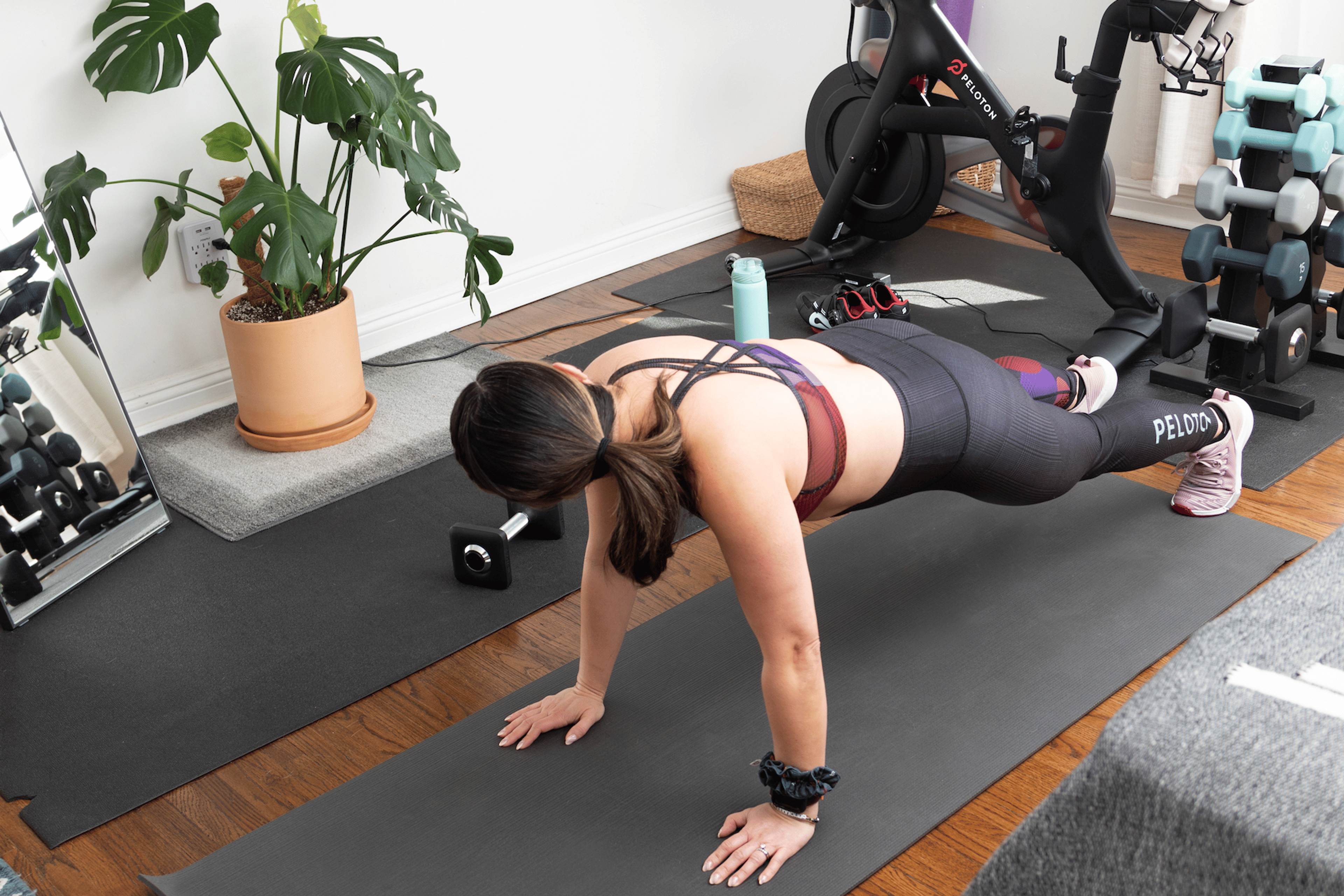
Start in a high plank position, hands under shoulders and feet shoulder-width distance apart. Spread your fingers, press into your fingertips for better grip. Engage your core by tucking your hips slightly, drawing the tops of your hip bones toward your bottom ribs. “This activates the abdominal muscles and prevents a hollow back,” Erik says.
Bend your arms to slowly lower your chest toward the mat, pointing your elbows out at a 45-degree angle from your body. Your whole body should move as one piece.
Pause when your chest grazes the mat, or as low as you can go while maintaining control. “Pull the shoulders away from the ears and also try to pull the shoulder blades down,” Erik says.
Exhale and press into your palms to push your body away from the floor, moving as one piece as your straighten your arms and return to the starting position.
Other Benefits of Push-Ups
Build Serious Strength
There’s a reason push-ups can feel so difficult. A 2011 controlled trial published in the Journal of Strength and Conditioning Research found that by doing a standard push-up, you’re pressing approximately 64 percent of your bodyweight. Meanwhile, knee push-ups involve pressing roughly 49 percent of your bodyweight. This offers a solid way to build strength in all the muscles listed above, even without weights or machines. The strength you build in push-ups can then carry over to other pushing exercises that target similar muscles, including the bench press, chest press, and overhead press.
Boost Functional Fitness
In addition to improving your pushing power in the gym, push-ups also boost your functional fitness, preparing your body to move well through activities performed in sports or daily life. For example, the strength you build with push-ups can make it easier to push open a door, carry your kids, and hoist something heavy overhead. Training functionally in your workout routine will help you move more efficiently and prevent injury when you have to tap into these muscles and movement patterns in everyday life.
Increase Mucular Endurance
Banging out push-up reps is a great way to increase your muscular endurance, or your muscles’ ability to work over a period of time. You’ll see this firsthand as you find that you’re slowly able to increase the number of push-ups you can do in a row. This increased muscular endurance comes in handy during upper-body intensive sports, such as boxing or rowing, and can even help you maintain a strong upper body position during long cycling rides. During daily life, better muscular endurance in your core and upper body also helps you maintain proper posture, so you can stand or sit tall for long periods.
Help Improve Important Health Markers
Push-ups are linked to benefits that may help you stay healthy longer in life. For example, 2019 research published in JAMA Network Open found that, in a 10-year longitudinal study of male firefighters 18 years and older, those who could crank out more than 40 push-ups had a significant reduction in cardiovascular disease and events associated with it, such as a heart attack. Those who performed 10 or fewer push-ups saw a higher incidence of cardiovascular disease and its related events. Resistance training (including bodyweight training such as push-ups) is linked with better bone health, as it increases bone density, which makes bones less prone to fracture.


Common Mistakes to Avoid When Doing Push-Ups
There are some common mistakes Erik sees when people do push-ups, and how to correct them.
Not Going Down Far Enough: Stopping halfway won’t work your muscles as effectively, meaning you’re doing a push-up without getting the full payoff. If you find you can’t lower very far with a traditional push-up, try elevated push-ups. “Try raising your hands with yoga blocks or books to achieve the full range of motion,” says Erik. You can also place your hands on a workout bench or plyometric box.
Sagging Hips: If your hips hit the floor before your chest, this is a sign you’re not activating your core. If your body resembles a hammock (back arched and belly or hips grazing the mat), return to plank, focus on engaging your core, and start from there. If you find you can’t maintain this position, practice planks on their own and modify push-ups by lowering your knees.
Lowering Too Quickly: “The magic ingredient in a push-up is the negative push-up, when you can lower yourself slowly,” says Erik. “Always try to go down to the mat with as much control as possible to increase the eccentric—the work or amount of resistance against gravity.”
Leading with Your Head: As you lower into the bottom of a push-up, make sure you don’t jut your neck forward to move your face closer to the floor. Instead, picture your head and spine as one straight line, ears in line with your shoulders, and chin slightly tucked. This all starts with a good starting position. “By keeping your hands directly under your shoulders, you’ll be able to be more aware of your power axis and help the rest of your body stay straight,” says Erik.
Elbows Flaring Out: Avoid letting your elbows push too far out to the sides. To do this, think about rotating them in slightly, so that they are pointing toward your hips. Keeping your hands pointed forward instead of out to the side will help keep your elbows in line too.

How to Get Better at Push-Ups
Push-ups may seem intimidating at first, but if you modify appropriately and take the time to focus on your form, the rest of the rep will follow.
1. Drill High Planks
One of the first things you can do to get better at a push-up is to work on your high plank. Aim to hold a plank for 30 seconds up to 1 minute to ensure that you have the core strength you need to do push-ups properly.
2. Modify As Needed—and Don’t Let Your Ego Get In the Way
“It’s important not to have false pride when learning how to do a push-up,” Erik says. “This means that if you know your form is off (i.e., you feel your back arching, have lower back pain, notice your elbows pointing out, or anything else), you should start with knee push-ups and work up from there.” You can also modify by placing your hands on an elevated surface, such as a workout bench, plyometric box, or even the wall; the higher the support, the easier it will be.
By dropping your knees or elevating your hands, you reduce the amount of weight you’re pressing; think of it like reaching for a 10-pound dumbbell first instead of going straight to 20. This will allow you to focus on the muscle groups you may be neglecting in your high plank, such as your core and triceps.
3. Do Push-Ups Consistently
“If you really want to focus on push-ups, use them in your training three times a week,” Erik says. He suggests doing five sets, doing anywhere from 5 to 12 reps per set, depending on your fitness level. After a few weeks, aim to increase the number of reps you’re doing. Stick with it, you just might surprise yourself with how many push-ups you can do.
Related Articles

Strength Train
15 Push-Up Variations to Master at Every Level of Your Fitness Journey

Strength Train
EMOM Workouts Can Add Variety and Challenge to Your Workouts. Here’s How to Try Them

Health
Why You Might Have Shoulder Pain During Push-Ups—and How to Address It

Strength Train
Yes, You Can Work Your Biceps with No Weights. Here's How
This content is for informational and educational purposes only and does not constitute individualized advice. It is not intended to replace professional medical evaluation, diagnosis, or treatment. Seek the advice of your physician for questions you may have regarding your health or a medical condition. If you are having a medical emergency, call your physician or 911 immediately.

Level up your inbox.
Subscribe for a weekly dose of fitness, plus the latest promos, launches, and events.
By providing your email address, you agree to receive marketing communications from Peloton.
For more about how we use your information, see our Privacy Policy.