Ivan Rodriguez Alba via Getty Images
Why Everyone Should Make Room for Garland Pose In Their Routine—Even Outside of a Yoga Class
Get grounded, improve posture, and increase mobility with this classic posture.
By Michelle Konstantinovsky•
What Is Garland Pose (Malasana) In Yoga?
The Benefits of Garland Pose
How to Do Garland Pose
Common Mistakes to Avoid
Tips to Keep in Mind for Garland Pose
Variations of Garland Pose
How You Can Use Garland Pose Outside of Yoga
The Takeaway
For most of us, chairs and couches are non-negotiable parts of our day. Many of us sit to get our work done, sit to drive, sit to eat, and sit to binge-watch our favorite shows. And while sitting is a necessary part of life, spending so many of our waking hours in this position can take a toll over time: prolonged sitting has been associated with certain health risks, including increased risk of heart diseases, diabetes, cancer, and negative mental health outcomes.
This doesn't mean you need to spend more time standing and walking (though that’s certainly not a bad idea); research suggests that other “active rest” postures require higher levels of muscle activity than chair sitting, and offer more health benefits. One particular active rest posture that yogis have loved for centuries is the squat, otherwise known as Garland Pose or Malasana in Sanskrit. And while this pose certainly has a place on your yoga mat, it may also be helpful to incorporate into other areas of your daily life and fitness routine.
Read on to learn more about Garland Pose, its specific benefits, and how to get the most out of your Malasana.
What Is Garland Pose (Malasana) In Yoga?
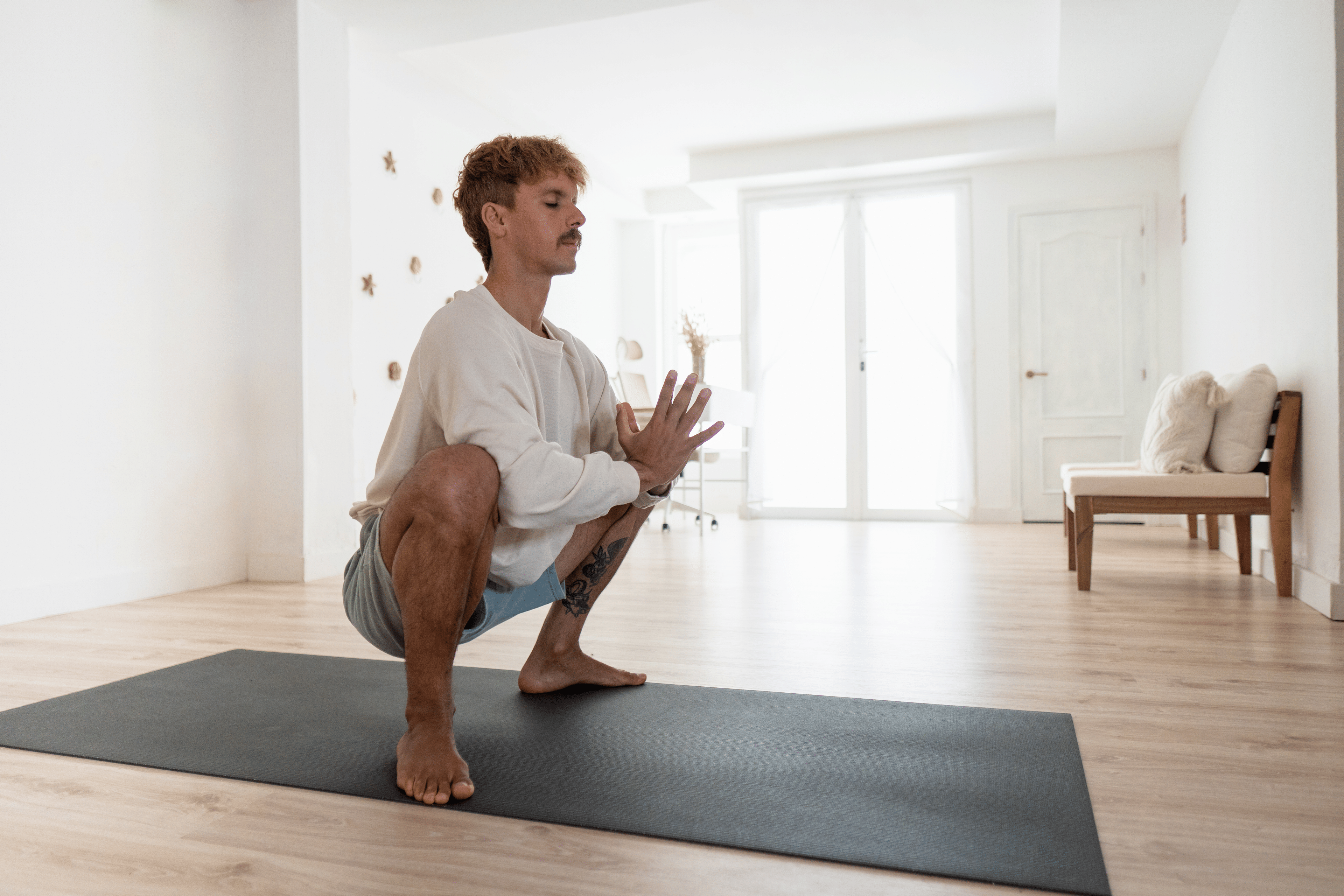
Garland Pose, or Malasana, is a deep squat pose that shows up often in various types of yoga classes, either on its own or as part of a flow or sequence. While squatting isn’t a typical everyday position in Western cultures, it’s a common pose in Asian cultures, and many people assume a deep squat to perform everyday tasks.
“Malasana is a deep squat and it’s a shape that humans have been doing for a really long time—especially before we had chairs and sofas and the ways in which we are often sitting today,” says Peloton Instructor Aditi Shah. “In Malasana, your feet are usually wider than your hips, your toes are turned out, and you’re just squatting your hips down towards the ground.”

Peloton App
Access thousands of classes with no equipment needed.
In the context of yoga, Garland Pose is thought to be calming, grounding, and help bring your attention back to your practice and the present moment. “I often use Malasana towards the beginning of a class or after a warm-up after Sun Salutations,” Aditi says. “I’ll do a little bit of dynamic moving into and out of a squat to start to open up through the hips, just standing and coming into a squat a few times. Sometimes I’ll hold it—especially when it’s a class with longer holds—because it’s a really healthy pose and can be very grounding and a place to sort of reset. But I often find I like to use it as a hip opener and a way to activate the body.”
Another place Malasana often shows up is as a precursor to Crow Pose. “In some variations of Crow, you’re actually taking your knees outside of the arms and squeezing inwards, and that is very much related to the way that you’re doing Malasana, because it’s literally the same shape: your arms are inside of your legs,” Aditi says.
Aditi also notes that while Garland Pose is typically performed in the aforementioned “yogi squat” version, there are other versions of Malasana that are a little bit different. In one traditional version of the pose (shown below), “you sit with your feet all the way together, knees wide, and you reach your whole torso and your arms through the legs,” Aditi says. “Then you potentially bind your arms by wrapping your arms around the legs and reaching behind your back.”

The Benefits of Garland Pose
Regularly incorporating Garland Pose into your yoga practice and/or everyday life can help address some of the issues many of us have from our modern lifestyle, including lost mobility and compromised movement patterns. “Even though it might not always feel comfortable and even though it might sometimes feel humbling, it's a really important pose that can benefit us in a lot of ways,” Aditi says. Here are a few of the specific physical and mental benefits.
Opens the Hips and Counteracts Chronic Sitting
By requiring the hips to move in flexion and external rotation, deep squats like Malasana help open the hips and can help reduce some of the tension from too much sitting. “Physiologically, it is a hip opener,” Aditi says. “You're going to feel the groin and the inner thighs opening. It’s really a wonderful way to counteract the hip tightness that you might get from sitting.”
Improves Lower Body Mobility
By stretching and increasing the range of motion in the ankles, knees, and hips, Garland Pose can help improve mobility in the lower body. “It’s really great for ankle mobility,” Aditi says. “It allows you to feel how you use your feet, it gives you space in your lower back. And the movement is going to translate to a lot of other things that you might do in life—even strength workouts.”
Engages the Core
Because the core has to work to stabilize the spine and keep the torso upright in Malasana, it gets a solid workout too. “You should be engaging your core in a Garland Pose to really create tension and find that uprightness to have a nice, open chest,” Aditi says.
Helps You Feel Grounded
Many yoga experts believe that by bringing you closer to the Earth and promoting stability, Garland Pose can instill a feeling of calmness and connection. “From a yoga perspective, I think energetically, it’s a posture that can feel really grounding,” Aditi says. “It’s a low pose, your feet are anchored down, and I think it can create a feeling of steadiness and stability.”

How to Do Garland Pose
While there are a few different variations of Garland Pose, here is how to perform the most common one that frequently pops up in yoga classes, including many of those on the Peloton App. There, you’ll also find Focus Flow classes dedicated specifically to practicing this pose.
1. Start Standing
Stand at the top of your mat in Tadasana (Mountain Pose) and widen your feet to be about the width of the mat. “Turn your toes out to about 45 degrees,” Aditi says. “But of course, you can adjust as you feel comfortable.”
Fold forward at the hips, reaching your hands toward the floor to come into Standing Forward Fold (Uttanasana). Relax your head toward the floor, bending your knees if needed.
2. Start to Squat
Slowly bend your knees and lower your hips toward the floor, lifting your chest lifted and keeping your spine long. Go as low as you can without feeling any pain. “Bring your hips down towards the ground and your hands to your heart,” Aditi says. “You’re working on keeping your spine long, so you’re really lifting up through the heart space and the crown of your head.”
3. Position Your Arms and Hands
Bring your upper arms to the inside of your knees or inner thighs and bring your palms together at your heart center in Anjali Mudra (prayer position), with your thumbs touching your chest. “Bring the palms to your heart and elbows to the inner knees,” Aditi says. “You want to gently press the elbows into the legs to sort of widen and open the chest. It’s not forcing, just a little bit of an effort.”
4. Engage and Lengthen
With your elbows pressing into your knees and your knees pressing into your elbows, broaden the chest and lengthen the spine upward from the tailbone to the crown of your head. “Once your hips are all the way down, you want to make sure you’re not collapsing into this pose and you really do have that intentionality and agency and tension in your body—you can also lift yourself up just an inch to feel that,” Aditi says.
5. Adjust As Needed (and Breathe!)
Keep your shoulders relaxed and your gaze soft as you hold the pose and adjust your position as needed for comfort and alignment. “It’s OK if the heels lift,” Aditi says. “Often when people’s heels lift, I invite them to try widening their stance or putting a blanket underneath the heel so they have something to press down upon, or just not go quite as low. Any of those options are totally fine.”
To come out of the pose, gently straighten your legs, allowing your torso to fold forward, reaching your hands toward the floor.
Common Mistakes to Avoid
While Garland Pose may seem fairly straightforward, there are some common Malasana mistakes that can compromise the integrity of the posture and even cause pain. Here are some of the most common mistakes to avoid in Garland Pose.
1. Putting Stress On the Knees
While the pose is inherently asking a lot of the knees, there shouldn’t be any pain around that part of the body—and if there is, there are some easy fixes. “The number one thing is protecting the knees,” Aditi says. “If you feel like you can't bend your knees all the way down into a low squat, then you shouldn’t. It’s absolutely not worth having knee tension or pain.” To keep your knees as safe as possible, keep your hips a bit higher and make sure your knees are tracking in the same direction as your toes.
2. Keeping Your Heels In the Air
It’s perfectly fine if your heels don’t touch the floor in Malasana. While some people find it easy to remain flat-footed in a deep squat, many people are simply limited in their mobility, potentially due to the shape, length, or angle of their femur heads in their hip sockets. While there’s no way to change your anatomy, you can make some adjustments to still reap the benefits of the pose. If your heels aren’t touching the ground, “instead of collapsing into the posture in any way, you can put a blanket underneath the heels or you can come up a little bit higher,” Aditi says.
3. Crouching Forward with a Rounded Back
In an effort to get as low as possible or place your elbows between your legs, you might find yourself hunching forward. “I often see the upper back getting tense and rounding a little bit,” Aditi says. “Relaxing the shoulders and just softening the face can be really helpful.”
Try a Malasana-Focused Class On the Peloton App


Tips to Keep in Mind for Garland Pose
Once you feel comfortable attempting Malasana, try to keep the following tips in mind to enhance the pose.
Press down evenly through your feet. Once your feet do have contact with something—whether it’s the floor, a towel, or a blanket—remember to plant firmly into all parts of each foot. “Really pressing down through the feet evenly—the inside, the outside, and the heel of the foot—is going to really help activate through the whole body,” Aditi says.
Envision your spine lengthening. Rather than allowing your upper body to sink in the direction of your hips, try to imagine a string pulling your head toward the sky, even as your lower body moves toward the ground. “Instead of just thinking about lowering the hips, think about having a tall posture, a really long spine, and an open heart,” Aditi says.
Be gentle with yourself. Remember that every body is different and that yoga is not about achieving a particular pose or proving anything. You can get something positive out of any version of the posture, even if you stay higher up in your squat or use props for more comfort. “There’s a difference between effort and forcing,” Aditi says. “Even as you’re using your elbows on the inner knees, be gentle with yourself.”
Don’t forget to breathe. Breathing is the foundation of yoga (and life!), so even if you’re struggling, keep your focus on inhaling and exhaling. “Don’t forget to breathe, especially because this posture can be uncomfortable for some people,” Aditi says. “Continuing to breathe evenly will be really, really helpful.”
Variations of Garland Pose
If you want to spice up a straightforward Garland Pose, try one of Aditi’s recommended variations for a slightly different experience.
1. Place a Rolled Up Blanket Beneath Your Heels
To get more depth in the pose, try placing a rolled up towel or blanket under your heels so you can still make contact with all parts of your foot. “This is really helpful for ankle mobility,” Aditi says. “Because if your heels don’t come to the floor, it gives you something to start to press your heels down into anyway, so you can start to develop that mobility.”
2. Sit On a Block
If maintaining the deep squat feels like too much on your lower body, you can place a yoga block under your seat to take some of the intensity out of the pose. “A block can be really helpful because if you have tight hips or ankles, it will help you get some of the benefits without a lot of strain,” Aditi says.
With that in mind, Aditi says she doesn’t always recommend this variation because relying on the block can take some of the muscular work out of the pose. “That doesn’t mean you’re not getting anything out of it,” she says, “but I think it’s important to pay attention to how you’re using your block.”
3. Add a Twist
Adding a twist to Garland Pose can add a sense of openness and just feel pretty fantastic. “One thing I love to do in Malasana are twists,” Aditi says. “The twist can feel really good and create space through the upper body and also help you to create stability in the lower body.”
Here’s how to perform Malasana with a twist: “When you’re already in the pose, take the left arm, snuggle the left elbow to the inner left knee, reach the arm out so your palm is on the floor, and then twist yourself open to the right,” Aditi says. “As you’re doing that, try to keep the shape from shifting too much. And then of course, you’ll do the opposite side.”
How You Can Use Garland Pose Outside of Yoga
In some parts of the world, squatting is just a way of life, and is used to perform a variety of everyday tasks and chores, like washing clothes, folding laundry, and even cooking. “Honestly, in India, it’s really funny because you will see people sitting in this posture while making Chapatis [Indian flatbread]—like, just cooking in this pose,” Aditi says. “So I don’t know if there are a lot of people doing that here in this country, but I think it is totally a potentially useful posture for daily life.”
However, for those wary of assuming Malasana in the kitchen, Aditi still suggests adding squats to other physical activities. “I think it’s a brilliant way to warm up for any kind of a movement practice—especially for a regular squat—because that’s also a place where people lack ankle mobility and lack hip mobility,” she says. “So if you think about this as a way to start to build those things while still keeping the torso upright, a lot of the same principles are going into your strength training.”
The Takeaway
Incorporating Garland Pose into your routine can help provide a potent antidote to the effects of chronic sitting—something most of us do every single day. The active rest posture doesn’t just improve hip and lower body mobility, but it engages the core, serves as an important transition in certain yoga flows, and can help you feel more grounded and stable in your practice and everyday life. While the pose may not always feel easy, practicing it with proper alignment and incorporating modifications and/or props can help you unlock benefits that translate off the mat.
“Even if it doesn’t always feel good, it’s practice, so it’s important to keep just showing up and remembering it’s not a punishment,” Aditi says. “You can just be curious about it, and being consistent is going to go so far.”
Related Articles

Strength Train
The Pistol Squat Is More Than Just a Fitness Flex. Here’s Why It’s Worth Your Time

Stretching + Mobility
Why You Should Care About Ankle Mobility—Plus 11 Exercises to Try

Yoga
12 Standing Yoga Poses to Build Stability and Strength

Stretching + Mobility
5 Game-Changing Benefits of a Workout Warm-Up, Plus the Best Moves to Include
This content is for informational and educational purposes only and does not constitute individualized advice. It is not intended to replace professional medical evaluation, diagnosis, or treatment. Seek the advice of your physician for questions you may have regarding your health or a medical condition. If you are having a medical emergency, call your physician or 911 immediately.

Level up your inbox.
Subscribe for a weekly dose of fitness, plus the latest promos, launches, and events.
By providing your email address, you agree to receive marketing communications from Peloton.
For more about how we use your information, see our Privacy Policy.