
South_agency via Getty Images
Why Bear Planks Can Feel Even Harder Than Regular Planks, and How to Do Them Right
By Renee Cherry•
What Are Bear Planks?
How to Do a Bear Plank
Muscles Worked By Bear Planks
Benefits of Bear Planks
5 Bear Plank Variations to Try
How to Add Bear Planks to Your Routine
The animal kingdom has inspired numerous exercise names, from the butterfly swim stroke to swan dive in Pilates. Among them, the bear plank exercise resembles the all-fours stance that its namesake spends most of its time in.
Just as bears may seem deceptively cute—you probably wouldn’t want to run into one on a hike—you might underestimate how challenging the bear plank is based on looks alone. It requires you to stay still, but you’ll engage muscles throughout your body to hold the position. As with other variations on the plank, seconds can feel like minutes.
Up for the challenge? Consider this your complete guide to the bear plank, including its benefits and variations, form tips, and how to add the move to your workout routine.
What Are Bear Planks?
The bear plank exercise is a variation on the standard plank exercise. The classic plank is a static hold where you’re balancing with your hands (or forearms) and toes planted on the floor, and the rest of your body suspended off the floor in a straight line, like a stiff plank of wood.
What sets a bear plank apart from a regular plank is that your knees remain bent instead of straight, hovering a few inches off the ground. This slight adjustment ups the ante, according to Milicia McDowell, doctor of physical therapy, exercise physiologist, and assistant vice president at US Physical Therapy. “Bear planks are an advanced plank variation that demands more endurance from your core, quads, and shoulders,” she explains.

How to Do a Bear Plank
Once you’re ready to give the exercise a try, here’s how to execute a bear plank, according to Peloton instructor Emma Lovewell.
1. Set Up Your Stance
Start on all fours with your hands directly under your shoulders and your knees under your hips. Keep your fingers spread wide for better ground contact. Keeping your feet hip-width apart, tuck your toes under.
Ensure your spine stays in a neutral position—don’t let your lower back arch or round excessively. Imagine creating a straight line from your head to your tailbone.
2. Liftoff
From the all-fours position, engage your core, exhale, and slowly lift your knees off the floor, bringing them about 1–2 inches above the ground. (The goal is to keep your knees bent, not to fully extend your legs like a high plank.)
Focus on creating tension across your entire body, drawing your shoulder blades back and down, away from your ears, and pushing the floor away from you. Keep your hips stable and level with your shoulders.
3. Hold This Position
Hold this position, keeping your neck neutral, with your gaze directed at the floor just slightly in front of your hands. Avoid craning your neck up or dropping your head. Actively engage your abs by gently pulling your belly button toward your spine without arching or rounding your back.
Continue to breathe deeply. Hold for 10–30 seconds, then lower your knees to the floor with control.
Try a Core Strength Class on the Peloton App


Muscles Worked By Bear Planks
The bear plank works muscles in your core, which includes your abs, obliques (located on the sides of your abdomen), muscles in your lower back, and pelvic floor (at the base of your pelvis), McDowell says. The exercise also hits your quads (the front of your thighs), plus your rhomboids and trapezius (in your upper back), your serratus anterior (on the side of the ribcage), and your deltoids (shoulders), which are all shoulder stabilizers, she says.
The potential benefits of strengthening these muscle groups aren’t just about aesthetics. For example, improving activation of your deep core muscles helps maintain spinal alignment and reduce excessive movement of your vertebrae, which is key in both everyday movement and athletic performance. A strong, stable core helps you safely (and powerfully) swing a tennis racket, lift heavy objects off the floor, and run with an efficient stride, for instance.
Benefits of Bear Planks
Through the bear plank, you can achieve similar benefits to a standard plank, only amplified, according to McDowell. The benefits of planking, in general, include improved muscular strength and endurance (throughout your body but especially in your core), reduced back pain, and improved stability, according to a 2023 study.
During a bear plank, by elevating your knees just slightly off the ground, “you take away the support of the lower body, asking your core to support more weight and your shoulders to more actively engage,” McDowell says. “The bear plank also asks more from your spine stabilizer muscles.”
Bear planks are “a great way to activate and even repair your deep core muscles,” Emma adds. One 2024 study found that the bear crawl exercise (a dynamic version of the bear plank) was better at building the transverse abdominis muscles (the deepest core muscle) compared to dead bugs and toe taps, for example.
Another 2024 study compared muscle activation in bear planks, bear crawls, and other quadrupedal movement training exercises (QMT, moves where your hands and feet are on the ground) with more traditional bodyweight exercises (specifically push-ups, squats, and standard forearm planks). The authors found that overall, QMT exercises had equal or greater core muscle activation compared to the traditional bodyweight exercises.
5 Bear Plank Variations to Try
You aren’t limited to the basic version of the bear plank. The bear plank is the base of various dynamic exercises, and it can also be scaled down if the standard version isn’t within reach. Here are some examples of exercise variations that incorporate the bear plank.
Bear Plank with Shoulder Taps
When you remove your hand from the ground during a bear plank, you’ll have to work harder to maintain proper alignment. “This variation is more advanced than the standard bear plank, as it requires additional core and shoulder stability to prevent your torso from swaying,” Emma says. A 2023 study of plank variations found that lifting a hand and/or foot off the ground led to higher activation in shoulder and scapular muscles.
Start in a standard bear plank position.
Lift your right hand off the ground to tap your left shoulder, without allowing your torso or hips to sway.
Return your right hand to the ground, then lift your left hand to tap your right shoulder. Continue alternating.
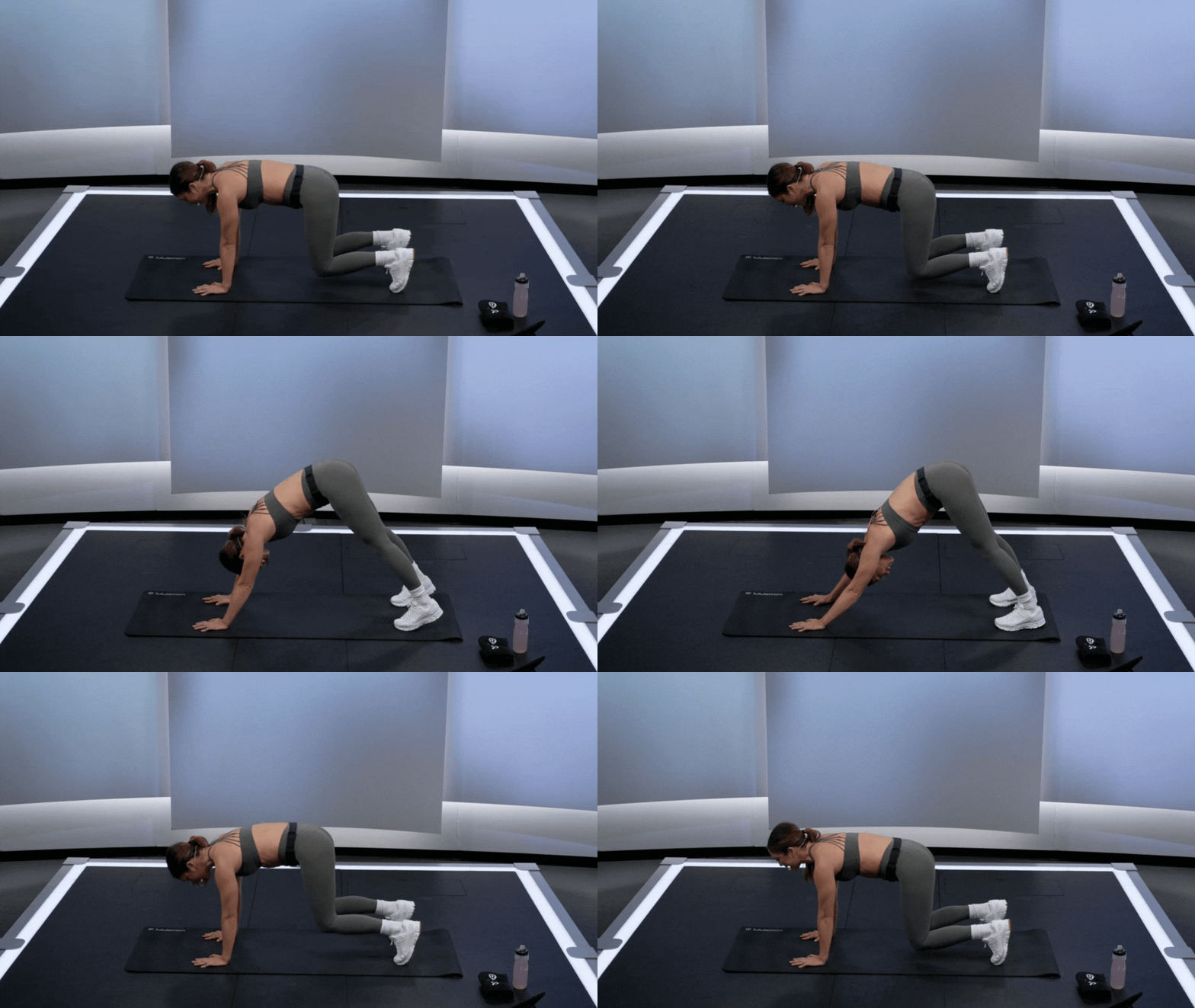
Bear Plank to Downward-Facing Dog
This take on the bear plank (shown above) provides a stretch for muscles in your back and the backs of your legs, according to Emma. “This is a slightly more advanced variation than the standard bear plank as it requires coordination, control, and flexibility,” she says. “However, in some ways, it’s a little bit easier because your core gets to recover while in Downward-Facing Dog.”
Start in a standard bear plank position.
Lift your hips up and backward while straightening your knees and pressing your chest toward your thighs, forming an upside down “V” shape with your body.
Lower your hips, allowing your knees to bend to return to a bear plank.
Repeat for your desired number of reps.
Rocking Bear Plank
Another way to make the bear plank more advanced is to add a rocking motion, according to Dr. McDowell. “This variation can help boost your wrist mobility and shoulder endurance,” she says. Try to rock back and forth for 10 to 30 seconds before resting, she suggests.
Start in a standard bear plank position.
Keeping your hands and feet planted, push into your toes to shift your body forward.
Press into your palms to rock backward into the starting position.
Continue rocking forward and backward for 10–30 seconds.
Bear Plank with Kickstand
If a bear plank is too demanding on your spine, shoulder, or wrists, you can modify the move by working one side at a time to build up to the standard exercise, McDowell says. She recommends holding this version of the bear plank for five to 10 seconds, increasing from there until you’ve developed sufficient strength to hold a standard bear plank without sacrificing your form.
Start in an all-fours position with your toes tucked.
Keeping your left knee on the floor, draw your belly button toward your spine, exhale, and slowly lift your right knee off the ground so it hovers about 1-2 inches above the floor.
Hold this position for 5–10 seconds, then lower your right knee back to the ground.
Repeat on the opposite side.
Bear Plank with Outer Thigh Taps
As with the bear plank with shoulder taps, this exercise reduces your points of contact with the floor to three, making it harder to stay stable, McDowell notes.
Start in a standard bear plank position.
Keeping the rest of your body still, reach your right hand back to tap your right outer thigh. Lower your right hand to the floor to return to a bear plank.
Reach your left hand back to tap your left outer thigh, then return your left hand to the floor. Continue alternating.

Peloton App
Access thousands of classes with no equipment needed.
How to Add Bear Planks to Your Routine
Emma favors using this plank variation towards the start of a workout session as a muscle activation. (She’s not the only one—you’ll see the bear plank in many strength warm up classes on the Peloton App.) “I like to program bear planks in the beginning of a class, in a warm up to fire up my core and legs,” she says. “I recommend holding it for 30 seconds at a time, and three rounds. As you get stronger you can increase the duration.”
Whether you’re looking to strengthen your core, improve your functional strength, or just add variety to your workouts, the bear plank can deliver. Add it to your regular routine and you may feel stronger and more stable in workouts and daily life.
Looking for some guidance to shape your core training? Try any of the core strength classes or Emma’s Crush Your Core programs on the Peloton App.


This content is for informational and educational purposes only and does not constitute individualized advice. It is not intended to replace professional medical evaluation, diagnosis, or treatment. Seek the advice of your physician for questions you may have regarding your health or a medical condition. If you are having a medical emergency, call your physician or 911 immediately.
Featured Peloton Instructor

Emma Lovewell
Emma has spent much of her career in fitness and wellness as a professional dancer, dance coach, fitness model, personal trainer, and Pilates instructor.
Level up your inbox.
Subscribe for a weekly dose of fitness, plus the latest promos, launches, and events.
By providing your email address, you agree to receive marketing communications from Peloton.
For more about how we use your information, see our Privacy Policy.