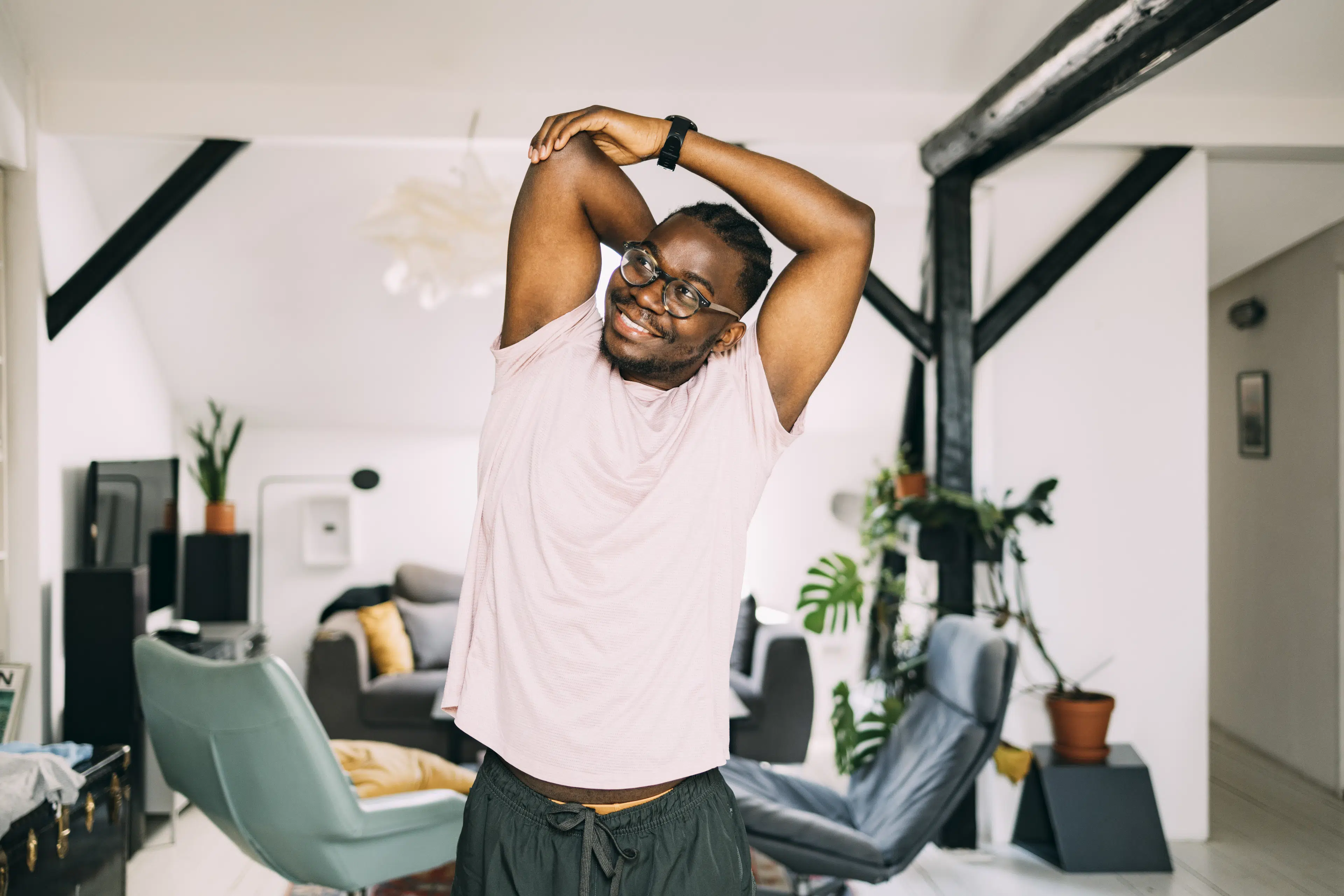
FreshSplash via Getty Images
10 Standing Stretches You Can Do Anywhere, Anytime
Stay limber while traveling, working, or sweating outside—no mat necessary.
By Michele Ross•
The Benefits of Standing Stretches
1. Standing Hamstring Stretch
2. Standing Quad Stretch
3. Standing Hip Flexor & Quad Lift Stretch
4. Standing Calf & Hip Flexor Stretch
5. Standing Shoulder Stretch
6. Standing Side Bend Stretch
7. Standing Figure 4 Stretch
8. Cross-Legged Side Stretch
9. Standing Spinal Twist
10. Lateral Lunge Stretch
Tips to Get the Most Out of Standing Stretches
The Takeaway
Modern life doesn’t exactly set us up for fluid movement—but standing stretches can help you get it back. While you might think that your best bet to get loose and limber is by sprawling out and stretching on the floor, the truth is that stretching while standing offers a range of underrated perks.
Keep reading to see why standing stretches are an unsung hero for post-workout cooldowns, recovery days, and for overall wellbeing. Plus: the best standing stretches that’ll lengthen and loosen your body from top to toe, with recommendations from Peloton instructor Erik Jäger.
The Benefits of Standing Stretches
For starters, you can do standing stretches anywhere, no mat required. This accessibility is a game-changer whether you’re cooling down after an outdoor run, stretching mid-travel, or shaking off tension at your desk. But that’s far from the only benefit of standing stretches versus those that are done while seated or reclined.
“Stretching while standing naturally engages the core and balancing muscles, which helps reinforce good posture and body alignment,” says Raquelle Felder, doctor of physical therapy and owner of San Diego Mobile Rehab. “Plus, some muscles are better stretched while standing to fully elongate the muscle and achieve optimal lengthening.” We also do many daily movements while standing—like walking, reaching, and lifting—so standing stretches help achieve mobility in ranges we actually use, Felder says.
Stretching should be non-negotiable in your greater movement routine, no matter if you prefer to run, ride, strength train, or do anything in between. Stretching improves mobility and flexibility, can help alleviate muscle imbalances, and can mitigate injury risk. Not to mention, stretching simply feels good—full stop.
Ready to get on your feet and give your body the relief it craves? Here are 10 standing stretches worth giving a go.

1. Standing Hamstring Stretch
If you get good use out of your Peloton Bike, Tread, Row, or dumbbells, chances are you grapple with tight hamstrings. To mitigate soreness and injury, it’s important to give them a dedicated stretch in your routine.
Stand with one leg slightly bent and the other extended straight in front, heel resting on the floor, toes pointing upward.
Keep your back straight and hinge forward from the hips as far as comfortable. You should feel the stretch in the back of your front leg.
Inhale to lengthen your upper body, exhale to gently deepen into the stretch.
Release and repeat on the opposite side.
While it’s tempting to yearn for your toes, you don’t need to make contact if they’re currently out of reach. “Just focus on maintaining a long spine for a deeper, safer stretch in the hamstrings,” says Erik.

2. Standing Quad Stretch
The quads aren’t just the most powerful muscle group in the legs; they’re also especially important to stretch for runners and cyclists due to overuse. Quad stretches will help to loosen tightness, enhance mobility, reduce the risk of overuse injuries, and keep your strides and pedals in good shape.
Shift your weight into one foot and kick the other foot up behind you, bending at the knee so you can grasp your ankle or foot.
Pull your heel toward your glutes while keeping both knees aligned. Push your hips gently forward to stretch the front of the thigh.
Release and repeat on the opposite side.
Not feeling it? “Slightly engage the glutes—which are the antagonists of the quads—to increase the stretch,” Erik shares.

3. Standing Hip Flexor & Quad Lift Stretch
This standing hip flexor stretch is a progression of the quad stretch Erik recommended above. (Also, who doesn’t love a two-in-one combo or a juicy hip opening stretch?)
Shift your weight into one foot and kick the other foot up behind you, bending at the knee so you can grasp your ankle or foot.
Lift your bent knee higher behind you while leaning your upper body slightly forward. Maintain your balance and keep your hips square.
Release and repeat on the opposite side.
“This position deepens the stretch through both the quads and hip flexors,” Erik says. For maximum effectiveness, he advises keeping your hips square and your back straight—don’t round or arch.

4. Standing Calf & Hip Flexor Stretch
Runners will especially love this calf stretch (with an optional hip flexor stretch), as these muscles need extra TLC to power your strides. Calf stretches can help boost strength, improve running form, enhance mobility and flexibility, and reduce the risk of injury.
Step one foot backward to come into a split stance, keeping the front knee slightly bent and the back leg straight, toes pointing forward.
Press the back heel firmly toward the floor to stretch the calf. For an added hip flexor stretch, gently reach the arm on the same side as the front leg overhead (as shown) or your rotate your torso toward the front leg.
Release and repeat on the opposite side.
While this standing stretch seems simple enough, it’s important to nail down the foundations. “Keep your hips square and your core engaged for balance,” says Erik.


5. Standing Shoulder Stretch
This shoulder stretch is ideal for people who work desk jobs, tend to slouch, or need a quick burst of energy. “This move provides a deep stretch for your chest and shoulders, which counteracts slouching postures and decreases muscle tightness and muscle imbalances," Felder says.
Stand tall with your feet shoulder-width distance apart. Place your arms behind your back and interlace your fingers.
Gently lift your knuckles away from your hips to open your chest.
If you’re unable to clasp your hands behind your back, simply grab a hand towel, hold it behind you with both hands, and proceed with the stretch from there. Want to advance? Felder suggests hinging forward at the hips while keeping your legs straight and allowing gravity to pull your arms further away from your body. No matter which route you take, she warns against arching your lower back.

6. Standing Side Bend Stretch
According to Felder, this stretch—which also stretches your lats and obliques—is great for anyone who sits for long periods of time. “It elongates your spine and stretches parts of your body that aren’t stretched in daily life,” she says. “It also helps with spinal alignment and posture.” Felder adds that it’s safe for people with pain along the spinal muscles, as well as those with a history of scoliosis.
Stand tall with your feet together and palms together in front of your chest.
Stretch your arms overhead, then lean to one side to open your side body. Engage your core to support your spine. Hold for 15 to 20 seconds.
Release and repeat on the opposite side.
“If you have issues with balance when you keep your feet together, you can modify the stretch by placing your feet shoulder-width apart to widen your base of support,” says Felder. To turn this static stretch into a dynamic one, she suggests slowly alternating from one side to the next with fluidity. Inhale as you lengthen, and exhale as you go deeper into the stretch.

7. Standing Figure 4 Stretch
This standing figure 4 stretch targets your hips and glutes. More specifically, it’s fantastic for stretching your piriformis muscle—a flat, pear-shaped muscle situated deep in the glutes—which can tense up with sitting for long periods of time. Keeping the piriformis loose is key to preventing sciatica, because “increased muscle tightness could cause sciatic nerve pain,” Felder notes. It’s also a solid choice for folks who lack hip mobility, she continues.
Stand tall. Cross one ankle over the opposite knee so that your shin forms the shape of a “4.”
Sink your hips back and down—as though you’re sitting in a chair—while keeping your chest lifted and your back as straight as possible.
Release and repeat on the opposite side.
If you struggle with balance during this standing piriformis stretch, Felder suggests reaching for a wall or sturdy furniture for support. To feel it even deeper, “lean forward slightly to intensify the stretch in the glutes and outer thigh,” Erik says.

8. Cross-Legged Side Stretch
Again, daily life doesn’t always present opportunities to stretch the sides of your body—including the IT bands, which are bands of connective tissue that run along the sides of your legs from hip to shin. It’s important to note that IT band stretches don’t stretch the band itself, but the muscle groups that it attaches to (namely, the glutes and tensor fascia latae). Recommended by Erik, this standing stretch benefits not only your IT bands but also your lats.
Cross your left foot behind your right, keeping your feet close together.
Reach your left arm overhead, leaning your upper body up and over to the right. Keep your core engaged, hips slightly tucked.
Release and repeat on the opposite side.
To advance, interlace your hands behind your head and rotate your upper body forward slightly. “This can stretch the lats, IT band, and even the quadratus lumborum [a deep core muscle that supports spinal stability],” says Erik.
9. Standing Spinal Twist
This standing spinal twist is great for improving posture. “It provides spine mobility, especially in the thoracic [middle] spine, which is a movement we rarely do throughout the day,” says Felder. Mobility in the thoracic spine helps decrease tightness in the cervical and lumbar spinal regions, she continues.
Stand tall. Place your left hand on your hip and the right hand across your chest.
Keep your hips square as you gently rotate.
Release and repeat on the opposite side.
Want to deepen the stretch? Felder suggests placing your left hip against a wall, keeping your right arm out like an airplane, and rotating until the right arm hits the wall (or as far as you can) before repeating on the opposite side.

10. Lateral Lunge Stretch
Suggested by Erik, this standing stretch targets your adductors (inner thighs).
Step one foot out wide to the side, keeping the other leg straight.
Bend into the stepping leg, pushing the hips back while keeping the straight leg’s foot flat on the floor. Be sure to keep your torso upright or slightly leaning forward over the bent leg. Avoid letting the heel lift off the ground.
Release and repeat on the opposite side.
As with all standing stretches, be sure to maintain a strong stance throughout. “Avoid twisting or altering your foot position during the stretch. This helps you stay stable and target the muscle more effectively,” says Erik.

Peloton App
Access thousands of classes with no equipment needed.
Tips to Get the Most Out of Standing Stretches
To get the most out of every second you spend stretching, Erik also offers a few tips:
Hold it. Stay in each stretch for at least 45 seconds, which will give your muscles time to release and lengthen.
Save static stretching for post-workout. Steer clear of static stretching (long, unmoving holds) before strength training to avoid reducing power output. “Instead, use these stretches as part of a recovery session or after your workout to improve flexibility and release tension,” he shares.
Consider the rest of your routine. If you’re feeling overly tight in one area, your workout routine may be to blame—and stretching isn’t a magic fix. “If you train main muscles and their antagonists [opposites] equally, maintain proper posture, and perform exercises with correct form, you’ll generally need less stretching because your muscles will already be actively supporting your mobility,” Erik says. Make sure you’re training all your muscle groups in order to maintain balance. When in doubt, consult a health professional such as a physical therapist to adjust your routine as needed to address any tightness or pain.
Don’t speed through. “Move mindfully between exercises—avoid rushing from one to the next,” he says. Be mindful of your form, practice consistently, and use your breath to move through your stretching sessions safely and with ease.
Make your stretching routine a regular ritual. “Treat stretching as a focused, intentional practice—not just a quick add-on,” he says.
The Takeaway
Standing stretches are an accessible way to improve flexibility and mobility, reduce tightness, and simply feel better in your body. While they’re wonderful to integrate into your workout routine, they also come in handy to give your body the release it craves throughout busy (and even sedentary) days.
Per Felder, the more intermittent stretching you do, the better the outcomes will be. “Stretching throughout the day helps you stay flexible; any increase in flexibility or range of motion [tends to] last less than two hours post-stretching,” she shares. (In other words, short “stretching snacks” will move the needle a lot more than you think.)
That said, when you can, a long, dedicated stretching session—including those offered on the Peloton App—are bound to offer targeted relief and recovery.
Related Articles

Stretching + Mobility
4 Ways Stretching Before Bed Can Boost Your Sleep

Stretching + Mobility
What's the Difference Between Static and Dynamic Stretching—And When Should You Do Each?

Stretching + Mobility
These Are The Two Key Times Everyone Should Be Stretching

Yoga
Nope, Yoga Isn’t the Same as Stretching — Here’s How the Two Workouts Stack Up
This content is for informational and educational purposes only and does not constitute individualized advice. It is not intended to replace professional medical evaluation, diagnosis, or treatment. Seek the advice of your physician for questions you may have regarding your health or a medical condition. If you are having a medical emergency, call your physician or 911 immediately.

Level up your inbox.
Subscribe for a weekly dose of fitness, plus the latest promos, launches, and events.
By providing your email address, you agree to receive marketing communications from Peloton.
For more about how we use your information, see our Privacy Policy.