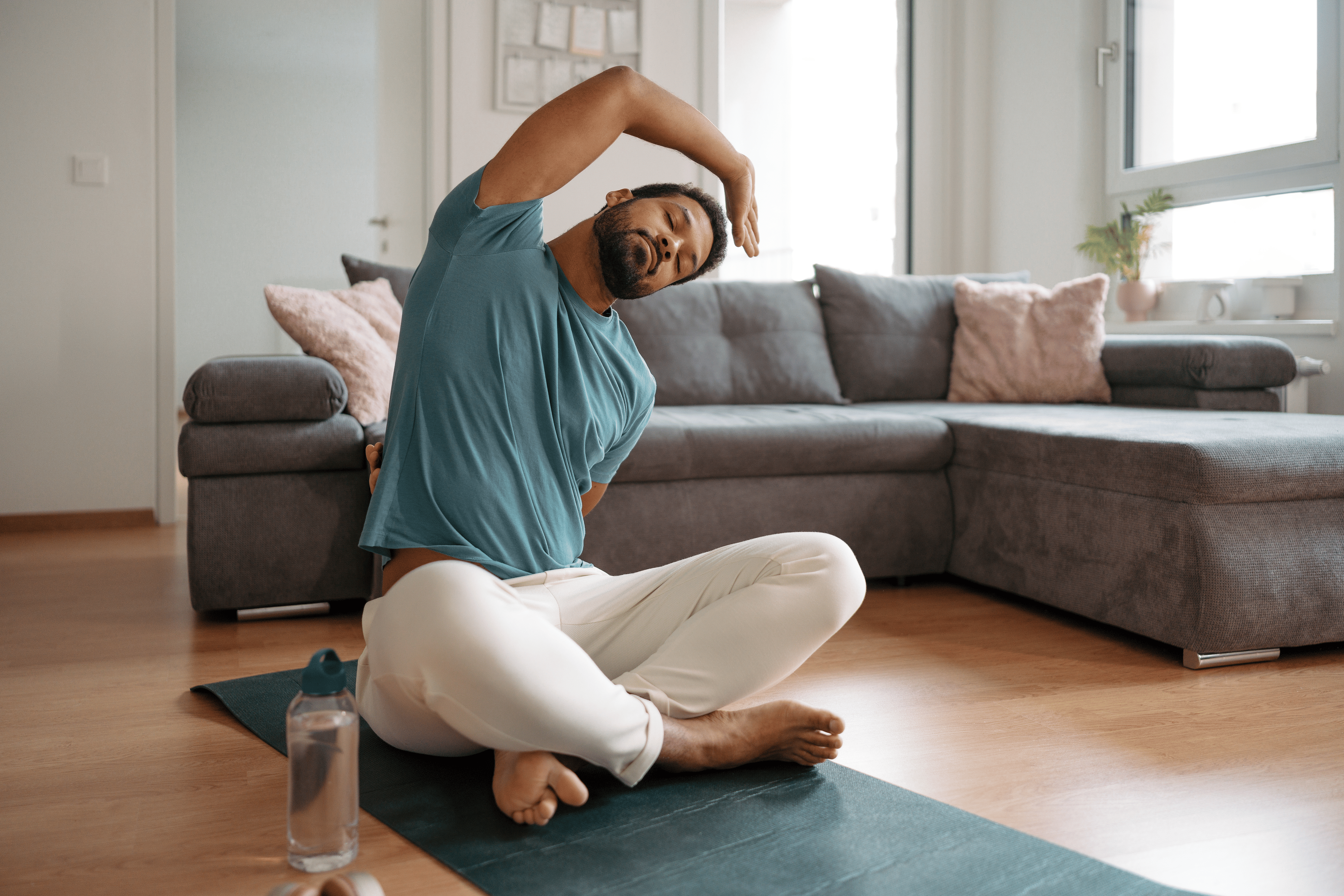
Halfpoint Images via Getty Images
Cranky QL? These 9 Stretches and Exercises Can Help Release (and Reinforce) Your Lower Back
The QL is a small but crucial stabilizer muscle that can play a role in lower back pain—and giving it a little TLC can go a long way.
By Alyssa Sparacino•
What Is the Quadratus Lumborum (QL) Muscle?
Why Your QL Is So Tight
9 QL Stretches and Exercises to Try
How to Prevent QL Tightness
No, “quadratus lumborum” isn’t a spell you heard cast in a wizard movie. This small but mighty muscle buried deep in your lower back is an important stabilizer that helps support your spine.
Athletes and exercisers of all kinds can often find that a stiff QL is partially behind the achey lower back they just can’t shake. As with other tight muscles, a mix of overload and surrounding weaknesses can be part of why the QL acts up.
That said, a multifactored approach of stretching, mobility, and strength training will get you feeling more fluid now and prevent more QL tightness in the future. Here’s your lower-back tune up protocol.
What Is the Quadratus Lumborum (QL) Muscle?
You may not be as familiar with the quadratus lumborum as, say, your biceps or glute muscles, but it’s a tongue-twister worth knowing. “The quadratus lumborum is a key muscle for maintaining spinal and pelvic stability,” says Peloton instructor Erik Jäger.
The QL muscle runs vertically on both sides of the spine, stretching between the bottom of the rib cage and the top of the pelvis. It helps you side bend and assists in extending the vertebrae in the lower back, Erik says.
All in all, this is a stabilizer muscle—your core and pelvis need the QL in order to stay put. “The quadratus lumborum’s unique combination of functions makes it essential for both posture and dynamic movement,” Erik says.

Peloton App
Access thousands of classes with no equipment needed.
Why Your QL Is So Tight
A “tight” QL can be the source of lower back pain for lots of folks. “Like other muscles of the lumbar spine, it can become hypertonic or stiff in response to overloading, fatigue, or strain,” explains Kevin Carr, certified functional strength coach, licensed massage therapist, and co-founder of Movement As Medicine. “When this happens, the QL may limit spinal mobility, contribute to asymmetrical movement patterns, and place additional stress on surrounding tissues.”
There’s no one single thing to blame for QL tightness, but there are some common culprits that are worth looking closely at if you’re dealing with it yourself, according to Erik.
Poor posture and prolonged sitting. These “can alter pelvic alignment and place extra strain on the muscle,” says Erik.
Weak surrounding muscles. Without a strong core and glutes, the QL muscle will often compensate to stabilize the pelvis and trunk.
Repetitive movements. “Frequent side bending, twisting, or lifting, whether in daily life or during training, is another common factor,” Erik says.
Improper exercise form. This is especially true for lifters or runners, he says.
Structural imbalances. Anatomical factors, including a discrepancy in leg length can overwork your QL and cause discomfort.
9 QL Stretches and Exercises to Try
Both Erik and Carr emphasize that static stretching is just one element required to truly manage QL tightness. You also need to incorporate mobility drills and strength exercises that focus on the surrounding muscles’ ability to handle load.
That said, here are a variety of stretches and exercises from the experts to help you achieve both relief from acute QL tightness and a stronger core to help prevent lower-back pain in the future. (If you’re experiencing severe or persistent pain, consult a physical therapist or other healthcare professional for a personalized diagnosis and treatment plan.)

Side Bend
This quadratus lumborum stretch can provide targeted relief for a tight QL.
Start standing with your feet staggered, hip-width distance apart, right foot in front of your left.
With your right hand down by your side and your left hand extended overhead, slowly bend your torso to the right. (You can also do this with your left hand behind your head or a light weight in the right hand for an extra stretch.)
Pause when you feel the stretch, holding for a few seconds, then returning to the starting position.
Repeat on the opposite side.

Standing Forward Fold
Be sure to breathe into all four corners of your ribcage at the bottom of this QL stretch.
Stand tall with feet hip-width apart.
Slowly hinge forward at the hips, reaching toward your toes while keeping knees as straight as comfortable.
Allow your head, back and arms to relax toward the floor.
Slowly curl spine back up to standing.

Quadratus Lumborum Foam Rolling
Foam rolling is another excellent way to restore movement and fluidity in tight muscles. Get the blood flowing with this move.
Begin in a side-lying position on your elbow for support.
Position a foam roller between your rib cage and pelvis, just behind the side of your torso.
Gently rock forward and back or side to side, breathing deeply to release tension for up to 2 minutes per side.

Lumbar Foam Rolling
Release the lower back even further with this foam rolling exercise.
Lie on your back with knees bent and feet flat. Placing a foam roller horizontally under your lower back just above the sacrum.
Shift slightly to one side so pressure is along the muscles next to the spine (not on the spine itself).
Slowly roll from the sacrum up toward the lower thoracic spine (mid-back).
Repeat on the opposite side. Aim for 2 minutes on each side.

Egg Roll
Think of this exercise like a massage for your spine.
Lie on your back, hugging both knees tightly to your chest. Gently tuck your chin toward your chest, rounding your spine into a small “egg” shape.
Slowly rock forward and back, massaging your spine.

Child’s Pose with Side Reach
Upgrade your typical Child’s Pose with a small tweak that makes a big difference in your lower back.
Begin on all fours with hands under shoulders, but knees wide and feet narrow. Knees can be near the sides of your mat and toes touching.
Press your hips back so that your hips rest on your heels.
Your stomach should be between your knees and arms stretched out long in front of you with your forehead resting on the floor.
Walk your hands to one side of the mat, still stretched long. You should feel a stretch on the opposite side.
Hold for several long breaths before switching to the opposite side.

Cat Cow
Breathe slowly as you move through this classic spinal mobility exercise.
Begin on hands and knees with your wrists under shoulders and knees under hips.
Slowly round your spine upward into cat, tucking your chin and pelvis.
Reverse the motion by arching your back and lifting your chest and tailbone into cow.

Plank to Side Plank
“A strong core also plays a key role in keeping the QL in a balanced, neutral state,” says Erik. Try this move in a forearm plank or high plank, as shown.
Begin on all fours, with your hands beneath your shoulders, palms pressing into the floor, and knees under your hips.
Tuck your toes, step your feet back, and lift your knees to come into a high plank position. Your body should form a straight line from head to heels. Squeeze your glutes and slightly tuck your pelvis. Keep your neck straight and gaze on the floor. Hold here for one second.
Then, without dropping your knees, pivot into a side plank with your left hand on the ground, rotating onto the sides of your feet and stacking your hips. Hold here for one second.
Then, return through the center without dropping your knees, and pivot into a side plank on the opposite side.

Deadlift
Strengthening the hips and glutes will help ensure your QL isn’t overcompensating for surrounding weaknesses.
Stand with feet hip-width apart and a kettlebell or heavy dumbbell vertically between your feet.
Push your hips back, keeping your spine neutral, bending your knees slightly to grip the kettlebell handle or head of the dumbbell with both hands.
Exhale and drive through your heels to stand tall, straightening your legs.
Reverse the movement to lower the weight to the floor with control.
Try a Stretching or Mobility Class on the Peloton App


How to Prevent QL Tightness
Remember that stretching is one important step to reduce QL tightness, but taking a holistic approach will serve you well in the long run, says Carr.
“While mobility of the QL is helpful, persistent stiffness is often less about the muscle being ‘tight’ and more about it being overworked due to underlying weaknesses,” he says. “Incorporating mobility drills while also addressing those factors through strength and stability training is typically far more effective than stretching alone.”
Focus on “strengthening the QL and surrounding core muscles so they can better tolerate frequent loading, which helps reduce the likelihood of strain or irritation,” says Carr.
Finally, bring practices such as yoga or meditation into your workout routines, suggests Erik. These modalities can be very beneficial, as deep, controlled breathing has a direct impact on QL tension.
You can find all of the above—guided yoga, stretching, foam rolling, breathwork, and core and glute strengthening workouts—on the Peloton App. If you regularly sit for prolonged periods as part of your job, consider checking out the Desk Worker Strength & Mobility Collection created in partnership with the Hospital for Special Surgery (HSS), which can help prevent common aches and pains that result from spending many hours at a desk.
Just remember: If you’re dealing with intense or chronic pain, it’s best to consult a healthcare professional such as a physical therapist for a diagnosis and treatment plan that’s personal to you.


This content is for informational and educational purposes only and does not constitute individualized advice. It is not intended to replace professional medical evaluation, diagnosis, or treatment. Seek the advice of your physician for questions you may have regarding your health or a medical condition. If you are having a medical emergency, call your physician or 911 immediately.

Level up your inbox.
Subscribe for a weekly dose of fitness, plus the latest promos, launches, and events.
By providing your email address, you agree to receive marketing communications from Peloton.
For more about how we use your information, see our Privacy Policy.