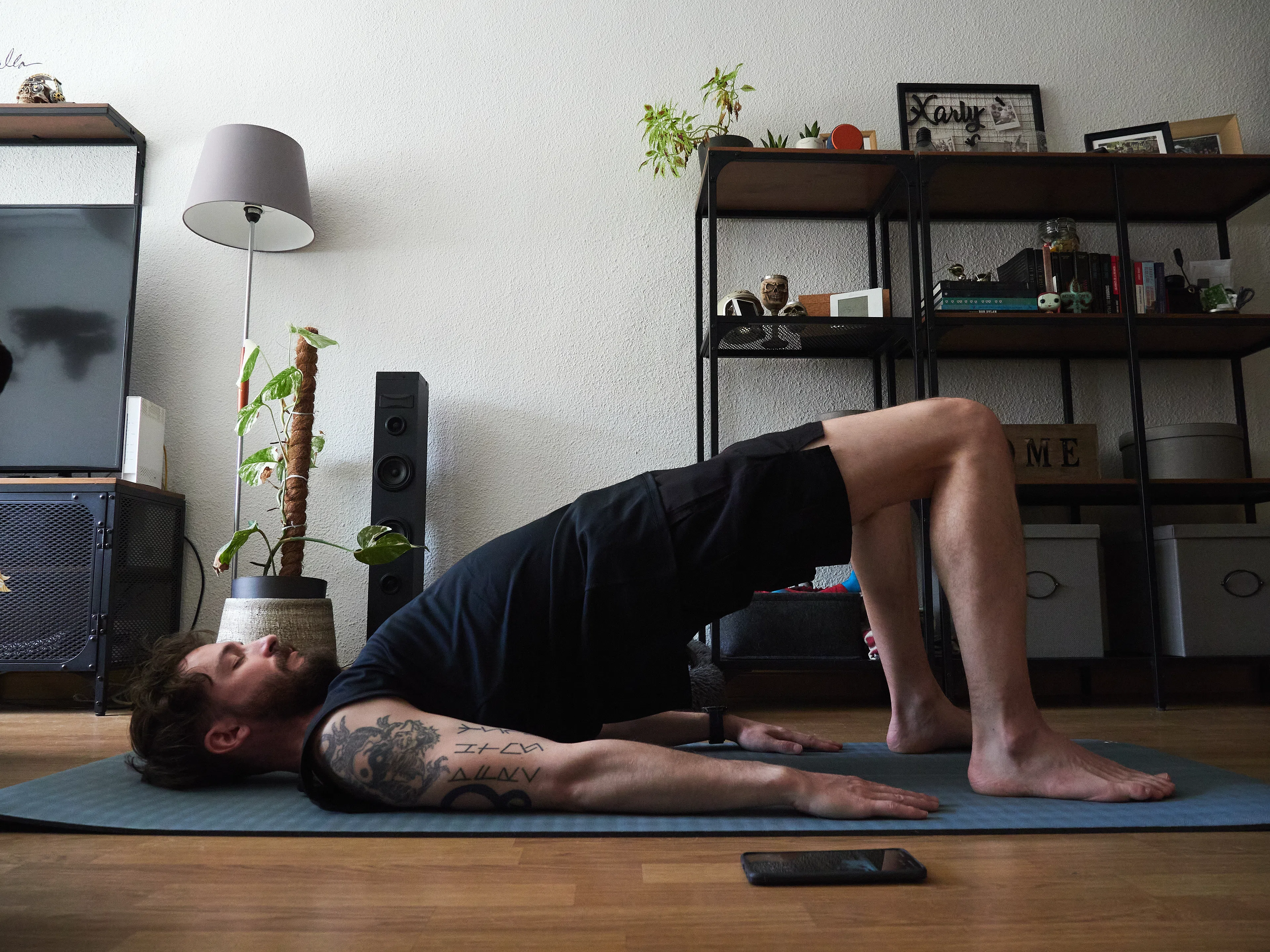
Carlos Ruben Hernandez Blasco via Getty Images
Men Can (and Should) Do Pilates Too. Here’s How to Get Started
Discover why more men are turning to Pilates, including how it boosts performance in running, lifting, athletics, and more.
By Eric Arnold•
What Is Pilates?
Why Men Should Do Pilates: The Benefits
5 Beginner Pilates Exercises to Try
How to Use Pilates to Complement Your Existing Exercise Routine
How to Get Started with Pilates
The Takeaway
A quick assessment of my social circle found plenty of athletic guys: swimmers, bikers, runners, multisport racers, soccer players, rugby players, and rowers. There are even a few disc golf fanatics who run the course and time themselves. But a guy who does Pilates on a regular basis? That required asking around. This was despite the fact that many of my friends and acquaintances admitted they were well aware of what Pilates is, and that it would be very good to add to their routine to build strength and flexibility, as well as to prevent injuries.
That begs the question: What holds men back from trying Pilates, sticking with it and enjoying the benefits?
“I think there can be a misunderstanding that Pilates is for flexible women, and that a stiff, muscle-bound guy couldn’t do it or would look silly,” says Peloton instructor Anna Greenberg. “But Pilates is for everyone and is incredibly beneficial for everybody.” She goes on to say that the exercises can be tailored to fit anyone’s fitness level or flexibility, and can give you a whole new level of body awareness, improving mobility, stability, and awareness of proper function, instead of just powering through.
And while it might seem, anecdotally, that men aren’t in yet on the Pilates secret, the trends suggest otherwise. Post-pandemic, a national chain of Pilates studios saw a 71 percent year-on-year growth in membership among men, as reported by GQ. And professional athletes from LeBron James to Antonio Brown credit Pilates with helping them with strength, stability, flexibility, and injury prevention.
If Pilates is good for pro athletes for these reasons, it’s good for all men, at all fitness levels. Here’s why you should consider giving it a try, and exactly how to get started.

Peloton App
Access thousands of classes with no equipment needed.
What Is Pilates?
Pilates is a form of low-impact exercise that focuses on building strength, flexibility, and balance through controlled movements. It was first developed in the early 20th century Germany by trainer Joseph Pilates, who began creating exercises that emphasized controlled, precise motions powered by the breath and the body’s core muscles.
Pilates eventually opened a studio in New York City where dancers, athletes, and performers embraced his approach to fitness. They gravitated to Pilates for the same reason people enjoy it today: Unlike high-intensity workouts, Pilates is about mindful, intentional movement designed to create strength, improve posture, and increase body awareness—and you get that combination of strength training and mobility work in one practice. It’s all about quality of movement, not quantity, which can give you an edge in both performance and recovery.
There are various types of Pilates classes, but the most common include mat Pilates (which is practiced on a mat on the floor) and reformer Pilates (which is done on a large piece of equipment that includes springs, ropes, and a sliding carriage).
Why Men Should Do Pilates: The Benefits
After some asking around, it turned out that one friend, Will P., does group Pilates classes at least once a week in addition to playing soccer. In large part, he credits Pilates with helping him stay strong and avoid injury. “I haven’t had ankle, calf, or knee tweaks and sprains (knock on wood) in the last two or three years since I've been doing Pilates,” he says.
Anna adds that the benefits extend far beyond injury prevention for athletes. “Practicing Pilates can greatly improve the way you move and carry yourself in all other areas of life,” she says. Certainly, that includes high-intensity sports, but everything from “walking down the street to standing, sitting, and sleeping.”
No matter the athletic pursuits you enjoy (running, cycling, weightlifting, soccer, swimming, you name it), “Pilates will not only help improve your performance in those modalities now, but will help ensure you can still enjoy doing them 15 years from now,” Anna says. ”It also helps with stress, and to feel better overall as a human moving through the world.” Indeed, research shows that Pilates has the power to do all this, significantly reducing anxiety, depression, and stress, and improving posture, flexibility, and muscular endurance.

5 Beginner Pilates Exercises to Try
Just like any form of exercise, it’s important to start slow. Get a taste for it and see how the exercises benefit you in certain areas, and gradually add more from there. With that in mind, Anna suggests these five beginner Pilates exercises in particular to give you a taste of the practice and what it's all about, as well as to help motivate you to continue (and perhaps even to try a Pilates class on the Peloton App).
“These five moves can all easily be modified as needed, and will help you feel the incredible control, connection and fluidity that Pilates is known for,” Anna explains. “These are all mat exercises, but they translate—and prepare you—well for the reformer!”
Imprinting
This gentle exercise teaches you how to find and maintain a neutral spine and pelvis. By subtly pressing the spine into the mat with mindful breathing, imprinting is key for setting the foundation for safe, effective movement in Pilates.
Knee Fold Toe Taps
Starting with the knees bent and feet lifted, this exercise (shown above) involves lowering one foot at a time toward the mat. One of Anna’s favorites, this exercise is excellent for training hip differentiation—teaching the legs to move independently of the pelvis—while reinforcing core stability and controlled breathing.
Articulating Bridge
Rolling the spine off the mat vertebra by vertebra, the articulating bridge helps improve spinal articulation, engages the posterior chain (glutes and hamstrings), and connects movement to your breath, all while activating and releasing the pelvic floor. It’s a versatile move for both strength and rehabilitation.
The Hundred
One of the classic Pilates warm-ups, the Hundred involves pumping the arms while holding a strong core curl and breathing rhythmically. “This one packs a punch,” Anna says, “and it’s one of my favorite ways to fire up the core.” This exercise also improves circulation and builds endurance, perfect for connecting to your center and energizing the body.
Single-Leg Stretch
With one knee drawing in and the other leg extending long, the single-leg stretch challenges core stability while promoting hip mobility and coordination. It’s a simple but precise move that introduces you to the flow and choreography of Pilates, emphasizing control and alignment with every repetition.
Try a Pilates Class on the Peloton App


How to Use Pilates to Complement Your Existing Exercise Routine
Pilates can be a powerful supplement to strength and cardio training, helping you get more out of the workouts you already love.
If you’re a runner, cyclist, or lifter, you’re probably familiar with muscle tightness, imbalances, or repetitive strain that comes from doing the same type of movement again and again. Pilates fills in those gaps because it builds strength from the inside out, focusing on deep stabilizing muscles and movement quality. As Anna puts it, “Pilates is an exercise system that’s sole purpose is to improve body function.” In other words, Pilates can be your proverbial secret weapon since it’s a quiet and subtle discipline, yet it’s massively impactful in terms of how you move.
And because it’s a low-impact workout, Pilates can fit almost anywhere in your weekly schedule. You might add a short mat Pilates session as a warm-up before lifting, running, or cycling to fire up your core and improve alignment. You can also slot in a 20- to 30-minute session on active recovery days when you want to move but don’t want to tax your body with another hard run or heavy lifting session. “Pilates is generally a very safe, low-impact exercise,” Anna says, adding that you should “always listen to your body—two to three times a week is great.”
At that frequency, you’ll likely notice results within a couple months in the form of a stronger core connection, better posture, greater body awareness and improved mobility. All of this translates to a more efficient running form, more power in your lifts and the ability to handle greater resilience on the bike.
Everybody is different and therefore the results will be different, Anna says, but the longer and more consistently you practice, the more benefits you’ll reap. So, don’t think of Pilates as a replacement for your other workouts; it’s a way to make them better.
How to Get Started with Pilates
It’s totally understandable if you find the idea of Pilates intimidating—especially using a reformer machine for the first time. You could start your Pilates journey by taking a group Pilates class at a studio near you (Will P. points out that some studios are even setting aside classes just for men); however an even better way to begin is to try mat Pilates classes first at home. That way, you can get a feel for the cadence, movements, and cueing while moving at your own pace and in the comfort and privacy of your own home.
Under the Strength category on the Peloton App, you’ll find Pilates classes ranging from 10 to 60 minutes dedicated to working your upper body, lower body, or full body, and for levels beginner to advanced. Most don’t require any equipment, though there are classes that incorporate Pilates props such as a Pilates ring or ball.
Whether you’re at home or in a studio with two dozen other people, the key is to come to your first class with an open mind and a willingness to focus on how you move, not how hard you push. Pilates emphasizes precision, control, and alignment over intensity, so you can expect the instructor to cue breath patterns and small, deliberate movements that activate muscles you may not even realize you have.
It’s also helpful to remember that group classes are meant to be supportive, not competitive. Everyone in the room is working at their own pace, and the exercises can often be modified or progressed depending on your needs. Don’t be afraid to let the instructor know it’s your first time, and approach the class with curiosity. Focus on those small, controlled movements, and you’ll build strength, stability and awareness that carry over into other areas of your life.
The Takeaway
Pilates may not have the same flash or swagger as lifting heavy weights or logging fast miles, but that’s exactly why it’s so effective. It teaches you to slow down, tune into your body, and strengthen the deep stabilizers that often get overlooked in other forms of training. For men in particular, Pilates can be a game-changer—helping to prevent injuries, improve flexibility, and add longevity to the sports and activities you already love. Whether you’re a weekend warrior or a competitive athlete, Pilates gives you the tools to move better, recover faster, and feel stronger.
Just remember, Pilates requires patience and consistency. The benefits build over time, and the subtle work you put in pays off in ways that go far beyond the studio.
“The longer you practice with consistency, the more positive changes you will experience, inside and out, from reduced aches and pains to muscle tone, to better function in everything you do,” Anna says. “Be patient and stick with it!”


This content is for informational and educational purposes only and does not constitute individualized advice. It is not intended to replace professional medical evaluation, diagnosis, or treatment. Seek the advice of your physician for questions you may have regarding your health or a medical condition. If you are having a medical emergency, call your physician or 911 immediately.

Level up your inbox.
Subscribe for a weekly dose of fitness, plus the latest promos, launches, and events.
By providing your email address, you agree to receive marketing communications from Peloton.
For more about how we use your information, see our Privacy Policy.