What Is HYROX? Plus, How to Train for It with Peloton
Learn what a HYROX race entails, and score all the training tips you need from Peloton instructors.
By Julia Sullivan•
What Is HYROX?
The HYROX Race Format
The Benefits of HYROX
What to Know Before You Sign Up for a HYROX Race
How to Train for HYROX
Tips for HYROX Race Day
Training for HYROX with Peloton
If you’ve seen videos of sweaty athletes rowing, running, dragging sleds, and chucking medicine balls across a winding, snake-like obstacle course on your social feeds as of late, there’s a good chance you were watching a HYROX event.
In a HYROX competition, athletes careen through a series of cardio- and strength-based workout stations where participants run 1 kilometer, then complete one functional workout station (like, say, sled pushes), repeated eight times. “HYROX is an internationally recognized and well known fitness competition that tests endurance, power, and strength,” explains Peloton instructor Ash Pryor.
The best part? HYROX races, with the right training, are doable for a wide swath of fitness-goers. That said, it’s best not to sign up for a competition with no preparation. Here’s everything you need to know about HYROX, including its benefits and how to train for success.
What Is HYROX?
HYROX is a fitness race that combines running with functional strength stations, Ash explains. It launched in Germany in 2017, and now holds races in 11 countries and more than 30 different metropolitan areas. No matter which location you’re in, however, the race’s format remains the same. (Again, a 1-kilometer run followed by one functional workout station, repeated eight times total). The competition is typically held in a big exhibition hall, which creates an immersive, electric energy for fans and athletes alike.
“I competed at HYROX Hamburg on October 4, 2025, which felt special, because Hamburg is the original HYROX city—that’s where it all started,” says Peloton instructor Benny Adami. “The atmosphere was electric and honestly a bit intimidating at first. You don’t race every day with 15,000 people around you.”
HYROX can be competed as a single, double, mixed doubles, or relay team, Ash adds, and there are both open and pro divisions, allowing all levels to participate.

Peloton App
Access thousands of classes with no equipment needed.
The HYROX Race Format
There’s no set time limit for completing a HYROX race, but the goal is to execute the eight rounds of work in the fastest time possible.
Here’s a breakdown of exactly what a HYROX race looks like:
1-Kilometer Run
The race starts with a 1-kilometer run, which you’ll then repeat after each of the stations below (except the final one). You’ll total 8 kilometers of running by the end of the race, or just under 5 miles.
1,000-meter Ski Erg
The ski ergometer (ski erg) machine involves pulling handles against resistance from overhead down to your hips, mimicking a movement you might execute on the slopes. Your core and upper body do the majority of the work.
Run 1 kilometer.
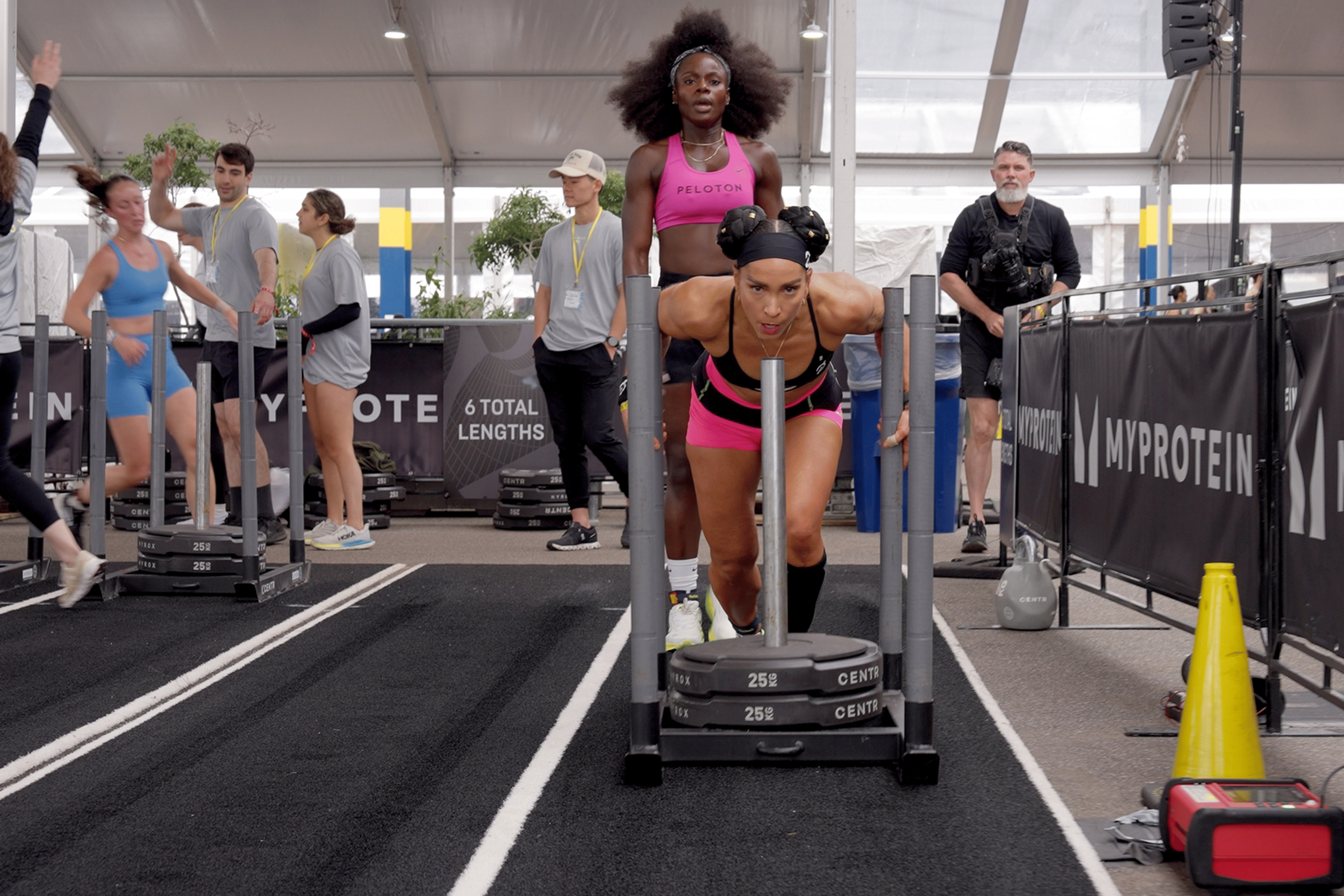
50-meter Sled Push
For this move, you’ll push a sled with weights on it across a surface, which puts your anterior chain (aka chest, arms, quadriceps) to work.
Run 1 kilometer.
50-meter Sled Pull
Like the sled push, this move requires you to move a sled across a 50-meter surface—but you’ll be pulling instead, primarily using your posterior chain (hamstrings, glutes, calves) to get it there.
Run 1 kilometer.
80-meter Burpee Broad Jumps
The burpee fires up every major muscle group in the body, combining a squat thrust, plank, push-up, and jump squat all in one. After each burpee, you’ll do a broad jump to gain distance until you’ve covered 80 meters. Run 1 kilometer.
1,000-meter Row
Hop on a rowing erg for this joint-friendly cardio exercise, which, like the burpee, hits on all major muscle groups. It also marks the second half of the race.
Run 1 kilometer.
200-meter Farmer’s Carry
Think of a farmer’s carry exactly as the name describes—you carry two weights in either hand at your side for a set distance, requiring your grip strength and postural muscles to go into hyperdrive.
Run 1 kilometer.
100-meter Sandbag Lunges
For this section of the race, athletes need to move through 100 meters’ worth of walking lunges, but with a 10-, 20-, or 30-kilogram sandbag hoisted over their shoulders. With the incorporation of the sandbag, this one is a major total-body move.
Run 1 kilometer.
100 Wall Balls
The grand finale: Athletes throw a weighted medicine ball against an overhead target…100 grueling, but exhilarating, times.
The Benefits of HYROX
HYROX races will test your endurance, strength, speed, and agility, but it’s also a big community-centric event, says Ash. Here are a few physical and mental benefits associated with the sport—and the training road to get there.
You’ll Feel More Capable and Confident Moving Through Life
According to John Gallucci Jr., a doctor of physical therapy, certified athletic trainer, and CEO of JAG Physical Therapy, the majority of moves in a HYROX race fall under the category of functional strength, meaning they mimic the movement patterns you see in everyday life (say, walking up flights of stairs, carrying groceries, picking up toddlers). “HYROX training combines running with functional strength exercises, which challenge cardiovascular health and muscle strength,” he says.
It’s not just empowering in the physical sense. “What makes HYROX so special is that even if you think, ‘there’s no way I could ever do that,’ you actually can,” Benny says.
Your Cardiovascular Fitness Will Get a Boost
HYROX athletes are in it for the long haul, and success in a race requires lots of endurance—both muscular endurance (the ability of your muscles to work for a long period of time without fatiguing) and cardiovascular endurance (how long your heart and lungs can power aerobic physical activity). Training and competing in HYROX can improve endurance, helping you run longer, for example, without getting tired, Gallucci says.
You’ll Boost Overall Strength and Improve Coordination
HYROX races themselves—and the training required to prep for them—are a form of hybrid training, or the combination of strength training and cardio. Hybrid training, in general, comes with tons of benefits, including helping you build well-rounded athletic skills such as improved endurance, strength, agility, explosive power, and even mobility and flexibility.
During her own HYROX training, Ash says she’s seen her strength increase week after week. She adds that it’s challenged her body in new, engaging ways. “I’m training differently and trying new movement patterns I wouldn’t normally program, and it’s exciting to see how strong I am mentally, emotionally, and physically,” she says.
You’ll Tap Into a Global Fitness Community
“I personally have a training group I work out with once a week, and it’s been fun to be surrounded by so many positive people who just want to be better,” Ash says. “No judgment, no ego. Just good programming, music, and vibes.” The effects of a workout buddy, group, or community are powerful: Research from Frontiers in Psychology found that social support can improve the likelihood that a person will stick to, and enjoy, their fitness regimen.
Benny has also seen the power of the HYROX community firsthand. “Everyone competes together, just at their own level,” he says. “That creates such an inclusive, empowering atmosphere. You’re all suffering, but you’re doing it side by side. It’s honestly a beautiful feeling.”
You’ll Cultivate Accountability and Motivation
Plus, a healthy dose of competition—and the motivation of working towards a fitness goal—can keep you accountable. “Watching others push themselves makes you want to match that,” Ash says. “There’s accountability to show up and then execute at a higher level.” Research suggests that creating and adhering to fitness goals can boost self-confidence and improve performance.
“At the end of the day, it’s about finding your own limits,” Benny says. “My weakness was running, so I had to stay disciplined and not overpace. The workout stations, on the other hand, allowed me to use my strength. This race taught me to trust my body in a completely new way.”
What to Know Before You Sign Up for a HYROX Race
If you’re nursing an injury, have any health conditions, or feel uncomfortable executing high-intensity, explosive movements in any capacity, HYROX might not be for you, Gallucci says. “HYROX workouts can be intense and repetitive,” he explains. “They can put stress on your joints, tendons, and muscles if you’re not properly trained.”
If you fall into any of the categories above, or you haven’t exercised in a while (or ever), it’s best to chat with a healthcare professional first to determine if HYROX is doable for you. “Without a proper warm-up, recovery, and gradual training, you increase the risk for muscle strains or overuse injuries. Pushing too hard too soon can also lead to burnout or fatigue,” Gallucci says.

How to Train for HYROX
Here, Ash, Benny, and Gallucci walk through tips on how to effectively train for your first HYROX race.
1. Be Realistic, Ask Questions, and Commit to Your Training
As Gallucci notes, HYROX races are demanding—and you shouldn’t jump into a race blindly. “Having a base level of fitness will make training and race day safer and more enjoyable,” he notes. “It’s less about speed alone and more about sustaining effort while moving efficiently.”
Make sure you give yourself enough time to train too. “Start early and have a plan,” Benny says. That could mean allotting anywhere from six to 16 weeks depending on your current fitness and experience level.
“Be realistic about what your goal is and keep that first in your training, especially on the hard days, to stay grounded,” Ash adds. “I’ve asked others about their pitfalls and highlights in racing and learn from them. I’m also honest in the areas I’m strong in and areas that I know I’m not as proficient in, to work on them.”
2. Build a Focused Workout Routine
During your training, you’ll want to familiarize yourself with all the moves included in a HYROX event. That could mean building more time in your schedule for functional strength work, or switching up your cardio to make sure you’re running, rowing, and hitting the ski erg.
“HYROX demands a lot of variety in your training,” Benny says. “I built my prep around two to three runs per week (a mix of interval sessions and endurance runs), plus two full body strength workouts. I used Peloton cycling classes to develop that endurance while giving my legs a break from high-impact running—low impact, but high benefit. I also used Peloton Tread workouts for my interval runs to dial in pacing and speed control.”
To give you another example, Ash offers up a sample week of her training below. Just note, however, that this schedule is tailored to her strengths, weaknesses, and personal preferences—your unique regimen will vary:
Monday: Pilates and Rowing. Lower-intensity practices like Pilates and yoga help to support body awareness and connectivity, Ash says: “Slowing things down helps to focus on control and precision of form and stability.”
Tuesday: Running, Wall Balls, and Core. “Wall Balls can make me nauseous, so I’m working on stamina and lifting to build leg and explosive shoulder strength so I can increase my reps,” she explains.
Wednesday: All Stations. In her HYROX training group, Ash says she spends 90 minutes practicing all eight moves she’ll ultimately do during the race.
Thursday: Running, Burpees, and Core. On Thursdays, Ash says she’ll do a shorter run in addition to some burpees and core work. A strong core will help propel you through a multitude of moves, research shows, including many of those in HYROX races.
Friday: Recovery. This isn’t just a rest day: “Don’t forget about recovery, stretching, myofascial release, etc.,” Ash says.
Saturday: Running, Lifting, and Plyometrics. On Saturdays, Ash says she tackles a longer run, plus weightlifting with plyometric movements incorporated.
Sunday: Pilates and Rowing.
It might look like a lot of cardio, but “building an aerobic base is one of the most underrated parts of HYROX training,” Benny says. “A strong aerobic foundation helps you recover faster between stations and stay consistent across all eight rounds.”
3. Prioritize Fuel, Recovery, and Sleep
Long before race day, Ash says she tests out which foods help energize her and don’t bother her stomach during intense stations like burpees or Wall Balls. “I want to feel strong and be able to use that to work with me, not against me,” she says.
Also, don’t forget to add in a rest or active recovery day, like Ash does above, which includes stretching and myofascial release (or foam rolling). Try to get ample sleep each night too—it’s a crucial time for your body to recover from tough workouts.
Related Articles

Strength Train
Hybrid Training Can Help You Become a Well-Rounded Athlete for Workouts—and Life

Stretching + Mobility
Yes, You Definitely Need an Active Rest Day—Here’s Why

Strength Train
4 Key Elements That Belong In Every Weekly Workout Routine, and How to Put It All Together

Nutrition
What to Eat the Night Before a Race, Whether You’re Running a 5K or a Marathon
4. Don’t Just Train, Practice
Closer to race day, Benny recommends including some HYROX simulations to practice transitions. “You learn fast how your body reacts when you go, for example, from 50 burpees straight into a 1-kilometer run,” he says. Then two to three weeks before race day, he recommends doing a run-through of a full HYROX race, if possible. “That was a real eye-opener for me,” Benny says. “You realize how different everything feels when fatigue sets in, exercises that seem easy in isolation suddenly become a real challenge after a few runs. That insight will completely change how you approach the real event.”
5. Know Your Limits
As Gallucci reiterates, HYROX is a demanding sport that places a significant load on the body, so it’s important to stay in tune with how you’re feeling both during training and on race day. For example, a small study on 11 athletes in a simulated HYROX event found that participants spent a majority of the race in a “hard” or “very hard” exercise intensity (between 70 and 100 percent of their maximum heart rate).
Some of your training should take you up into those higher heart rate training zones, but not all of it should be that high intensity. “You don’t want every training session to be built to crush you,” Ash says. “Mix it up in both intensity and focus.”
And if anything hurts, stop immediately, Gallucci stresses: “Pain is a signal, not something to push through.”
6. Find a Support System
Benny says the support he received on race day stood out above all else—and helped him push through the finish. “So many Peloton Members came to cheer me on. One even dressed up as me and held a sign that said: ‘Even Benny Adami sometimes needs a Benny Adami.’ That honestly got me emotional and gave me a huge push,” he says. “Members spread out across the entire hall so that no matter where I was running, someone shouted my name. It felt like getting a little high-five every lap and that made all the difference.”
You can ask friends and family to be there to cheer you on, though connecting with fellow HYROX racers can help you find like-minded people who are training for and might be at the same event. To get connected with the HYROX community, check out the HYROX Training Team on the Peloton App, which includes support, advice, and encouragement from fellow Members as well as Peloton instructors (including Ash and Benny!).
7. Keep It Fun
Ash says it’s common to feel stressed or nervous as race day approaches (something she can relate to, even as a Peloton instructor!), but following a plan—and remembering to find joy in the training process—can make a world of difference. “Remember why you want it,” she encourages. “Have a race plan to manage the mental and emotional aspect. I do a lot of visualization to keep myself excited rather than scared of doing something for the first time.”

Tips for HYROX Race Day
You’ve put in the work during your training—now it’s time to put your skills to the test. Here, Benny shares his tips for a smooth race day.
Lock In Your Gear: “Bring a tracksuit. It can get cold in the arena and adrenaline hides that at first,” Benny says. “Tie your shoes properly, especially for the sled push and pull. I’ve seen people lose their shoes mid-race, no joke.”
Focus On Fuel: If you were running a half marathon or marathon, you’d likely have a pre-race nutrition plan; HYROX isn’t all that different. “When it comes to nutrition, I focused on protein in the weeks leading up to the event, and in the so-called taper week (week before the race), I reduced the training volume while increasing carbs to refill my glycogen stores,” Benny says. “That made me feel fully fueled on race day.”
Have a Warm-Up Plan: “Don’t get overwhelmed. Everyone there is pushing to their own personal limit. Have a clear warm-up plan before you step into the zone,” Benny advises. “I made the mistake of letting the energy around me stress me out—people sprinting everywhere, doing heavy lifts—know what works for you and stick to it. Go to the start line about five minutes before your wave. Anything earlier just builds unnecessary tension.”
Watch Your Intensity: It’s easy to let the excitement and adrenaline get the best of you on race day. Try your best to pace yourself; it’s a marathon (well, an 8K), not a sprint. “Don’t overpace on the runs,” Benny says. Once you go overboard, it’s hard to go back. Use a heart rate monitor to keep track of your intensity. “It’s your best guide,” he says.
Have Fun: “Above all, enjoy it,” Benny says. “HYROX makes you feel truly alive.”
Training for HYROX with Peloton
Peloton offers a wide variety of classes to help get you strong and ready to compete in HYROX. This includes:
Bootcamp classes, which alternate bouts of cardio and strength, to help you practice switching between workout types. Try the HYROX Bootcamp classes specifically designed to help you prep for a race.
Rowing classes, where you’ll learn proper form on the erg and how to build power.
Cycling classes to help you build stamina, do low-impact cross training, and recover from tough workouts.
Guided running classes, where instructors offer pace targets, coach you through intervals and effort, and offer support on how to progress.
Strength training classes, so you can build strength and better familiarize yourself with common HYROX movement patterns.
Meditation, yoga, mobility, and Pilates classes, which are ideal for recovery and combating stress and anxiety leading up to race day.
For more inspiration on which classes to try, check out the HYROX Collection in the Peloton App or on your Peloton Bike, Tread, or Row. It contains curated picks from each of the above workouts to help you hone your skills as you train for a HYROX race.


This content is for informational and educational purposes only and does not constitute individualized advice. It is not intended to replace professional medical evaluation, diagnosis, or treatment. Seek the advice of your physician for questions you may have regarding your health or a medical condition. If you are having a medical emergency, call your physician or 911 immediately.


Level up your inbox.
Subscribe for a weekly dose of fitness, plus the latest promos, launches, and events.
By providing your email address, you agree to receive marketing communications from Peloton.
For more about how we use your information, see our Privacy Policy.