Want to Track Your Fitness Progress? Here’s Why You Need Strength Benchmarks
Strength benchmarks are a great way to track progress over time—and find untapped motivation to crush your next goal.
By Alyssa Sparacino•
What Are Strength Benchmarks?
Why Is It Important to Benchmark Your Strength Progress?
How Do Peloton’s Strength Benchmark Classes Work?
How to Do a Strength Benchmark Test
Common Exercises Used for Strength Benchmarks
How to Set Goals and Understand Progress
When you start an exercise routine for the first time or begin a new workout program to amp up your gains, the first thing you notice might be how you feel. You may feel stronger—or, let's be honest, also sorer—and more confident that you could do more reps, take less rest, or grab heavier weights.
But without setting a benchmark for where you started, how can you truly know just how far you’ve come? That’s where strength benchmarks come in. While you can do this with essentially any class or workout that you perform on repeat, Peloton’s Strength Benchmark classes make tracking your progress super simple, so you can very quickly see how you’ve improved. Here’s more about what they are, how to utilize them in your training schedule, and why benchmarks are something you’ll want to keep in your fitness arsenal, according to Peloton instructor Adrian Williams.
What Are Strength Benchmarks?
In general, benchmarks are a way to keep an eye on where you started and see how you’re progressing toward where you want to go.
Peloton’s Strength Benchmark classes are designed that way—asking you to take note of reps or weight or time when you first take a class, then coming back to the same workout time and time again so you can assess your progress along the way. These classes give “members the opportunity to test their current fitness capabilities against specific criteria, such as the number of reps they can do in a given amount of time, or which weights they are comfortable using,” Adrian says.

Peloton App
Access thousands of classes with no equipment needed.
Why Is It Important to Benchmark Your Strength Progress?
“It’s important to use Strength Benchmark classes to track your progress from week to week,” says Adrian. ”By tracking your progress, you're able to lift heavier weights or do more reps.”
If you’re saying to yourself, “I’ll be able to tell when it’s time to move to the next level,” you’d be surprised how often exercisers (beginners and veterans alike) reach for the same set of weights time and again to perform certain exercises. When a Peloton instructor cues a circuit and tells you to grab heavy dumbbells, if the weight of those heavy bells never changes, neither will your progress.
Why? It comes down to the principle of progressive overload, which says that, in order to continue seeing developments in your fitness, you need to continue challenging your body by increasing the demand placed on it over time. In regard to strength training, you can do this by increasing the number of sets and/or reps, the amount of weight lifted, the difficulty of an exercise, or the time under tension. That additional challenge is what prompts your body to adapt, building more muscle and/or enhancing the capabilities of your current muscles, ultimately helping you continue to see results from your workouts.
Benchmarking can also do the opposite, and show you how other factors in your life might be negatively impacting your performance or gains. For example, if you’ve been chronically short on sleep, not eating enough to fuel your workouts, or perhaps taking on a heavy mental or emotional load, you might see that show up in your strength workouts as not being able to lift as much weight or do as many reps.
How Do Peloton’s Strength Benchmark Classes Work?
Each of Peloton’s Strength Benchmark classes will ask you to follow the same guidelines. The first time you take a class is meant to act as a baseline, so you can understand your current strength level. Don’t worry, your instructor will lay out exactly which measures you should track—whether that’s time, weight, reps, or a mix.
Then, after six weeks, you’ll repeat the class to retest your strength, making sure to record the same measurements (time, reps, weight) and compare those numbers to the initial figures. Why six weeks? This is generally when significant progress can be measured, Adrian says. (For example, it takes at least four weeks to start seeing muscle growth from a new strength routine.) This ensures you have enough time under your belt to walk away with some satisfying achievements that keep you coming back for more.
During those six weeks, you can follow your normal workout routine, an instructor-led program, or your personalized plan generated by the Peloton App. If you want the best chance at improving your scores, you can also repeat the same Strength Benchmark class (as part of your overall workout routine) consistently during those six weeks.
And while you should see some progress within six weeks, you don’t need to stop there; you can come back to the same Strength Benchmark classes every few weeks or months to see how you’re progressing.
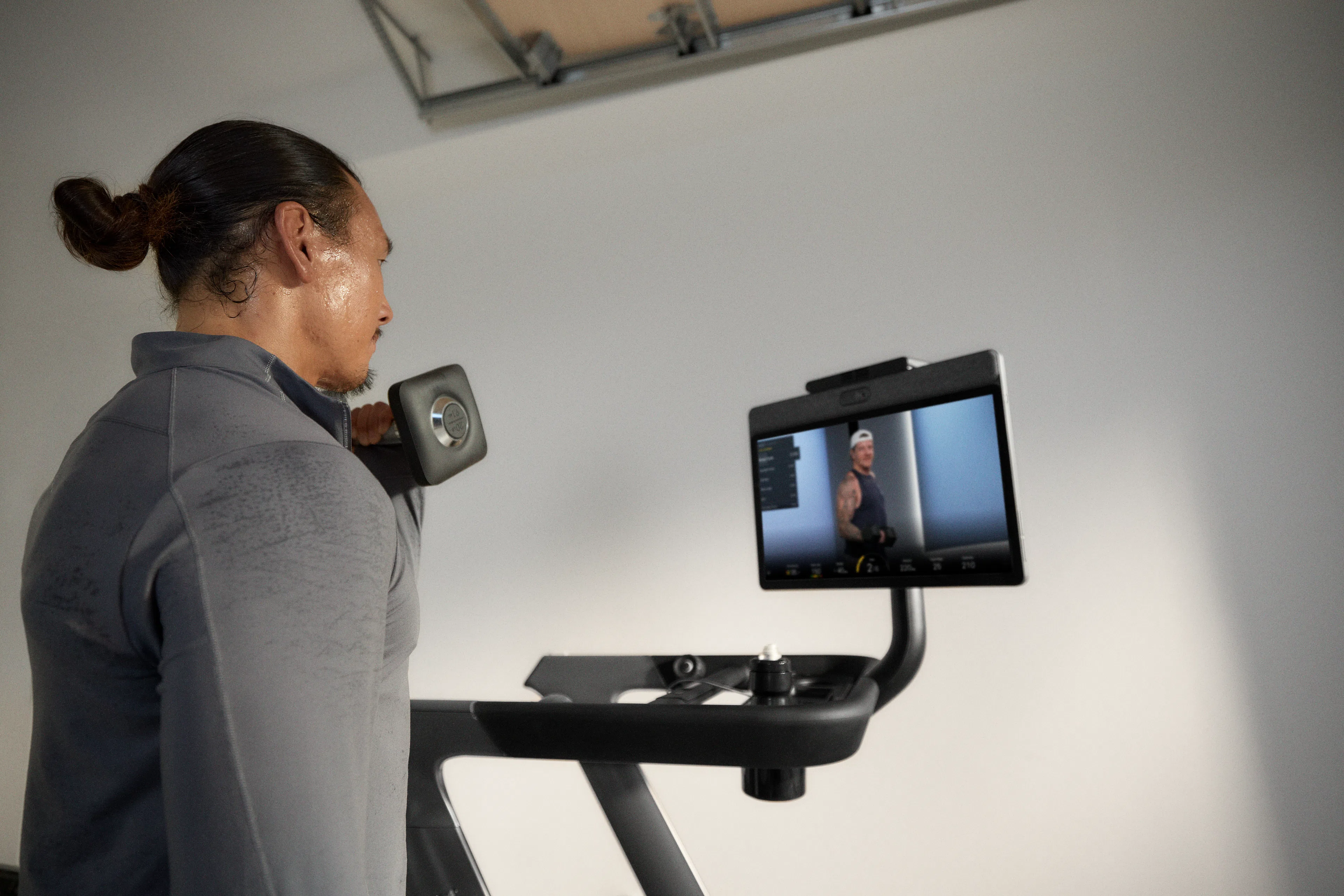
If you’re working out with the Peloton Cross Training Bike+, Tread+, or Row+, there’s no need to keep a tally of your reps or weight manually; when you take a movement-tracking enabled strength workout, Peloton IQ can help by tracking your reps and weight digitally. When you keep coming back to the same strength workout—whether it’s a Strength Benchmark class or not—you’ll be able to see charts mapping your progress over time.


How to Do a Strength Benchmark Test
Each Peloton Strength Benchmark class will test you differently. You’ll find upper body, lower body, core, full body, and bodyweight Strength Benchmark classes on Peloton. Try them all for a complete look into your strength level in each of these key areas.
During a Strength Benchmark class, you might test your strength based on any of the following metrics:
Time: A test of your muscular endurance, or how long your muscles can perform before they fatigue. For example, you might test how long you can hold a plank.
Reps: Another test of muscular endurance, you may be cued to see how many reps of an exercise you can perform in a given amount of time. For example, you might count the number of push-ups you can do in one minute or see how many overhead presses you can do with a certain dumbbell weight.
Weight: How heavy you can lift when doing a specific exercise for a certain number of sets and reps. For example, your instructor may challenge you to go as heavy as possible for 6 reps of deadlifts. This is a useful measurement if you’re looking to increase your one rep max or what your “heavy” weight is to you for a particular exercise.
Again, you’ll record your reps, weight, or time during the first class, take it again after six weeks to retest your strength, Adrian says.
Common Exercises Used for Strength Benchmarks
You can use almost any exercise for benchmarking your strength—and you’ll see a large variety of movements show up in Peloton’s Strength Benchmark classes. That said, here are a few key moves for monitoring your strength progress, and what makes them so great at doing so:
Squat: This classic lower body exercise is a great option for benchmarking your strength, whether you see how heavy you can lift for 5 reps or how many bodyweight squats you can do in one minute.
Deadlift: The deadlift tests the strength of your posterior chain, the muscles along the back of your body. Because this exercise taps into so many large muscle groups, it’s a great way to gauge your overall strength.
Bench Press: Along with the squat and deadlift, the bench press (sometimes called chest press when done with dumbbells or on the floor) completes the “big three”: the trifecta of strength exercises used to test maximal strength in powerlifters and other athletes. This move specifically tests the pushing muscles in your upper body.
Push-Up: Because push-ups are so challenging for most people, they’re a great move for measuring your strength progress without weights. See how many reps you can do without resting.
Plank: Another perfect bodyweight strength benchmark move is the plank. Whether you go for a classic high plank or forearm plank, you can use this move to test your core endurance. (Pro tip: Also try testing your side planks to see if you have balanced core strength on each side.)
How to Set Goals and Understand Progress
The key to setting any goal—in your workouts, or life—is to make them measurable and realistic. Consider what you’re after when it comes to your strength: Do you want to increase your endurance and stamina? Do you want to be able to lift heavier? Do you want to build strength to power your other sports, like cycling, running, or rowing? Then try to make these even more specific: Do you want to be able to hold a 60-second plank without dropping to your knees or use 40-pound dumbbells for your deadlifts?
Once you have a goal in mind, make sure it feels realistic for your current fitness level and schedule. If you’re totally new to exercise, start with a 20-second plank, then work your way up, for example.
Over time, you will start to lift heavier weights or be able to do more reps, Adrian explains. And be sure to “pay attention to how you feel,” he says. “Exercises that were challenging may start to feel easier or you may be able to recover from sets more quickly.” In fact, “one of the biggest indications of leveling up is needing less rest,” he adds.
With the Peloton Cross Training Bike+, Tread+, or Row+, you have extra tools to watch your strength progress over time. Peloton IQ tracks your reps and weight during movement-tracking enabled strength workouts, so when you repeat the same workout over and over again, it compares your performance so you can see how you’ve improved.
Whether you are looking for a motivation boost or just your next fitness challenge, strength benchmarks are a great tool to validate all that hard work in clear, measurable terms. Pick a class from the Benchmark Strength collection, and get ready to be seriously impressed with yourself a little more than a month from now.
To give the new Peloton Cross Training Series a try, visit your local Peloton store or retail location, or book a virtual appointment with an expert.
Related Articles

Strength Train
Hypertrophy vs. Strength Training: Which Training Method Is Best for You?

Strength Train
Lifting Heavy Weights Is One of the Best Things You Can Do For Your Body—Here’s Why

Mental Health
Why You Feel So Good After Lifting Weights, According to Science

Beginners
New to Lifting? Here's What to Know Before Reaching for Your Weights
This content is for informational and educational purposes only and does not constitute individualized advice. It is not intended to replace professional medical evaluation, diagnosis, or treatment. Seek the advice of your physician for questions you may have regarding your health or a medical condition. If you are having a medical emergency, call your physician or 911 immediately.

Level up your inbox.
Subscribe for a weekly dose of fitness, plus the latest promos, launches, and events.
By providing your email address, you agree to receive marketing communications from Peloton.
For more about how we use your information, see our Privacy Policy.