How to Do a Romanian Deadlift, the Ultimate Hamstring and Glute Strengthener
RDLs are a staple lower body strength exercise—but the form is tricky to master.
By Amber Sayer•
What Is a Romanian Deadlift?
What Muscles Do Romanian Deadlifts Work?
What Are the Benefits of RDLs?
How to Do an RDL
RDL Variations and Alternatives
4 Common RDL Mistakes and How to Fix Them
Who Should Avoid RDLs?
How to Include Romanian Deadlifts In Your Routine
Regardless of whether you’re new to working out or a seasoned pro, lower-body strength exercises can feel, well, complicated. Do you focus on bodyweight movements? Grab some dumbbells? What about form? Or variations?
The deadlift and its counterpart, the Romanian deadlift (RDL), often inspire such angst. But they don’t have to. Here, we asked Peloton instructor Rad Lopez to break down everything you need to know about Romanian deadlifts, including how to do them, common mistakes, and go-to variations.
What Is a Romanian Deadlift?
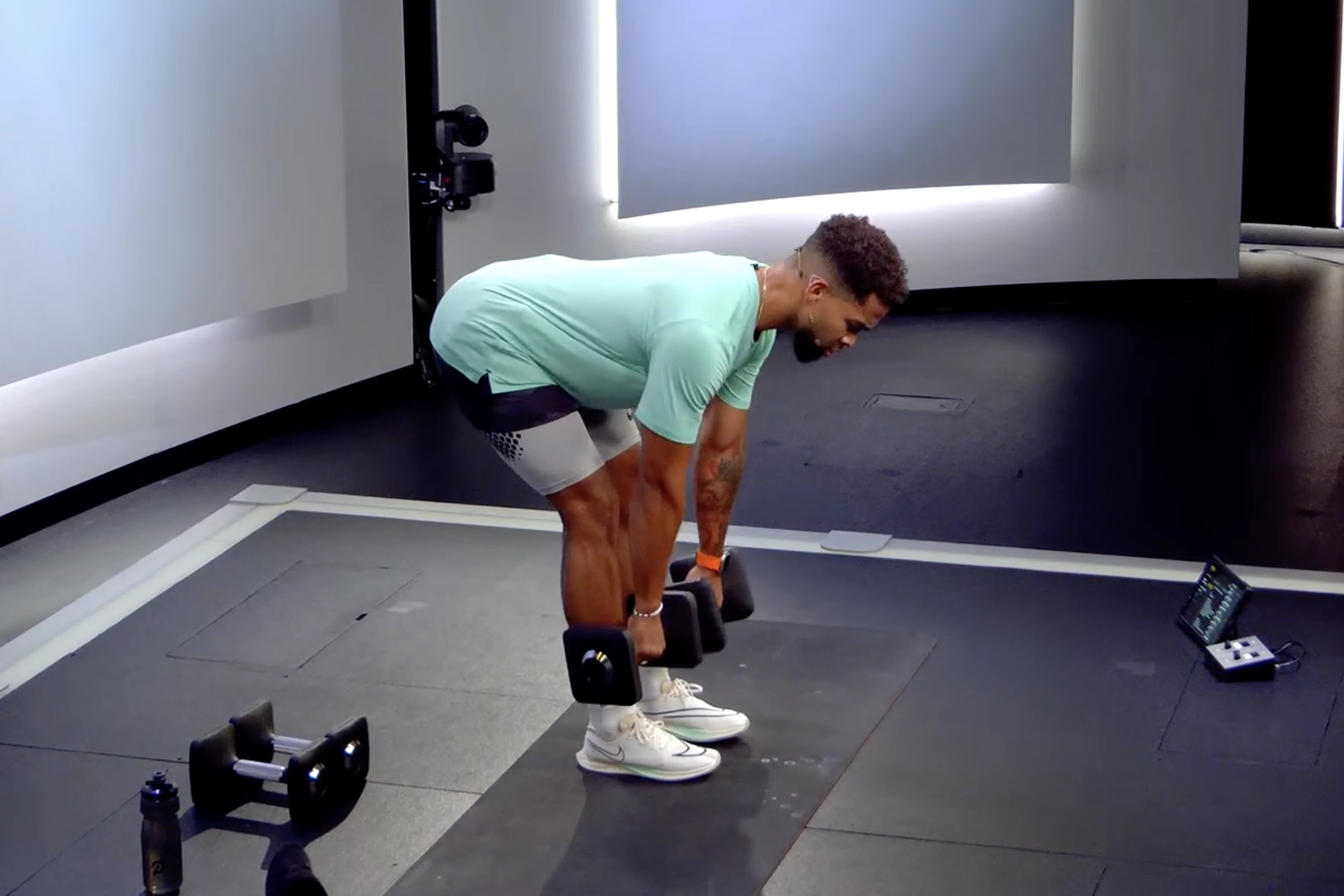
In a Romanian deadlift, you hinge at your hips to lower weight toward your ankles, then straighten your hips to lift your torso and stand up. The secret to this exercise is all in the hips. “The movement pattern behind this exercise is a hip hinge, in which we hinge at the hips, slightly bend our knees, and tilt our upper body forward,” Rad says.
RDL vs. Deadlift
While RDLs and conventional deadlifts strengthen many of the same muscles, their movement patterns are a bit different, Rad says. Here are some of the key differences between deadlifts and RDLs:
Starting Position: “The deadlift is more often than not performed by lifting the weights from the ground,” Rad says. A rep involves lifting the weights off the floor and then lowering them. An RDL, on the other hand, starts from the top; a rep involves lowering the weights until you feel a stretch in your hamstrings, then standing back up.
Range of Motion: In an RDL, you use a truncated (i.e., shortened) range of motion compared to a traditional deadlift; you only lower the weights to your shins vs. all the way to the ground. As a result, you bend your knees significantly more in a traditional deadlift than in an RDL.
Emphasis: The traditional deadlift involves lifting weight off the floor “using a combination of leg drive, a deeper contraction and involvement of the hamstring, and hip drive,” Rad says. The focus is on powerfully lifting the weight, whereas RDLs emphasize the hip hinge and slow eccentric (lowering) portion of the movement.

Peloton App
Access thousands of classes with no equipment needed.
What Muscles Do Romanian Deadlifts Work?
The RDL primarily strengthens your posterior chain muscles, including your lower back, glutes, hamstrings, and calves, Rad says. Secondary muscles strengthened by RDLs include your core muscles, adductors (inner thigh muscles), trapezius (aka traps, in your upper back), and rear deltoids (the backs of your shoulders).
What Are the Benefits of RDLs?
“The benefit of the RDL exercise is that it helps strengthen all the muscles in your posterior chain, which in turn, allows us to maintain a structurally sound posture,” Rad says. “By successfully training these muscles, you’re going to make sure that you can complete and perform everyday tasks, such as walking, running, lifting heavy objects, bending over, and even playing with your kids and pets.”
Because RDLs engage your abdominal and back muscles to brace your spine throughout this movement, Rad notes that the Romanian deadlift also helps improve your functional core strength. This, in turn, can promote better posture, improve balance and stability, enhance athletic performance, and help prevent injury—especially to the lower back. “Strengthening your posterior chain is going to allow you to have better posture and prevent any lower back and spine injuries,” he says.

How to Do an RDL
Rad suggests first mastering Romanian deadlifts with dumbbells. “Holding a dumbbell in each hand allows for a more natural grip and reduces the need for balance, compared to a barbell,” Rad says. “This variation helps beginners focus on the hip hinge movement pattern and strengthens the posterior chain muscles.” When you’re ready to advance, you can level up to a barbell or try some of the RDL variations listed below.
Here’s how to do a Romanian deadlift properly:
Start standing with your feet hip-width distance apart. Hold a dumbbell in each hand in front of your hips with your arms straight and palms facing your knees. Engage your core and draw your shoulder blades back and down.
With a slight (about 15-degree) bend in your knees, hinge at your hips, and push your glutes backward. Keep your back flat and core engaged, allowing your torso to tilt forward as you lower the weights along the front of your legs. Keep your neck long and in a straight line with your spine.
Pause briefly when the weights reach the top of your shins, when you feel a deep stretch in your hamstrings, or when your torso is parallel to the ground.
On an exhale, press into your feet and push your hips forward to lift your torso and return to standing. That’s one rep.

RDL Variations and Alternatives
Glute Bridge
If you’re looking for a way to work up to an RDL, start with beginner-friendly exercises that target the same muscle groups and help you master the hip hinge, such as a glute bridge.
Good Morning
The good morning exercise (shown above) is another move that drills the hip hinge. If you’re new to deadlifts, doing good mornings can help you train the muscles and motion you’ll need to use in an RDL. Once you’re more advanced, you can use them as a way to warm up your hamstrings, glutes, and lower back muscles before doing RDLs.
Kickstand Deadlift
Once you feel comfortable with RDLs, you can also try variations, such as the kickstand deadlift, to focus on working your posterior muscles unilaterally (i.e., one side at a time), Rad says. During a kickstand deadlift, you shift the focus onto one leg by placing your weight in one foot, stepping the other foot backward, and lifting that heel off the floor.
Single-Leg Deadlift
For a stability challenge and to strengthen one leg at a time, try advancing to the single-leg deadlift, which requires you to balance on one leg.
Try a Lower Body Strength Class on the Peloton App


4 Common RDL Mistakes and How to Fix Them
Form is everything when it comes to doing deadlifts—RDLs included. Here are a few common RDL mistakes and how to correct them.
1. Improper Foot Placement
One of the biggest mistakes people make during RDLs is improper foot placement, Rad says. “You want to make sure that your feet are directly beneath your hips.” Make sure to distribute your weight evenly between both feet. At the beginning of an RDL, your weight should be centered in the middle of your feet, and then as you lower, it will shift back toward the heels, according to the National Strength and Conditioning Association.
2. Rounding or Arching the Spine
Another major mistake when doing RDLs is either rounding or arching your back. “You want to make sure that you keep a nice neutral spine throughout the entire move and stop your upper body when it’s parallel with the ground on the hinge,” Rad says.
Doing drills like pelvic tilts can help you find a neutral spine, and learning to properly engage your core can help you maintain that position while you move. While you’re doing RDLs, imagine your back is a plank, and you need to tilt the entire plank as you move, instead of curving your spine to move the weight.
3. Holding the Weights Too Far Away from Your Legs
Throughout an RDL, you want to keep the weight close to the front of your legs—don’t allow it to drift forward or hang directly under your shoulders, which can increase the torque placed on your lower back, according to research published in the Strength and Conditioning Journal.
4. Moving Too Quickly
Unlike a traditional deadlift, which focuses on a quick and powerful hip drive to lift the weights off the floor, RDLs should be done slowly with an emphasis on the eccentric (lowering) portion.
Who Should Avoid RDLs?
If you have any back or spine issues, Rad recommends avoiding this move. “This exercise puts significant stress on the lower back and spinal erector muscles,” he says. “It’s also best to avoid RDLs if you are experiencing acute injuries or pain, or even inflammation in the hips, hamstrings, or lower back.” If you’re unsure whether or not you should try RDLs, consult a doctor or physical therapist to see if the move is safe for you.
How to Include Romanian Deadlifts In Your Routine
In general, how often you do RDLs and how many reps and sets you do will depend on your fitness level and goals.
If you’re focused on building maximal strength, Rad suggests focusing on lifting heavier weights for fewer reps (1–6 reps per set). If muscle growth (aka hypertrophy) is your goal, perform 8–12 reps with a moderately heavy weight. You’ll know you’ve chosen the right weight if the last few reps of each set challenge you, but you can still finish with proper form.
You can include RDLs in your full body strength workouts, lower body strength workouts, or pull workouts (if you follow a push-pull workout split) between one and three times per week. Keep in mind, your muscles need time to recover between training sessions. The National Academy of Sports Medicine recommends giving a muscle group 48 hours to recover between workouts.
Looking for more guidance on how to structure your strength training? Try following one of the instructor-designed strength programs on the Peloton App or Peloton Strength+.


This content is for informational and educational purposes only and does not constitute individualized advice. It is not intended to replace professional medical evaluation, diagnosis, or treatment. Seek the advice of your physician for questions you may have regarding your health or a medical condition. If you are having a medical emergency, call your physician or 911 immediately.

Level up your inbox.
Subscribe for a weekly dose of fitness, plus the latest promos, launches, and events.
By providing your email address, you agree to receive marketing communications from Peloton.
For more about how we use your information, see our Privacy Policy.