What Muscles Does Rowing Work? Broken Down By Phase
Does Rowing Build Muscle?
Rowing Mistakes to Avoid
Where Should You Feel It When Rowing?
How Long Does It Take to See Results From Rowing?
The Takeaway
You may have heard the staggering statistic that rowing works more than 86 percent of the muscles in your body—and as unbelievable as that may seem, it’s true. Research shows that a rowing stroke involves almost all of the muscles in the body, while providing a comprehensive, high-intensity, low-impact cardio workout.
Take it from Peloton instructor Katie Wang: “Rowing is a fantastic full body workout,” she says. It also strengthens your heart and lungs, increases flexibility, and offers other impressive benefits for your overall health and well-being.
Wondering which muscles work the hardest when you’re rowing, or where you can expect to be sore following an intense session on the rowing machine? Also curious whether or not rowing is enough to build muscle in all these areas it targets? Keep reading to find out the answers to all these questions, plus get tips on how to row with proper form—a key to tapping into all the right muscles.

What Muscles Does Rowing Work? Broken Down By Phase
As a whole, rowing works muscles throughout the body. One small 2014 study that tasked people with rowing three times a week for eight weeks found that the routine resulted in significant increases in lower-body, back, core, and grip strength (along with improved flexibility, agility, and explosive strength too).
How does it do all that? The rowing motion can be broken down into four phases—the catch, drive, finish, and recovery—and each one engages your muscles differently. Here are the details.

The Catch Phase
Also known as the ready or start position, the catch phase is the beginning of the exercise. (It gets its name from the point at which the blade of an oar on a boat “catches” the water.) In the catch, you’re crouched at the front of the machine with your hips and knees bent, arms extended, and shins vertical. The sliding seat of the machine should be about six to eight inches from your feet, and your heels should be lifted just a bit. Your torso is leaning forward slightly, maintaining tall posture, so your shoulders are just in front of your hips.
Proper form in the catch prepares you to do serious work in the drive, creating the most efficient stroke, Katie says: “Think of it as finding your form before doing a heavy lift.”
Some of the primary muscles worked in the catch phrase include:
Triceps: The triceps, the muscles on the backs of your upper arms, engage to keep your elbows straight.
Abdominals: Your abdominals (including your rectus abdominis, or “six pack” muscles) work to lean your body forward.
Hip Flexors: Your hip flexors draw your thighs closer to your chest, holding you in the catch position.

The Drive Phase
The drive is the phase when your muscles are working the hardest, since it’s when you generate all the power in each stroke. The drive has two parts: First, you extend your legs to push the seat backward, then you open at the hips and lean back slightly.
“The general format of rowing is: legs, body, arms,” Katie says. The drive encompasses those first two steps: extend the legs, then lean the body. “You use your legs during the drive phase (your calves, quads, hamstrings, and glutes), then in the back half of the drive, your body starts to open up using both your [hip] flexor muscles as well as your obliques to stabilize,” she explains.
Some of the main muscles worked during the drive phase include:
Quads: Your quads work to powerfully straighten your knee, pushing your hips and body backward during the first half of the drive.
Calves: Your calf muscles kick in to help you push off the foot stretcher.
Hamstrings and Glutes: Your hamstrings and glutes both help to extend your hips as you straighten your legs, finish the first half of the drive, and lean your torso back.
Latissimus Dorsi: Your latissimus dorsi (upper back muscles better known as the “lats”) help lock your upper body in place, stabilizing your shoulders against the pull of the handle.
Spinal Extensors: Muscles along your spine, including the erector spinae and lumbar multifidus, fire to keep your back long and straight.
Abdominals: Your abs aren’t one muscle but several—including your internal obliques, external obliques, and rectus abdominis—and they engage to help you maintain a rigid torso as you push your body away from the machine.

The Finish Phase
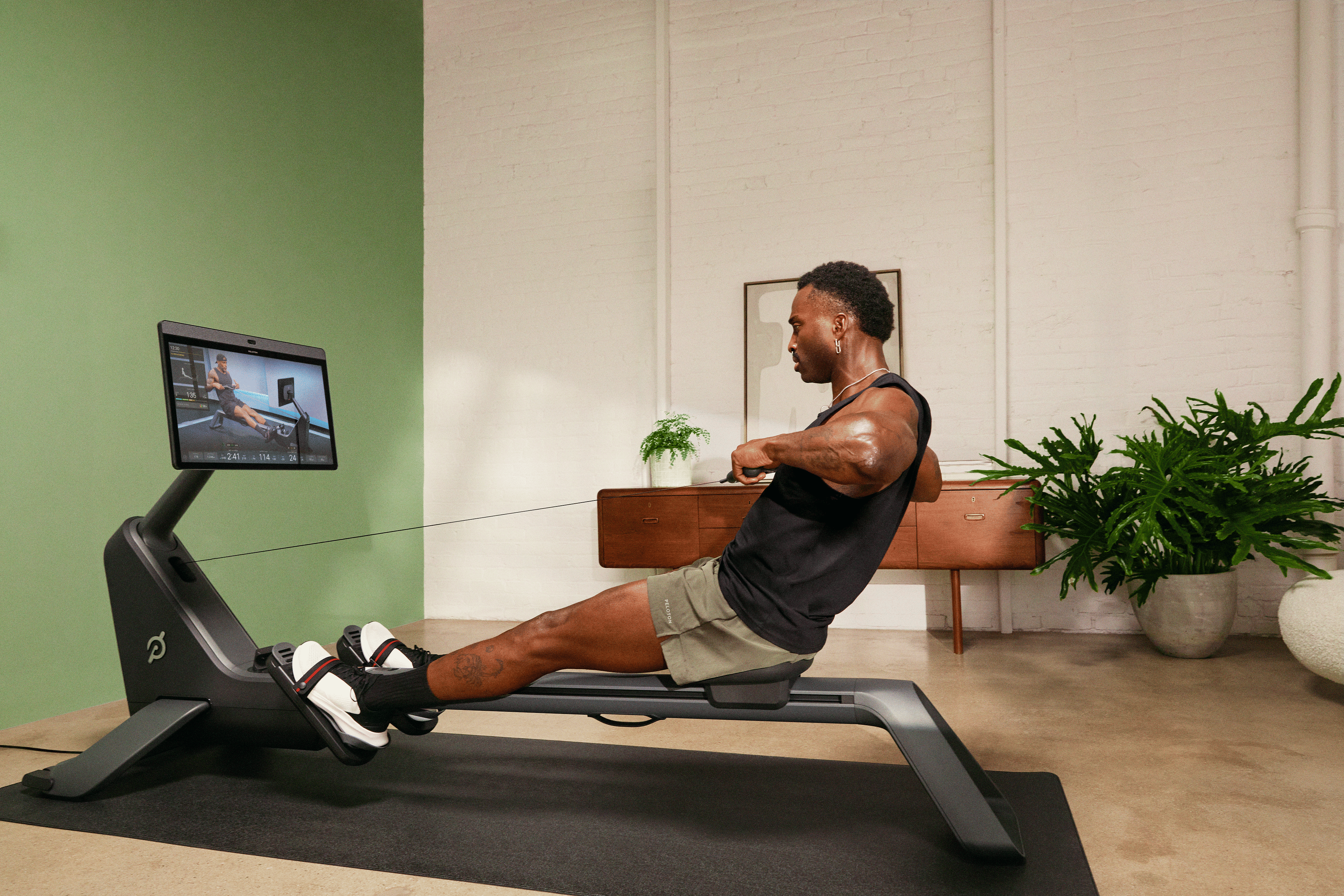
You complete the stroke by pulling the handle to the lower part of your ribs while still leaning back slightly. At the finish, your shoulders will be slightly behind your hips, and you’ll feel your core muscles working. As Katie mentions above, the correct sequence of movement involves your legs driving first, then your body hinging back, and finally your arms pulling into position.
“The catch and the finish are moments in time that prepare you with proper form for the work in the drive and the recovery, creating the most efficient stroke,” Katie explains.
The muscles worked during the finish phase include:
Biceps: Your biceps bend your arm at the elbow, and as such, are key for the finish, since they help pull the handle back toward your chest.
Trapezius: The trapezius (traps) are upper back muscles that help to pull your shoulder blades back and stabilize the shoulder as you row the handle toward your body.
Rhomboids: The rhomboids are small muscles that connect your shoulder blades to your spine, and they work to pull your shoulder blades together as you finish a stroke.
Rear Deltoids: Like the rhomboids, the rear delts are small muscles (they lie on the back of the shoulder). They perform the small but important action of pulling your upper arms behind your body during the finish.
Core: Many of the muscles that worked to get you into the finish position—including the core, glutes, and quads—are holding their contraction to keep you there. Your core, for example, is firing to keep your torso rigid and tall while only your arms move during the finish.

The Recovery Phase
The recovery phase is a sequence of movements that are the reverse of the drive: your arms extend first, then your body leans forward, and then your legs bend, sliding your hips forward so you return to the catch. Whereas the drive is quick and forceful, the recovery should be slow, smooth, and easy.
The main muscles used during the recovery phase include:
Triceps: Your triceps extend your elbows, so your arms are straight going into the catch.
Quads and Hip Flexors: Your quads and hip flexors work to bend your hips, pulling your thighs closer to your torso.
Hamstrings: Your hamstrings bend your knees, pulling you into a compact catch position.
Core and Back: Your core and back muscles continue firing to stabilize your upper body, maintain a tall torso, and allow you to lean into the catch.


Does Rowing Build Muscle?
It depends, Katie says. Rowing can help you build muscle, but it’s not going to be as effective as a strength training program specifically designed for building muscle mass (aka muscular hypertrophy). Research suggests that rowing can induce some muscle hypertrophy (especially in slow-twitch muscles); however, it’s more likely to result in gains for people who are untrained or new to rowing, and less so for more experienced athletes.
“Whether on the Peloton Row or lifting weights, building muscle mass comes down to load, volume, and intensity,” Katie says. You need to challenge your muscles enough to trigger the muscle-building process, and there’s a chance that rowing won’t do that for you.
“Strength training to build muscle is very difficult to do on any cardio machine,” Katie continues. “Rowing at a low enough stroke rate increases time under tension on your muscles, which, if done using the proper form for long enough periods, can somewhat simulate lifting. However, more people use rowing as a cardio-based workout in partnership with strength training.” And if your main fitness goal is to build muscle, generally speaking, that’s the approach you should take.

Peloton Row+
Work 86% of your muscles in just 15 minutes.
Rowing Mistakes to Avoid
Rowing might seem like it’s an easy enough exercise to master, but there’s a lot going on in every stroke. Certain mistakes can prevent you from taking full advantage of its benefits. Here are some of the most common and how to avoid them. For additional help mastering proper rowing form, consider trying a Form & Drills Class on the Peloton Row or App, which are focused entirely on perfecting your stroke.
Forgetting to Warm Up
Warming up is an important prelude to any form of exercise, as it prepares your body for the hard work ahead. Before rowing, consider engaging in some dynamic stretching. Then hop on the rowing machine and start with a few minutes of low-intensity rowing to gradually increase your heart rate and circulation, as well as help lubricate your joints. Doing this will increase blood flow to your muscles, priming them for efficient and precise movement and decreasing your injury risk. On the Peloton Row or App, try a Pre-Row Stretch class and a Warm Up Row before you dive into your workout.
Relying Too Heavily On Your Arms
“It's a common misconception to think rowing is all upper body, but it’s actually majority lower body,” Katie says. “Think about pushing with the legs first, similar to how you would in a leg press when you’re trying to generate power.” Approximately 70 percent of your power should come from pushing with your legs against the foot stretcher, where your feet are strapped in, 20 percent should come from bracing your core, and a final 10 percent should come from pulling with your arms.
People instinctively want to use their arms and upper body because they have their hands on a handle, Katie adds. “Resist that temptation and think about the ways you can move something heavier without using your arms. You have much more muscle mass from the chest down—so put that to work!”
Mixing Up the Order of Operations
Rowing with your arms and pressing through your legs at the same time will decrease your power and can put unnecessary strain on your upper body. Instead, focus on the three-step process of pushing with your legs first, hinging backwards at your hips so your shoulders pass your pelvis, and then pulling your arms into your chest. Once you’ve pulled your hands to your chest, reverse the order to return to the starting position, and then repeat. Remember how Katie described the rowing stroke as “legs, body, arms?” That’ll become your rowing mantra.
It can be tricky to get your stroke just right, especially without anyone watching you and providing feedback. On the Peloton Row, the Form Assist feature will alert you if you’re making any form mistakes, including moving out of order, rushing the lean, or pulling with your arms too soon.
Rounding or Arching Your Back
Another common mistake is to round or arch your back during your stroke. Correct your posture by sitting tall, in a stacked position, with your core engaged—brace your stomach as if someone were about to punch you. At the same time, relax your shoulders so they’re pulled back and down.
Rushing Your Stroke
If you move through your stroke too quickly, you won’t generate as much power. “If you rush your recovery by bending your knees too early, you won't be able to properly load your hamstrings, which then under-serves the power of your drive,” Katie explains. “The rhythm of your stroke should be a 1:2 ratio—think one count drive, two counts recover to the front of your stroke.”
Take a Form & Drills Rowing Class on the Peloton App


Where Should You Feel It When Rowing?
With each full stroke, you engage and help strengthen your calves, quadriceps, hamstrings, glutes, core, arms, shoulders, and upper and lower back. So, if you’re rowing correctly, you’ll feel it in any (or all) of those muscles—both during your workout, and likely even after you’ve climbed off the rowing machine.
If your arms or forearms are feeling really fatigued, it could be a sign you’re gripping the handle too tightly or relying too heavily on your upper body. “Do your best not to grip the handle too tightly or narrowly, and let your upper body relax,” Katie says. (When you’re holding the handle, your pinkies should be at the very edges, your thumbs should wrap around the bottom, and your palms shouldn’t be touching the handle.)
It’s normal to be sore when you begin a new workout routine or do an especially intense session. However, any sharp pain, joint or tendon discomfort, or pain that doesn’t go away is a sign you should take a rest day and potentially see a doctor or other medical professional.
How Long Does It Take to See Results From Rowing?
How long it takes to notice results from any workout will depend on many different factors, including your body, workout history, and current routine. You might experience some benefits of exercise—such as a sunnier mood or better sleep—immediately, while others take time. For example, a small 2015 study found that untrained adults increased back and core strength, improved body composition, and decreased cholesterol levels after six weeks of rowing, while a 2023 study found that rowing can significantly improve cardiorespiratory fitness in 12 weeks.
The Takeaway
Rowing offers a unique combination of cardio and resistance training, engaging nearly every muscle in your body. While rowing can’t entirely replace strength training in your routine, it’s a great way to fire up your legs, arms, back, and core while elevating your heart rate.
Ready to try it? Hop on the Peloton Row or take one of the many rowing classes available on the Peloton App. For beginner rowers, Katie recommends Peloton’s You Can Row program, which includes three weeks of form and drills classes and beginner-level rowing workouts to help you get comfortable on the machine.
Related Articles

Cardio
Fast-Twitch Muscle Fibers Are Behind All Your Speed and Power. Here’s How to Train Them

Strength Train
Are You Training All of Your Muscle Groups? Here’s How to Do it—And Why it Matters

Row
Try These 4 Dynamic Warm-Ups Before Your Next Row

Row
How to Use a Rowing Machine Even If You’re a Total Beginner
This content is for informational and educational purposes only and does not constitute individualized advice. It is not intended to replace professional medical evaluation, diagnosis, or treatment. Seek the advice of your physician for questions you may have regarding your health or a medical condition. If you are having a medical emergency, call your physician or 911 immediately.

Level up your inbox.
Subscribe for a weekly dose of fitness, plus the latest promos, launches, and events.
By providing your email address, you agree to receive marketing communications from Peloton.
For more about how we use your information, see our Privacy Policy.