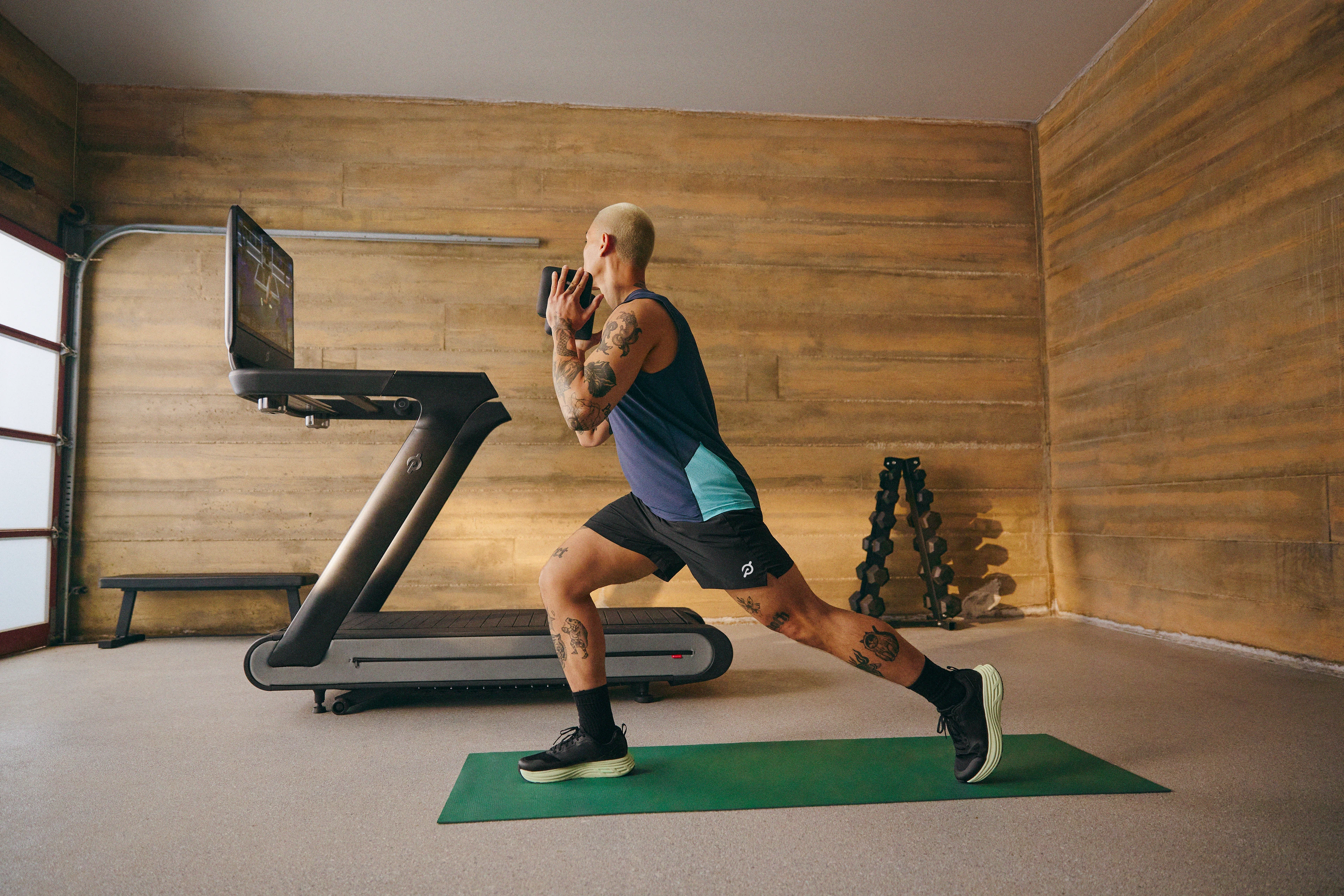
The Best Quad Exercises for Building Powerhouse Legs
Best part? You don't need a gym to do them.
By Julia Sullivan•
What Muscles Make Up the Quads?
The Benefits of Doing Quad Exercises
7 Best Muscle-Building Quad Exercises
Tips to Keep In Mind When Doing Quad Exercises
How to Integrate Quad Exercises Into Your Routine
When you hear the term “leg muscles,” you might naturally think of the quadriceps (aka quads) first. For one, they’re some of the most visible lower-body muscles when you’re facing a mirror. They’re also one of the largest in the body. And when we say someone has strong legs, chances are, they have rock-solid quads.
It doesn’t take a ton to activate the quads—you put them to work when climbing up a flight of stairs, sitting down on the couch, or even going for a walk. “Many activities are quad-dominant, meaning you have greater activation of your quadriceps than your hamstrings,” explains Kaleigh Ray, a certified exercise physiologist and personal trainer. “For example, running and cycling are quad-dominant exercises.”
To adequately prepare those muscles for everything that comes their way, it helps to perform exercises that specifically target the quads. The best part? While you can execute quad-focused moves in a gym setting, it’s not a requirement. Some of the best moves you can do for your quads can be whipped out right in your living room, with no equipment at all.
Here’s everything you need to know about the quads, including the benefits of working them, how they play a role in your overall body mechanics, and seven quad exercises to try at home or in the gym.

Peloton App
Access thousands of classes with no equipment needed.
What Muscles Make Up the Quads?
Though we often think of the quads as a single muscle, Ray says, it’s actually a group of four muscles (get it, quad?). “All four of these muscles are involved in knee extension, while only the rectus femoris flexes the hip,” Ray notes. Here’s a breakdown:
Vastus Lateralis: This is the biggest quadriceps muscle and is situated on the outer side of your thigh. It connects your thigh bone to your kneecap and shin bone.
Vastus Medialis: This teardrop-shaped muscle lies on the front, inner side of your thigh, just above your knee, and helps to stabilize the knee joint.
Vastus Intermedius: This quad muscle lies in the middle of your thigh, underneath the rectus femoris. It’s primarily used for knee extension, i.e., straightening the knee.
Rectus Femoris: This is the most superficial of the quad muscles (meaning, it’s closest to the surface) and runs vertically down the front and center of the thigh. It’s also the only muscle in the quads that crosses both the hip and knee joint, acting as both a hip flexor and knee extensor.
The Benefits of Doing Quad Exercises
Targeting your quad muscles through strength training will help you develop a strong, functional lower body. “Building strength in your quads will not only benefit you in athletic performance, such as running or squatting, but also in everyday activities such as standing, walking, and climbing stairs,” says Peloton instructor Callie Gullickson. Studies suggest that strong quads can help improve a person’s running speed, acceleration, and vertical jump.
Ray agrees: “Because we’re using these muscles repetitively, it’s important to ensure they’re strong enough to withstand the load placed on them,” she says. This is especially true for anyone who participates in a quad-heavy sport, such as cycling or running.
Importantly, having strong quads can help with injury prevention and rehabilitation, particularly involving the knee, both Ray and Callie say. A 2024 study from the Archives of Physical Medicine and Rehabilitation found a negative correlation between quad strength and knee pain, meaning the stronger a person’s quads were, the less likely they were to report knee-related issues. Similar results have been found in older studies published in Osteoarthritis and Cartilage and the Journal of Physical Therapy and Science. “The strength of our quads also directly affects the stability of your knee and helps prevent injury,” says Callie.
7 Best Muscle-Building Quad Exercises

1. Goblet Squat
Squats are the gold standard of lower-body compound moves for a reason, Ray says—research shows it’s a standout exercise for boosting athletic performance, including maximal lower body strength and jumping power. All squat variations, from back squats to front squats, will ignite the quadriceps; however, Ray says that a front squat (where you’re holding the weight in front of your body, such as in a goblet squat) can be a bit more accessible if you don’t have a barbell or squat rack on hand.
Stand holding an upside-down kettlebell or one end of a dumbbell at your chest, feet hip-width apart, toes pointed out slightly.
Take a deep inhale and brace your core, then hinge at the hips and bend your knees to lower into a squat position.
Pause once your thighs are roughly parallel to the floor, then exhale and push into your feet to straighten your legs and hips and return to standing. That’s one rep.

2. Single-Leg Squat
Not only will a single-leg squat help reveal any muscle imbalances, Ray says, but it’s also a killer quad-igniting move, and will feel advanced without any equipment. (To progress, level up to a pistol squat.)
Stand with your feet hip-width apart next to a counter, railing, or high surface that you can rest your hand on for stability, if needed.
Using the surface to your side for support, shift your weight entirely to one leg, lifting the other foot off the floor. (You can also extend your arms out in front of you for balance if you don’t use a surface for support.)
Take a deep inhale and brace your core as you bend your standing knee, descending into a squat position on your standing leg.
Pause once your thigh is parallel to the floor, or as close to parallel as possible, then exhale as you drive your foot into the floor, straightening your leg and hip to return to a standing position. That’s one rep.

3. Forward Lunge
“Weighted lunges are another great exercise for anyone, but especially runners and cyclists,” Ray says. “Like single-leg squats, your legs are out of phase with each other, so this motion requires balance and coordination, in addition to working your quads.” Pro tip: To shift the focus to your quads even more during a walking lunge, Ray recommends bringing your knee up high before stepping into the next lunge. “By adding a hip flexor movement, you’re working the rectus femoris even more,” she says.
Stand with your feet hip-width apart, holding a dumbbell in each hand by your sides. (Beginners can start with just their body weight, as shown above.)
Inhale and engage your core, then take one big step forward with your right foot, bending both knees to lower into a lunge.
Pause when both knees are bent at about 90 degrees, or your front thigh is parallel to the floor.
Exhale and drive your weight into your right foot. Straighten that leg and return to standing, bringing your left foot with you to step it next to your right.
Repeat on the other side. That’s one rep.

4. Rear-Foot-Elevated Split Squat
The rear-foot-elevated split squat is a dynamite lower-body move that targets your quads, glutes, hamstrings, and calf muscles simultaneously. This move can be either hamstring- or quadriceps-focused, depending on foot placement. To shift the emphasis into the quads, you set up with a shorter stance; the front foot is closer to the rear foot.
Stand a few feet in front of a bench, chair, or box that’s at about knee height or slightly shorter. Pick up a weight or two, if you’ll be using some.
Lift one leg behind you, allowing the top of your foot to rest on the support. Adjust the front leg so your foot is underneath your knee.
Keeping your entire front foot planted on the ground and your chest up, sit back into a squat with your standing leg, descending so that your back knee dips toward the ground.
Allow your front knee to shift forward over your toes, pausing when your front thigh is parallel to the ground.
Press through your front foot to drive up and out of the squat, straightening your front knee. That’s one rep.

5. Reverse Nordic Curl
This move gives both your quads and core a major workout, and like single-leg squats, it feels like an advanced move without any equipment. Unlike most other quad exercises, which involve bending at the hip and knee, this move allows you to focus only on knee extension.
Start kneeling on a mat with your knees slightly wider than hip-width apart. Push your hips forward slightly so your body forms a straight line from your head to your knees. Cross your arms over your chest or reach out in front of you.
Inhale to squeeze your glutes and brace your core, and lean your torso backward, trying not to bend your hips.
Go back as far as you can (you should feel tightness, but not strain, in your quads), then exhale to pull your body back up to a tall kneeling position. That’s one rep.
6. Depth Jump
According to Ray, some of the best quad exercises are plyometric moves, like depth jumps. “A depth jump engages the quads eccentrically,” she explains. (An eccentric movement is when you’re engaging a muscle while it’s lengthening.) During this exercise, your quads activate to slow you down when you land. “Training this movement can help prepare your quads for the stress of walking or running downhill,” Ray adds. “By exposing your quads to eccentric movements gradually and intentionally, you can reduce your soreness and muscle damage commonly associated with eccentric activities.”
Stand on the edge of a plyometric box (or other stable, elevated surface that’s roughly two to three feet off the ground) with your feet hip-width distance apart.
Inhale, brace your core, and bend slightly at the hips and knees, then step or jump off the elevated surface.
Landing in a quarter-squat position as softly as possible to absorb some of the impact. (Avoid stepping off the box or landing with straight legs.)
Step back onto the box. That’s one rep.
7. Wall Sit
A favorite of Callie’s, wall sits are another super accessible, do-anywhere quad exercise that will also give your core and hamstrings a major burn.
Stand with your back against a wall, feet shoulder-width distance apart.
Keeping your back pressed against the wall, bend your knees and sink into a squat, walking your feet away from the wall until your thighs are about parallel to the floor and your knees are bent at about 90 degrees.
Hold this position for 30 to 60 seconds.
Push into your feet to straighten your legs and stand. That’s one rep.


Tips to Keep In Mind When Doing Quad Exercises
One of the biggest form mistakes Callie tends to see people make while doing quad exercises is neglecting to maintain a strong core. “Posture is important; you want to stay as upright as possible,” she explains. “Staying upright helps to keep the quads firing up versus the glutes.”
Moreover, no matter what quad-focused move you’re doing, make sure you control the movement and perform the full rep, Callie says. If you don’t move through a full range of motion—sinking to a parallel position in a squat, or forming a 90-degree angle in a lunge or split-squat variation—the move won’t be nearly as effective. (Granted, if you need to modify based on your fitness level or personal mobility limits, that’s always OK.)
Ray adds that knee alignment is important, too. “Does your knee tip inwards toward your midline or out to the side?” she says. That’s not ideal; you want your knee to track straight over the middle of your foot. “Use a mirror to help you track the alignment of your knee, so you can make corrections as you go,” she says. “If you’re unable to maintain good knee alignment, I recommend decreasing or removing the weight until you can manage the correct form.”
How to Integrate Quad Exercises Into Your Routine
Ray recommends specifically training the quads about two to three times per week. She suggests doing one compound quad exercise, like a squat or lunge, at the beginning of a workout, then transitioning to movements that isolate the quads, such as rear foot elevated split squats, toward the end. If you’re at a gym, you can also use the leg extension machine (a single-joint movement exercise).
That said, don’t neglect your hamstrings and glutes, Callie says. “It’s important not to forget about the hamstrings as well to keep overall balance and prevent injury,” she urges. You might’ve heard of something called quad dominance, which means you rely more on your quadriceps to drive lower-body movements, as opposed to your hamstrings or glutes.
“While training the quadriceps is very important, you also want to make sure that you’re maintaining a good strength ratio with your hamstrings,” Ray explains. “Overdeveloped quadriceps can put you at risk of injury, so be mindful of developing a workout routine that targets both muscle groups.”
For more guidance in executing a balanced strength routine, try one of the instructor-led strength programs in the Peloton App or Peloton Strength+.


This content is for informational and educational purposes only and does not constitute individualized advice. It is not intended to replace professional medical evaluation, diagnosis, or treatment. Seek the advice of your physician for questions you may have regarding your health or a medical condition. If you are having a medical emergency, call your physician or 911 immediately.

Level up your inbox.
Subscribe for a weekly dose of fitness, plus the latest promos, launches, and events.
By providing your email address, you agree to receive marketing communications from Peloton.
For more about how we use your information, see our Privacy Policy.