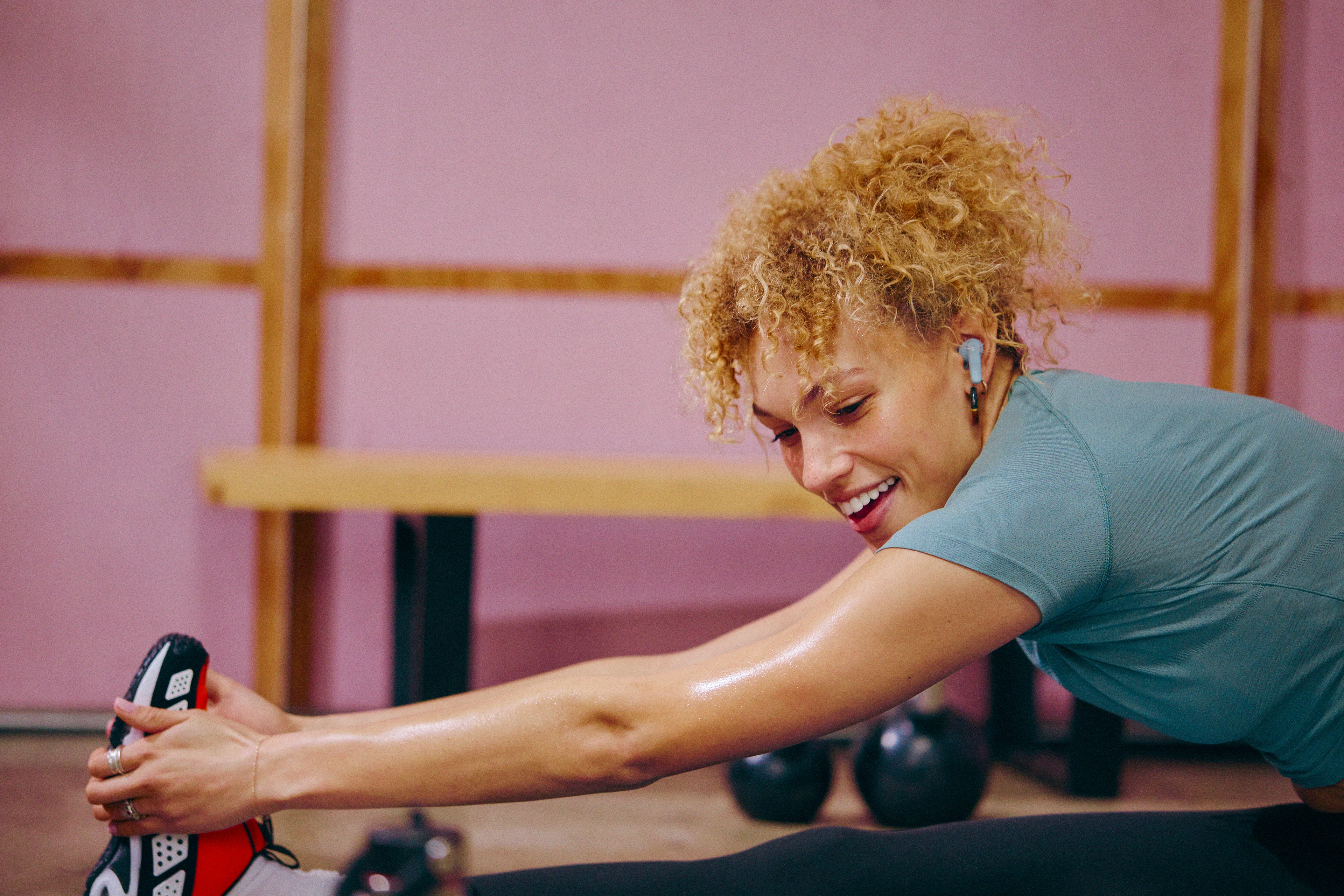
The Best Post-Workout Cooldown Exercises to Leave You Recovered and Refreshed
If you’re rushing straight from your workout into the rest of your day, you’ll miss out on the mind and body benefits of a thorough cooldown.
By Alyssa Sybertz•
The Benefits of Doing a Post-Workout Cooldown
Strength Workout Cooldown vs. Cardio Cooldown
10 Cooldown Exercises to Try
Can You Ever Skip a Post-Workout Cooldown?
It can be tough to fit working out into your busy daily schedule. Between work, family, and other to-dos, there are likely some days when you can only carve out 20 minutes or so to spend on exercise. So if you’re short on time, you should use that limited time to go as hard as you can for the entire workout, right?
Not so fast. Here, we’re diving into the facts on the important yet often surpassed post-workout cooldown. Discover when and why you should include a cooldown in your workout plan, as well as 10 exercises to try after your next session.
The Benefits of Doing a Post-Workout Cooldown
“The point of a cooldown is to lower your heart rate and to ease your body into a healthy recovery zone,” says Peloton instructor Hannah Corbin. “Think the exact opposite of a workout warm-up. If we go from waking up to lifting the heaviest weight of all time, our body is not going to cooperate. The same goes for the flipside. If we go from 10 to 0 with no in-between, the body will be confused and a little cranky.”
There are many physiological reasons you may not feel your best if you skip the cooldown after a hard workout. “When we finish a demanding workout, often our blood vessels are dilated in order to get sufficient oxygenated blood to the working muscles,” Peloton instructor Matt Wilpers explains. “By simply continuing to exercise but at a much lower intensity, it allows our bodies to gradually (instead of suddenly) come back to a pre-workout state. As we proceed through the cooldown, the contraction and relaxation of our muscles helps remove waste products as well as maintain good blood circulation.”
Cooling down helps prevent blood from pooling in your extremities and aids in the removal of metabolic waste products (such as lactic acid) from your muscles. If you don’t take the time to cool down, these compounds can hang around and cause soreness or discomfort. Indeed, one study published in the Journal of Human Kinetics found that a cooldown increased circulation and the removal of waste in exercised muscles to reduce muscle soreness later. Winding down your workout also helps prevent dizziness or lightheadedness after a workout, which may happen if you change intensities too quickly.
Taking a few minutes to cool down can also help bring you mentally back to Earth after your workout, and allow you to appreciate everything you just accomplished. “Whatever ride you completed, I want you to finish with a mentality focused around the phrase: strong body, strong mind, strong living. And finish and feel powerful when you jump off the bike,” says Peloton instructor Ben Alldis.
A cooldown will also help with a very practical aspect of working out: “Are you still sweating after your shower? Then make some time to cool down after all the work you put in,” says Hannah.


Strength Workout Cooldown vs. Cardio Cooldown
If you have a well-rounded exercise routine, you’re likely doing a variety of types of workouts—from high-intensity and endurance-based cardio, such as rides, runs, or rows, to strength and resistance training, such as lifting weights, barre, or Pilates. And if that’s the case, your cooldown is going to vary slightly based on the type of workout you completed that day.
For a post-cardio cooldown, you can start by gradually dialing back your intensity—sometimes called a “descending cooldown.” For example, after a run, slow down by jogging and then walking for 5–10 minutes. Then, finish with a few minutes of static stretching targeting the muscle groups involved in your workout. After running, that’d be your quadriceps, hamstrings, hips, glutes, and calves. The lower-intensity cardio will serve to flush those soreness-inducing waste products from your muscles, while the static stretches will help relax the muscles that worked the hardest and restore length to them, so you preserve your flexibility.
After strength training, you’ll want to release any tension left in your muscles and help move waste products out by increasing circulation with a 5-10 minutes of cardio and dynamic stretching. Try gentle bodyweight exercises or stretches that help improve flexibility and range of motion in the muscles you trained. As you wind down, you can also finish with some relaxed static stretches.
10 Cooldown Exercises to Try
These 10 cooldown exercises will help bring your heart rate down and loosen your muscles after a challenging workout.

1. Chest Opener
Hannah likes to incorporate chest openers after a ride to counteract the tight, hinged forward position of the upper body on the Bike. This move will stretch and expand the pectoral muscles and the anterior deltoids, the muscles on the front of the shoulders.
Stand or kneel with your feet hip-width apart.
Tilt your chin up slightly and open your arms wide to the sides in a goal post position.
Extend your hands slightly behind your shoulders until you feel the stretch across the front of your chest.

2. Kneeling Hip Flexor Stretch
Hip flexor stretches are critical for runners and cyclists, Hannah says. They’re also beneficial after a row or a lower body strength workout in which you are doing a lot of compressing the hips.
Start in a half-kneeling position on the floor, one foot planted on the floor in front of your.
Keeping your chest tall, gently push your hips forward until you feel a stretch along the front of your back hip flexor.
Hold for 3-5 seconds, then release.
Do 5 reps, then repeat on the other side.

3. Child’s Pose
Yoga’s Child’s Pose (Balasana) stretches the hips, back, and shoulders while helping you start to relax.
Start on your hands and knees, then sit your butt back on your heels.
Drop your head and walk your hands forward as far as you can without your butt lifting from your heels.

4. Cat-Cow
The cat-cow stretch helps release tension in the back and restore spinal mobility after your workout.
Start on your hands and knees with your back flat.
Arch your back up toward the ceiling and tuck your chin toward your chest like a cat and hold for a few seconds.
Drop your belly toward the floor, lifting your chin and tailbone to the ceiling like a cow.
Continue to move back and forth in a slow and controlled manner.

5. Downward-Facing Dog
This is an excellent stretch for all the large muscles on the back of the body, including the calves, hamstrings, glutes, and lower and upper back.
Start on your hands and knees.
Tuck your toes under and lift your tailbone to the ceiling, straightening your legs as much as you can (it’s okay if your heels are off the ground).
Press into the heels of your hands, let your head hang, and shine your chest toward your knees.
Hold for 5-10 breaths. If you’d like, pedal out your feet to stretch your calves.

6. Runner’s Lunge
A cooldown staple, the runner’s lunge is extremely effective at stretching your hip flexors and quads.
Stand with your feet hip-width apart.
Place your hands on the floor in front of your feet and take a large step back with one foot, so your back leg is mostly straight, your front knee is at a right angle, and your hands are on either side of your front foot.
Repeat on the other side.
7. Spinal Twist
The muscles of the back and core are working during almost every form of exercise, so it’s crucial to keep them loose. A simple spinal twist is a great way to do so.
Sit on the floor or on a mat with your legs straight out in front of you.
Cross one foot over the opposite leg, placing it flat on the floor next to your knee or thigh.
Hug your knee with the opposite arm and twist toward your leg. Repeat on the other side.

8. Thread the Needle
The thread-the-needle stretch drills spinal and shoulder mobility and help you ground down and relax post-workout.
Start in a tabletop position on your hands and knees.
Inhale and reach your right hand toward the ceiling, rotating your chest open to the right. Try to keep your hips square.
Exhale and thread your right hand between your left arm and left leg, underneath your left armpit, with your right palm facing up. Slowly lowering your right shoulder and the side of your head to the floor, rotating your chest to the left.
Hold this position for 20-30 seconds. Then return to tabletop position and repeat on the other side.

9. Neck Stretch
No matter what type of workout you’re cooling down from, there’s a good chance you’re holding some tension in your neck. This stretch will help release it before you move on with your day.
Stand with your feet hip-width distance apart.
Drop your right ear toward your right shoulder, and gently place your right hand on the top left side of your head to stretch your neck on the left side. Extend your left arm long and out at a slight diagonal.
Hold this position for 10-20 seconds. Then, repeat on the other side.

10. 90-90 Stretch
The 90-90 stretch hip mobility move can be a static stretch when you hold the position, as shown above, or a dynamic one when you rotate from side to side, switching legs but keeping your feet and hips where they are on the floor.
Sit on the floor with your right knee bent at a 90-degree angle, thigh pointing directly out to the side, and foot behind you, inner thigh resting on the floor. Bend your left knee so it’s also at 90 degrees, your left shift is horizontal in front of you and your left thigh pointing straight forward from your hip.
Lean forward from your hips while keeping your back straight.
Hold for 20 to 30 seconds, then slowly return to the starting position and repeat on the other side.
11. Scorpion Stretch
This stretch opens up the whole front of your body, including your hips and shoulders, while improving spinal mobility.
Start lying face down on the floor with legs long, right palm pressed into the floor directly under your shoulder and the left arm extended out to the side, palm down.
Bend your right knee and flex your foot so the bottom of your foot is pointing directly up at the ceiling.
From this position, inhale and lift your right knee off the floor and reach your right foot across your body so it lands on the floor on the outside of your left leg or hip.
Hold for one second, then slowly reverse the movement to return to start. Switch your arm position, and repeat on the other side.
Can You Ever Skip a Post-Workout Cooldown?
In general, gentle, low-intensity workouts such as light stretching, gentle yoga, or even a Low-Impact Ride on the Peloton Bike may not require a separate cooldown. That said, it can be helpful to incorporate just a few minutes of relaxation exercises to calm your mind and body rather than running straight to the shower or your next to-do in order to enhance recovery and promote overall well-being.
Related Articles


This content is for informational and educational purposes only and does not constitute individualized advice. It is not intended to replace professional medical evaluation, diagnosis, or treatment. Seek the advice of your physician for questions you may have regarding your health or a medical condition. If you are having a medical emergency, call your physician or 911 immediately.



Level up your inbox.
Subscribe for a weekly dose of fitness, plus the latest promos, launches, and events.
By providing your email address, you agree to receive marketing communications from Peloton.
For more about how we use your information, see our Privacy Policy.