How to Flow Through Chaturanga Dandasana with Perfect Form, Plus Modifications to Help You Get There
This challenging move is a cornerstone of any yoga practice.
By Ingrid Yang•
The Benefits of Chaturanga Dandasana
How to Do Chaturanga Dandasana
Common Mistakes to Avoid During Chaturanga Dandasana
How to Modify Chaturanga Dandasana
3 Variations of Chaturanga Dandasana
In yoga, few poses are as foundational—and as formidable—as Chaturanga Dandasana. Also known as Four-Limbed Staff Pose, Chaturanga Dandasana is a fundamental posture in many yoga practices, particularly in Vinyasa and Ashtanga flows, as it’s part of the Sun Salutation sequence.
“Chaturanga is a common pose in Vinyasa yoga classes, so the first time I did a Chaturanga was in my very first Vinyasa class,” says Peloton instructor Kirra Michel. Despite its frequent appearance, it remains one of the most daunting poses for practitioners of all levels. “Chaturanga is similar to the bottom portion of a triceps push-up and requires triceps and upper body strength,” she explains.
Understanding how to properly execute this yoga pose is crucial, as it builds strength, improves alignment, and serves as a gateway to more advanced poses. Keep reading to explore the benefits of Chaturanga Dandasana, detailed instructions on how to perform it properly, common mistakes to avoid, and helpful modifications and variations to keep in mind during your yoga practice.
The Benefits of Chaturanga Dandasana
Chaturanga Dandasana offers a host of physical and mental benefits that can elevate your yoga practice to new heights.
Strengthens the Upper Body: Kirra says this pose strengthens the arms, wrists, shoulders, upper back, and core, building the foundation for more advanced arm balancing poses, such as Crow Pose (Kakasana).
Engages the Core: Maintaining a straight line from head to heels requires significant core engagement, which strengthens the abdominal muscles and improves overall stability.
Activates the Legs and Glutes: Even though it feels primarily like an upper body pose, Kirra emphasizes that the entire body is working, including the glutes and legs. “Just because we can’t see our torso and lower body in the pose, it doesn’t mean it isn’t playing a big role in holding this challenging pose,” she says.
Improves Posture: By aligning the shoulders, spine, and hips, Chaturanga Dandasana helps to improve posture and prevent the rounding of the back.
Enhances Body Awareness: Practicing this pose builds “proprioception—awareness of where the body is in space,” says Kirra, which increases overall body awareness and coordination.
Builds Concentration: Holding and transitioning into Chaturanga Dandasana requires focus, which can enhance concentration skills both on and off the mat.
Encourages Discipline: The challenge of maintaining proper form in this pose fosters discipline and patience, qualities that are beneficial in all aspects of life.
Breath Control: Lowering into Chaturanga Dandasana is paired with a focused exhale, which can help you reconnect with your breath and maintain rhythm during even the most intense flow practice.

How to Do Chaturanga Dandasana
Performing Chaturanga Dandasana correctly is essential to gain its full benefits and prevent injury. Here, Kirra shares step-by-step instructions:
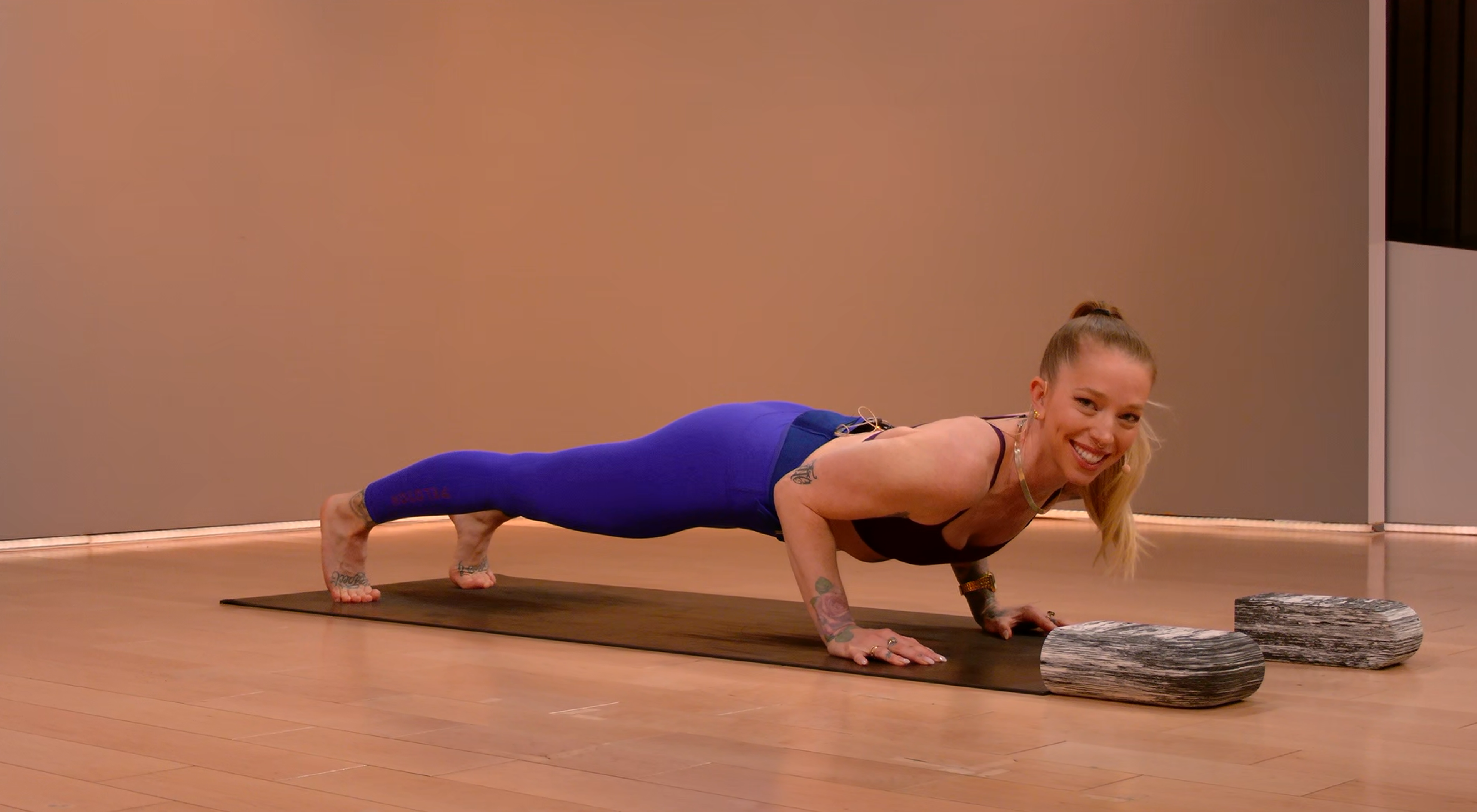
Start in a high plank position with your hands shoulder-width apart, fingers spread wide, and your shoulders directly over your wrists. Ensure your body forms a straight line; engage your core, squeeze your glutes, and keep your legs active.
Inhale through your nose to prepare, then exhale to slowly bend your elbows backward, hugging them close to your torso. Lower your body as one unit, maintaining a straight line from head to heels.
Pause when your elbows are bent at 90 degrees, upper arms parallel with the floor. Finish your exhale as you hover in this position, gaze slightly forward and neck long.
From Chaturanga, you can lower completely to the ground (as shown) or transition into Upward-Facing Dog (Urdhva Mukha Svanasana) on the inhale by rolling over your toes, lifting your chest, and straightening your arms.
Common Mistakes to Avoid During Chaturanga Dandasana
To practice Chaturanga Dandasana safely and effectively, avoid these common mistakes:
Sagging or Lifting the Hips
Dropping your hips as you practice Chaturanga puts strain on your lower back, while letting your hips pike (lift) up cheats your core muscles out of working. Engage your core to keep your body in a straight line. “Keep your ears, shoulders and hips in alignment as you lower, and hold the posture at the bottom,” Kirra adds. “If one area sinks down, that means more strength is required.”
Flaring Elbows
Elbows that flare out to the sides can stress the shoulders. Keep your elbows tucked close to your ribs, Kirra says.
Rushing Through the Pose
Moving too quickly through Chaturanga can compromise form. Focus on slow, controlled movements to build strength and precision.
Sinking the Shoulders or Head
When you lower, don’t let your shoulders or head dip below elbow height. Misalignment can lead to shoulder injuries. Remember: Ears, shoulders, and hips in line, Kirra says. If you’re struggling, she suggests, “drop to your knees, or use blocks under the shoulders,” which can help you stay in alignment.
Forgetting to Breathe
Holding your breath during Chaturanga can lead to unnecessary tension. Inhale before you move, then exhale as you lower down. After all, the essence of yoga is to move with your breath, keeping your flow steady and your focus sharp.

How to Modify Chaturanga Dandasana
As Kirra mentions above, Chaturanga Dandasana is no walk in the park—it’s a challenging isometric hold somewhere between a plank and push-up. That said, beginners can (and should) try these modifications to build up their strength and find alignment before trying the full expression of the pose.
Knees Down: The easiest way to modify Chaturanga Dandasana is to lower your knees to the mat, Kirra says. This reduces the load on your upper body so you can practice proper alignment and improve your upper body strength.
Don’t Lower As Far: Kirra also suggests beginners modify the pose by not lowering as far. Instead of pausing when your elbows are bent at 90 degrees, lower only part of the way. Pause where you feel in control.
Use Blocks: You can also practice holding Chaturanga with a block under the lower section of your front ribs and/or another at your upper thighs, Kirra suggests. Alternatively, you could place blocks under your shoulders with your elbows at 90 degrees. “These will be challenging to hold, but will teach correct form without requiring as much strength to hold you up,” she explains.
Keep in mind, even if you can do a full Chaturanga Dandasana, it’s OK to modify whenever you’re not feeling it, getting tired, or feeling your form slip. “You can do one of two on the balls of your feet and then drop to your knees if you’re starting to fatigue,” Kirra says. “Maintaining proper form is more important than how many you can do.”
To build strength for Chaturanga, Kirra also recommends strength training outside of your yoga practice. “Do tricep dips, inclined push-ups (which allow you to push a lower percentage of your bodyweight), tricep pushups with a resistance band just above your elbows, holding at the bottom so you have something tangible to lower down to and help keep you in the isometric position,” she says.
On the Peloton App, look for Yoga Drills and Focus Flow classes dedicated specifically to improving your form and mastering Chaturanga Dandasana.
Try a Chaturanga-Focused Yoga Class on the Peloton App


3 Variations of Chaturanga Dandasana
Incorporating Chaturanga variations into your practice can help you build strength gradually, accommodate injuries, and add variety. Here are some variations with step-by-step instructions:
Knees-Down Chaturanga
This easier variation is ideal for beginners and those building strength.
Start in a high plank position and inhale through your nose.
Exhale to lower your knees to the mat while keeping your body in a straight line from head to knees.
Bend your elbows and lower your torso, maintaining a straight line.
Pause when your elbows reach a 90-degree angle, then lower to the floor or transition to Cobra (Bhujangasana) or Upward-Facing Dog.
One-Legged Chaturanga
This more difficult variation of Chaturanga is suitable for intermediate to advanced practitioners looking to increase the challenge.
Start in a high plank position.
Inhale to lift one leg off the ground, keeping it straight and in line with your body.
Exhale and bend your elbows to lower your body, maintaining proper alignment and keeping your lifted leg off the floor.
Pause when your elbows reach a 90-degree angle, then lower to the floor or transition to Upward-Facing Dog.
Repeat on the other side.
Slow Motion Chaturanga
Doing Chaturanga at an even slower pace helps you learn to control the descent, pay attention to your alignment while moving, and also builds strength in your upper body.
Start in a high plank position.
Inhale, then exhale to very slowly bend your elbows to lower your body, maintaining proper alignment.
Take three or four seconds to reach the bottom Chaturanga position with your elbows bent at 90 degrees.
Pause for a second, then lower to the floor or transition to Upward-Facing Dog.
Mastering Chaturanga Dandasana is a journey that requires patience, practice, and attention to detail, but it’s beyond worth it. Chaturanga is bound to show up in almost any yoga class you take, including many of those you’ll find on the Peloton App. Taking the time to understand and perfect this pose will help you move through every Vinyasa and Sun Salutation with confidence.


This content is for informational and educational purposes only and does not constitute individualized advice. It is not intended to replace professional medical evaluation, diagnosis, or treatment. Seek the advice of your physician for questions you may have regarding your health or a medical condition. If you are having a medical emergency, call your physician or 911 immediately.

Level up your inbox.
Subscribe for a weekly dose of fitness, plus the latest promos, launches, and events.
By providing your email address, you agree to receive marketing communications from Peloton.
For more about how we use your information, see our Privacy Policy.